
Property Managers: Drone + DI Water for Chemical-Free Window Cleaning
· Exterior Drone Washing
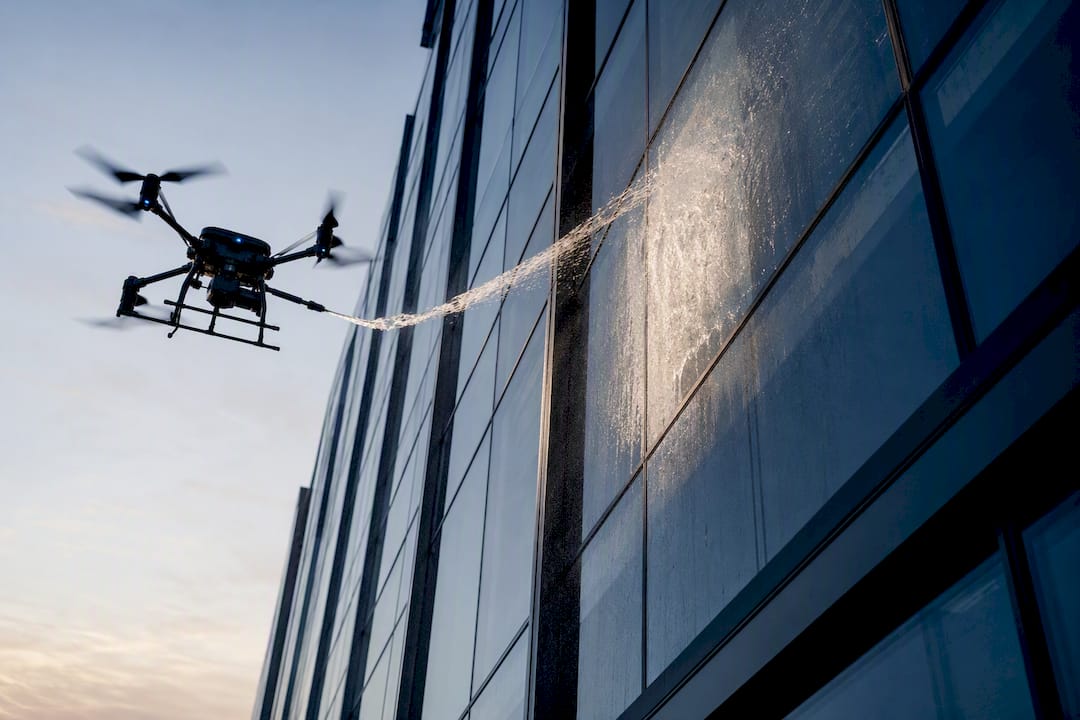
Yes, commercial high-rise windows can be cleaned without detergents. The professional method is deionized (pure) water applied through industrial drone systems or water-fed pole rigs, applied by drone up to 320 feet (about 29 stories) per staging position, or by water-fed pole on low-rise glass. This is not the vinegar-and-newspaper approach from home cleaning tips. It’s a commercial process built for dust, pollen, and urban grime on curtain walls, solar arrays, and coated glass, delivered fast and without runoff chemicals.
TL;DR:
- Drone and pure-water cleaning can typically be completed in a single day for routine maintenance on standard facades, significantly reducing scheduling complexity.
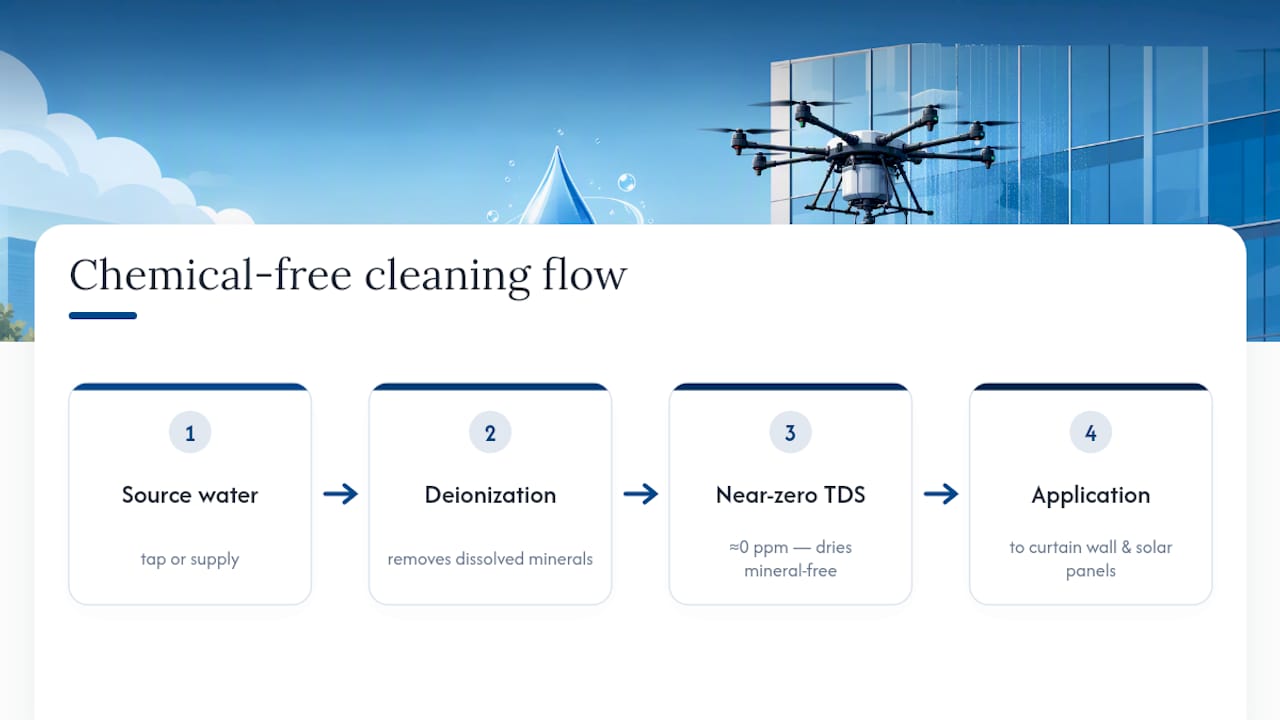
- The process relies on deionized water with a total dissolved solids level near 0 ppm, preventing mineral spots and residue buildup on coated glass and solar panels.
- A compliant contractor must provide proof of FAA certification, aviation insurance, detailed water quality guarantees, and clear site safety and control measures.
- Wind over a certain threshold will ground drone flights, and complex or heavily soiled surfaces may still require traditional methods with physical contact.
- Cost savings often range from 30 to 60 percent compared to scaffolding or rope-access jobs, driven primarily by reduced equipment, labor, and site disruption expenses.
Table of Contents
- What Window Cleaning Without Chemicals Means for Commercial High-Rises
- How Drone and Pure-Water Cleaning Actually Works
- Drone Cleaning vs. Scaffolding, Lifts, and Rope Access
- Building an RFP That Actually Verifies Chemical-Free Claims
- What Chemical-Free Cleaning Costs and How Long It Takes
- Safety, Insurance, and Compliance Requirements to Verify
- Why This Method Is Gaining Ground With Property Teams
- Getting a Chemical-Free Cleaning Quote From Exterior Drone Washing
- Sources
- FAQ
What Window Cleaning Without Chemicals Means for Commercial High-Rises
For property managers, window cleaning without chemicals means deionized water paired with a professional delivery system, either an aerial drone platform or a ground-fed water pole. It does not mean a spray bottle recipe scaled up. The active ingredient, so to speak, is the absence of dissolved minerals in the water itself.
That’s measured in total dissolved solids, or TDS, and the trade standard is a reading near 0 ppm. Water at that purity level dries without leaving mineral spots, which is why no soap or squeegee finish is needed. This matters most on modern glazing, curtain wall systems, and solar panels, where residue buildup from hard water can etch coatings over time. Routine maintenance, pollen season cleanups, and post-construction dust removal are the jobs this method handles best.
How Drone and Pure-Water Cleaning Actually Works
The equipment stack is more specific than most property teams expect. A compliant job typically involves:
- An industrial drone flown by an FAA Part 107 certified pilot with a stabilized spray head for consistent water pressure at height
- A deionized water supply, either an onboard tank or a ground fill station feeding a lightweight hose or tether
- Cameras and positioning sensors, sometimes LiDAR, to hold the drone steady against wind drift near glass
- A ground crew for staging, water supply, and visual observation during flight
The workflow follows a predictable sequence: a site survey to map facade sections and access points; staging and water hookup; establishing a ground safety zone with visual observers; then flight passes that rinse each section with pure water before moving to the next. Industrial UAV systems clean facades without any physical contact, which is what keeps detergents out of the process entirely. Documentation, usually photo or video capture per section, closes out the job.
Wind speed, direct sun exposure, and building geometry all affect how long a pass takes and how many sections a crew can cover in a day. A flat curtain wall moves faster than a facade with deep recesses or ornamental features.
Drone Cleaning vs. Scaffolding, Lifts, and Rope Access
The trade-off comes down to risk, speed, and what kind of soiling you’re dealing with. Drone and pure-water systems win on:
- Eliminating worker-at-height exposure, since no one is suspended on ropes or standing on a lift platform
- Faster mobilization, often hours instead of the days needed to erect scaffolding
- Less tenant and pedestrian disruption, since there’s no scaffolding blocking entrances or walkways for a week
- Lower water and chemical runoff, since pure-water systems use no detergents at all
Providers commonly cite cost savings compared with traditional scaffolding or rope-access jobs for routine maintenance work, though exact amounts depend heavily on building height and facade complexity.
Where drone cleaning falls short: heavy adhesion like caked construction residue, restorative cleaning of etched or damaged glass, and any job requiring physical contact to scrub off buildup. Wind above a certain threshold grounds the flight entirely, and airspace restrictions near airports or dense urban cores can limit scheduling. If your building needs restoration work rather than maintenance, traditional rope access with mechanical scrubbing is still the better call.
Building an RFP That Actually Verifies Chemical-Free Claims
Any bid for chemical-free window cleaning should include these contract essentials:
- Proof of FAA Part 107 pilot certification for every operator assigned to the job
- A certificate of insurance that explicitly names aviation liability coverage, not just general liability
- A written equipment list, including drone model, spray system, and DI water source
- A DI water quality guarantee with TDS meter readings documented in writing
- A site-specific safety plan covering cordons, pedestrian control, and emergency procedures
- Before-and-after photo or video deliverables for every facade section cleaned
Before signing off on a full mobilization, ask for a small test clean on a discreet section of the building. Watch the crew check the TDS meter at the hose connection, not just assume it. Reputable operators verify multiple readings across the fill point and final rinse, since a single reading can mask resin exhaustion in the water filtration system.
Pro Tip: Schedule cleaning for early morning or late afternoon. Direct midday sun can flash-dry water on glass before it fully sheets off, leaving faint spotting even with properly deionized water.
Also confirm tenant notification timelines and water source access on-site. If the building doesn’t have a usable hookup, the vendor needs a fill station plan, which affects both cost and schedule.
What Chemical-Free Cleaning Costs and How Long It Takes
Pricing on these jobs is driven by square footage, facade complexity, water logistics, and insurance overhead, in roughly that order. A flat glass tower with easy ground access costs less to clean than a building with recessed balconies or ornamental stonework, even at the same square footage.
Timeline is where this method changes the math most. Jobs that once took multiple days with scaffolding or rope access frequently compress into a single day with drone and pure-water systems, particularly for routine maintenance rather than full restoration. Wind delays, building height, and facade obstructions can still stretch that timeline.
When comparing bids, ask each vendor for a fixed price and the per-square-foot rate behind it, and check whether travel, mobilization or minimum charges are added on top.
Safety, Insurance, and Compliance Requirements to Verify
Aerial cleaning is regulated commercial aviation activity, not a maintenance contractor showing up with a hose. Only a limited number of providers are properly licensed and set up for compliant drone operations, which is worth confirming before you sign anything.
At minimum, the operator should carry:
- FAA Part 107 certification for every pilot on the job, with operational approvals for the specific airspace if required
- Aviation liability insurance, distinct from general commercial liability, plus a current certificate of insurance
- Visual observers on the ground during every flight, not just one person running the drone
- Documented flight logs and a written emergency response plan for the job site
Site controls matter just as much as the aviation paperwork. That means cordoned zones beneath the flight path, clear signage for pedestrians and tenants, and direct coordination with building facility operations on timing. Commercial drone providers that operate compliantly treat these controls as standard, not optional add-ons.
Why This Method Is Gaining Ground With Property Teams
The buildings where drone cleaning makes the most sense are the ones where access is genuinely hard, tenant disruption is expensive, or scaffolding would mean closing an entrance for a week. That’s the real business case, not novelty.
What surprises a lot of managers is how much of the value sits in the paperwork, not the flight itself. A TDS reading, a pilot’s Part 107 card, a current COI. Skip verifying those, and you’re trusting the pitch instead of the proof. A small test-area clean before full mobilization settles the question fast, and it costs you almost nothing to ask for one.
— Eliot
Getting a Chemical-Free Cleaning Quote From Exterior Drone Washing
Exterior Drone Washing’s FAA Part 107 certified pilots clean commercial facades, windows, roofs and solar arrays up to 320 feet with soft-wash systems and deionized water, across the United States. That combination is what lets a job that used to take a scaffolding crew several days often get finished in a single day, with no worker at height.
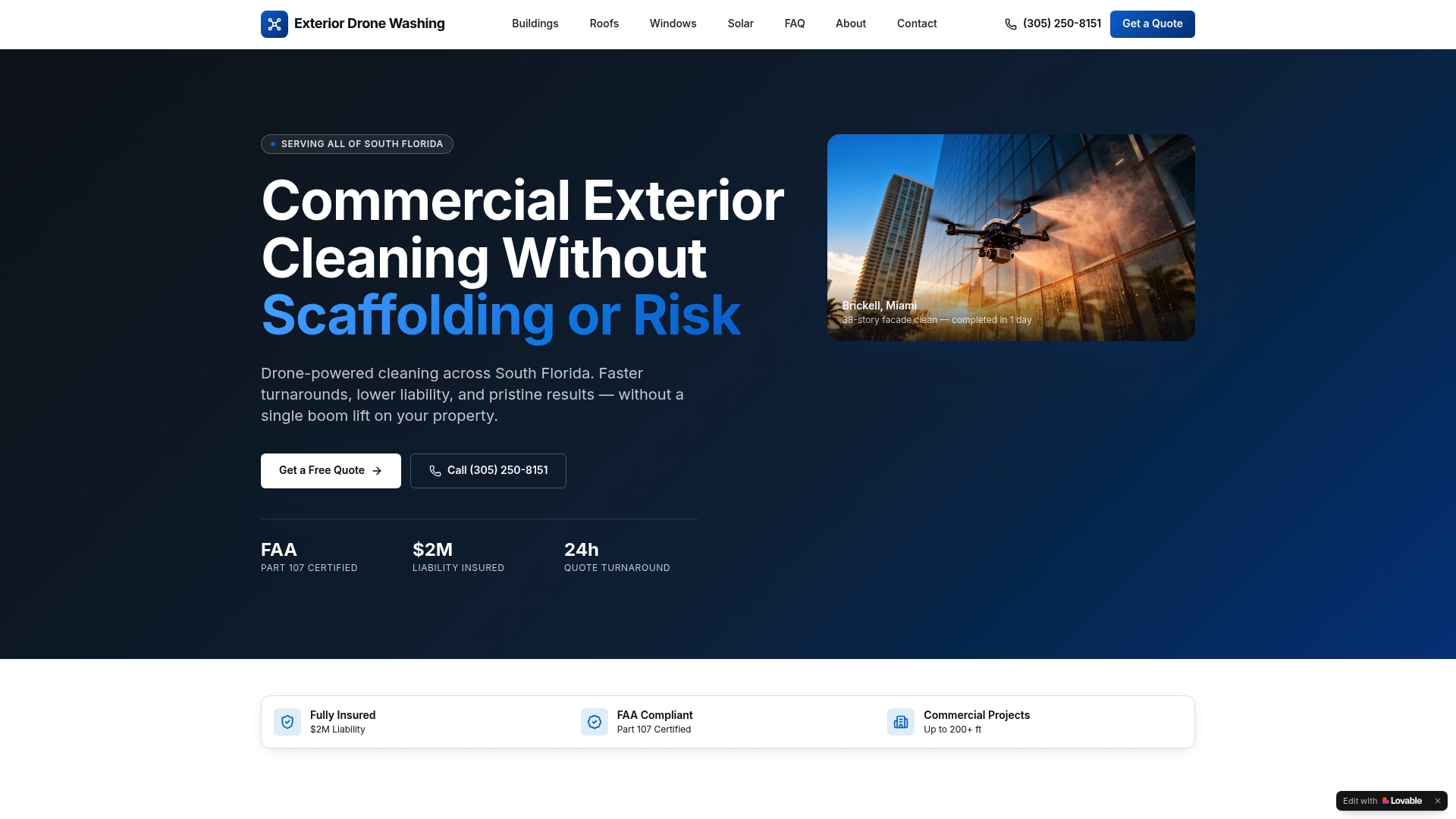
The savings claims property managers hear about, generally in the 30 to 60% range versus traditional rope access or scaffolding, come from cutting crew size, equipment rental, and site closure time, not from cutting corners on the water quality. Jobs are documented with before-and-after photos, so you’re not taking anyone’s word for the result.
Before you contract with any vendor for this kind of work, ask for pilot credentials, a current certificate of insurance, a TDS reading on the water supply, and a sample flight map for your building. If you want that conversation started, request a scoped site survey and quote and get a real number attached to your facade, not a rough guess.
Sources
- Using drones for high-rise window cleaning, without the high risk - Excellerate Services
- A Clear Guide to Deionised Water for Window Cleaning - 24 Pure Water
- Drone Window Washing for Commercial Properties in Phoenix
FAQ
Is Deionized Water Safe for All Types of Glass?
Deionized water is safe for standard and coated commercial glass and is the preferred method for routine maintenance, though heavy soiling or damaged coatings may still need additional detail work.
How Do I Confirm a Vendor’s DI Water Is Actually Pure?
Ask for a TDS meter reading at the hose connection and again at the final rinse point, since a single reading can miss issues like resin exhaustion in the filtration system.
Can Drones Clean Windows in Windy Conditions?
No. Wind above a set threshold grounds the flight, since stabilized spray accuracy depends on the drone holding position against the glass line.
How Much Faster Is Drone Cleaning Than Scaffolding?
Many routine jobs that took multiple days with scaffolding or rope access now compress into a single day with drone and pure-water systems, though facade complexity and weather can extend that.
Does Exterior Drone Washing Handle Solar Panels Along With Windows?
Yes, Exterior Drone Washing services solar arrays with the same pure-water drone systems used for facade and window cleaning, which is useful for properties booking multiple services in one visit.