Parking garage cleaning: flat-rate decks, drone-cleaned facades
Decks, drive lanes, walls, columns, ceilings and stairwells cleaned by a ground crew with heated water. The exterior facade and open top deck cleaned by drone in the same mobilization. The only per-service rate on this site, published flat, no condition adjustment on the deck.
Fully Insured
$2M Liability
FAA Compliant
Part 107 Certified
Commercial Projects
Up to 200 ft by drone
Parking garage cleaning, in short
Exterior Drone Washing cleans parking garages nationwide at a flat $0.06 per square foot of deck on structures of 100,000 sq ft and up, with walls, columns, ceilings, and stairwells at $0.06–$0.08 per square foot. Decks, ramps, and interior surfaces are cleaned by a ground crew using heated water at 8–10 gallons per minute and rotary surface cleaners. A covered deck is the wrong place for a drone. The drone cleans the garage's exterior facade and open top deck in the same mobilization. Work runs overnight in coned sections, so the structure stays open. Rates shown are our published national rates. Every job is a fixed price after a free site survey.
- Deck rate
- $0.06 / sq ft, flat, no condition adjustment
- Wall / column / ceiling rate
- $0.06–$0.08 / sq ft
- Minimum size for a published rate
- 100,000 sq ft
- Deck method
- Ground crew, heated water, rotary surface cleaners
- Facade and top deck method
- Drone soft-wash from grade
- Compliance
- FAA Part 107 · $2M liability
How a parking garage gets cleaned
A garage is really two different cleaning jobs under one mobilization: the deck, drive lanes and interior surfaces, which are ground work, and the exterior facade and open top deck, which is drone work. Running both from the same visit is what keeps the price down without cutting either scope.
The process, in three steps
- Free site survey: deck area, coating type, drain routing, and a shift-by-shift closure plan
- Heated surface cleaning of decks, ramps, columns, ceilings, and stairwells, section by section
- Drone soft-wash of the exterior facade and open top deck, then 4K documentation of the finished structure
The full process, from survey to walkthrough
Deck take-off and measurement: We pull the gross drive-on area of every level and ramp from the structural or as-built drawings, then confirm it on site. The take-off goes out with the proposal so you can check the square footage the price is built on, rather than take a lump sum on trust.
Coating and substrate assessment: Bare concrete, sealed concrete, and elastomeric traffic membrane each take a different process. We identify which you have, note where a coating is already failing, and photograph it, because heated cleaning will lift paint that was already letting go, and that needs to be a record before the shift, not an argument after it.
Drain routing and runoff plan: We trace where each deck drains (sanitary, storm, or an oil-water separator) and build the recovery, filtration, and inlet protection around the answer. On municipal structures this is usually the item that has to be documented, so it is resolved at the survey rather than on the night.
Section sequence and shift plan: The structure gets divided into coned sections and scheduled around your occupancy, events, and any parking operator. You get a shift-by-shift plan early enough to post tenant notice through your own channels, which is the notice that actually gets read.
Heated deck and ramp cleaning: A BE hot box heating 8–10 gallons per minute feeds rotary surface cleaners, with degreaser given dwell time on oil and tire marks before the machine passes. Ground level and the entry ramp go first, so the improvement is visible from the street after one night.
Hand work on columns, walls and stairwells: Vertical and overhead surfaces are hand-worked rather than machine-covered, which is why they are a separate line item. Stairwells and elevator lobbies are treated as occupied interiors: controlled water volume, contained runoff, dry before the space reopens.
Drone facade, documentation and walkthrough: The exterior facade and open top deck are flown with low-pressure soft-wash from grade, no lift, no lane closure. We deliver 4K before-and-after footage for the board or asset file and walk the finished structure with you before the final invoice.
What we run on a garage job
The deck, walls, columns, ceilings and stairwells are ground work. A covered structure with low clearance and no reliable GPS signal is the wrong environment for a cleaning drone, so the drone's role on a garage is limited to what it does best: the open-air exterior facade and the uncovered top deck.
Equipment and specifications
- Water heating: BE hot box, 8–10 GPM heated
- Deck tooling: Rotary surface cleaners, coating-matched pressure
- Chemistry: Biodegradable degreaser on oil and traffic film
- Water treatment: 3-stage pre-filter into de-ionization resin, 0 TDS
- Vertical reach on foot: 70 ft carbon water-fed pole, own DI tank
- Facade drone: Lucid Bots Sherpa, tethered, flown from grade
- Drone reach: Up to 200 ft per staging position
- Runoff control: Inlet protection, recovery and filtration as required
- Documentation: 4K aerial and deck-level, before and after
- Pilot credential: FAA Part 107 certified, LAANC where required
How a garage stays open while it is cleaned
The structure never fully closes. Coned sections move with the crew rather than levels being surrendered for the day. Tenants, visitors, and any parking operator keep using the garage, and no section is out of service longer than a single shift.
Traffic control and signage. Cones, barricades, and section signage are ours. Tenant notice is joint. We supply the shift-by-shift plan and you post it, because a notice from the property manager gets read and one from a contractor does not.
Equipment exclusion zones. EV chargers, gate arms, ticket equipment, card readers, cameras, and sub-panels are mapped at the survey and given no-spray buffers or physical covering. Anything already damaged is photographed and flagged before the shift.
Coating protection. Elastomeric traffic membranes get reduced pressure and neutral-pH chemistry. High pressure on a coated deck chalks or lifts it, and a recoat costs many times what the cleaning did, so the coating is identified before water is applied, not after.
Runoff and discharge. Drain routing is traced at the survey and the recovery plan built to match the discharge point, with inlet protection keeping solids out. On municipal decks the handling is documented so the property has a record if the discharge is ever questioned.
Insurance and airspace. $2M commercial general liability plus dedicated UAS aviation liability, with certificates naming the owner, operator, and property manager issued before mobilization. Drone work runs under 14 CFR Part 107 with LAANC authorization wherever the structure sits in controlled airspace.
A typical garage project, day by day
Week before, survey and plan: We measure the deck from drawings and confirm on site, identify the coating and its condition, trace drain routing, and agree the section sequence and shift windows with you and any parking operator.
Day before, notice and staging: You post tenant notice through your normal channels using our shift-by-shift plan. We confirm water access, the discharge point, and where the truck stages so it costs you the fewest stalls.
Shift one, ground level and ramps: The most-seen surfaces go first, so the improvement is visible from the street after a single night. Cones move with the crew; the rest of the structure operates normally.
Shifts two onward, level by level: Heated surface cleaning works upward one section at a time. Oil and tire marks get degreaser dwell time before the machine passes. No level is out of service for more than a shift.
Hand work: columns, walls, stairwells: Where scoped, columns, walls, ceilings, stairwells, and elevator lobbies are hand-worked with hot water and chemistry, with controlled water volume and contained runoff in occupied interiors.
Close-out: facade, documentation, walkthrough: The drone soft-washes the exterior facade and open top deck, we deliver 4K before-and-after footage for the board or asset file, and we walk the structure with you before the final invoice.
Parking garage pricing
Garages are the one service on this site priced outside the general commercial band. On structures of 100,000 sq ft and up the deck is a flat $0.06 per square foot, not a range and not adjusted for condition. Walls, columns, ceilings and stairwells are a separate line item at $0.06–$0.08 per square foot. Below 100,000 sq ft, a garage is quoted a fixed price after a free site survey instead of a published rate.
Deck and ramps, 100,000 sq ft and up
$0.06 / sq ft
Flat rate: $6,000 at 100,000 sq ft, $15,000 at 250,000 sq ft · Heated surface cleaning of every deck level and ramp · Degreaser dwell time on oil drips and tire marks · Coned section work. The structure stays open throughout · Drain inlet protection and runoff handling · 4K before-and-after documentation, COI before mobilization
Walls, columns, ceilings and stairwells
$0.06–$0.08 / sq ft
Per sq ft of vertical and overhead surface, $2,400–$3,200 at 40,000 sq ft · Hand-worked rather than machine-covered, which is why it prices separately · Stairwells and elevator lobbies treated as occupied interiors · Controlled water volume, contained runoff, dry before reopening · Quoted alongside the deck so there is one mobilization, not two
Exterior facade and open top deck
Quoted with the deck
Drone soft-wash from grade, no lift, no lane closure, no permit cycle · Precast panel, painted concrete, metal screen and spandrel glass · Flown in the same mobilization as the deck rather than as a second contract · Reach up to 200 ft per staging position
Under 100,000 sq ft
Fixed price on survey
No published rate below the threshold. Mobilization is too large a share of a small garage · A single per-sq-ft number there would overcharge some properties and misquote others · The survey is free and the resulting price is fixed, so it costs a walkthrough to find out · Same process, same documentation, same insurance
Multi-property portfolio
Shared mobilization
Several garages under one owner or manager share a mobilization and a schedule · Portfolios of smaller garages often reach the $0.06 rate despite being under the threshold · Sequenced so no two properties are disrupted in the same week · One consolidated documentation package for the asset file
Annual or semi-annual program
Rate locked for the term
The deck rate is already flat and already our lowest, so a program does not discount below $0.06 · What it does buy: a locked rate across the term and priority scheduling · Each visit is a lighter clean, a deck on a cycle never builds up the film that makes a first clean slow · The saving shows up in the wall and facade scopes, and in never needing a heavy reset
Not included, and worth checking in any bid you compare against: line re-striping, recoating a failed traffic membrane (a coatings trade, not a cleaning one), concrete repair, and interior tenant spaces. A bid that is materially cheaper is usually quoting a smaller deck area or leaving walls, stairwells and the facade out. Ask for the measured square footage and compare on the same unit.
Rates shown are our published national rates. Every job is a fixed price after a free site survey.
Where we work
Every state, the same standard: tethered Lucid Bots Sherpa drones, heated chlorine-free chemistry with a 0 TDS pure-water rinse, FAA Part 107 crews and $2M liability coverage. Crews and equipment mobilize anywhere in the United States, with travel built into a fixed quote after a free site survey. In Florida we operate as Vista Drone Cleaning.
In New York, drone flights are scheduled around the city's takeoff and landing permit process, and water-fed pole and ground crews cover work that cannot wait for a permit.
Frequently asked questions
How much does parking garage cleaning cost?
On garages of 100,000 sq ft and up, the deck and drive surface is a flat $0.06 per square foot, not a range, and not adjusted for condition. A 100,000 sq ft garage deck is $6,000, a 150,000 sq ft deck is $9,000, and a 250,000 sq ft deck is $15,000. Walls, columns, ceilings, and stairwells are a separate line item at $0.06–$0.08 per square foot of surface. Below 100,000 sq ft we quote a fixed price after a free site survey instead of publishing a rate, because mobilization is a much larger share of a small garage and a published number would mislead.
Why is the garage rate so much lower than your building cleaning rate?
Because almost everything that makes facade work expensive is absent. A garage deck is flat, open, drive-on, and reachable at grade. There is no access equipment, no rigging, no working at height, and no elevation-by-elevation sequencing. Our surface cleaners cover ground per hour at a rate no vertical surface can match, so at garage scale the economics are genuinely different from a building envelope. That is also why the rate is only published at scale: the saving comes from volume, not from cutting the process.
Does a drone clean the parking deck?
No, and any company telling you otherwise is overselling. A garage deck is a covered structure with low clearance and no reliable GPS, the wrong environment for a cleaning drone. Decks, columns, ceilings, and stairwells are cleaned by our ground crew with heated water and rotary surface cleaners. Where the drone does earn its place on a garage is the exterior facade and the open top deck, which we fly in the same mobilization rather than sending a second contractor and a lift.
Do you use hot water, and does it actually lift oil and tire marks?
Yes. Our truck carries a BE hot box heating 8–10 gallons per minute, so chemistry is applied hot rather than cold, which is what makes the difference on embedded automotive residue. Heated surface cleaners plus a degreaser lift drip stains, tire rubber, and traffic film that cold water and chemistry alone leave behind. Deep, long-standing oil shadows in a numbered stall will lighten substantially but do not always disappear entirely. Concrete is porous, and we will tell you that at the survey rather than after the invoice.
How many levels do you have to close at a time?
One section at a time, and usually not a whole level. We work in coned sections and move as we finish, so tenants and visitors keep using the structure throughout. Most garages are cleaned overnight or across a weekend, when occupancy is at its lowest and drying time is uninterrupted. Full closures are the traditional model because lifts and long hose runs need the space. Our footprint is a crew and a truck, not a staging area.
How long does a large garage take?
A 100,000 sq ft deck is typically two to three overnight shifts. A 250,000 sq ft structure runs closer to a week, sequenced level by level so no part of the garage is out of service for more than a shift. Walls, columns, and ceilings add time, because they are hand-worked rather than covered by a surface cleaner. The survey gives you a shift-by-shift schedule before you sign anything.
What happens to the wash water and the storm drains?
It is planned before we arrive, not improvised. Garage drains route to the sanitary or storm system depending on the structure, and the survey identifies which. We recover and filter runoff where the discharge point requires it, use biodegradable degreasers, and keep the solids out of the drain with inlet protection. On structures with a documented oil-water separator, we confirm its condition with the property before the first shift rather than assuming it can take the load.
Is the concrete or the traffic coating at risk?
Not with a correctly matched process, which is exactly why the survey matters on a garage. Bare and sealed concrete take heated surface cleaning without difficulty. Elastomeric traffic coatings and waterproofing membranes are different: they need reduced pressure and a neutral-pH degreaser, because an aggressive nozzle will chalk or lift a coating and turn a cleaning bill into a recoating bill. We identify the coating and its condition first and adjust the process to it.
Do you clean garage facades, spandrel panels, and the exterior screen?
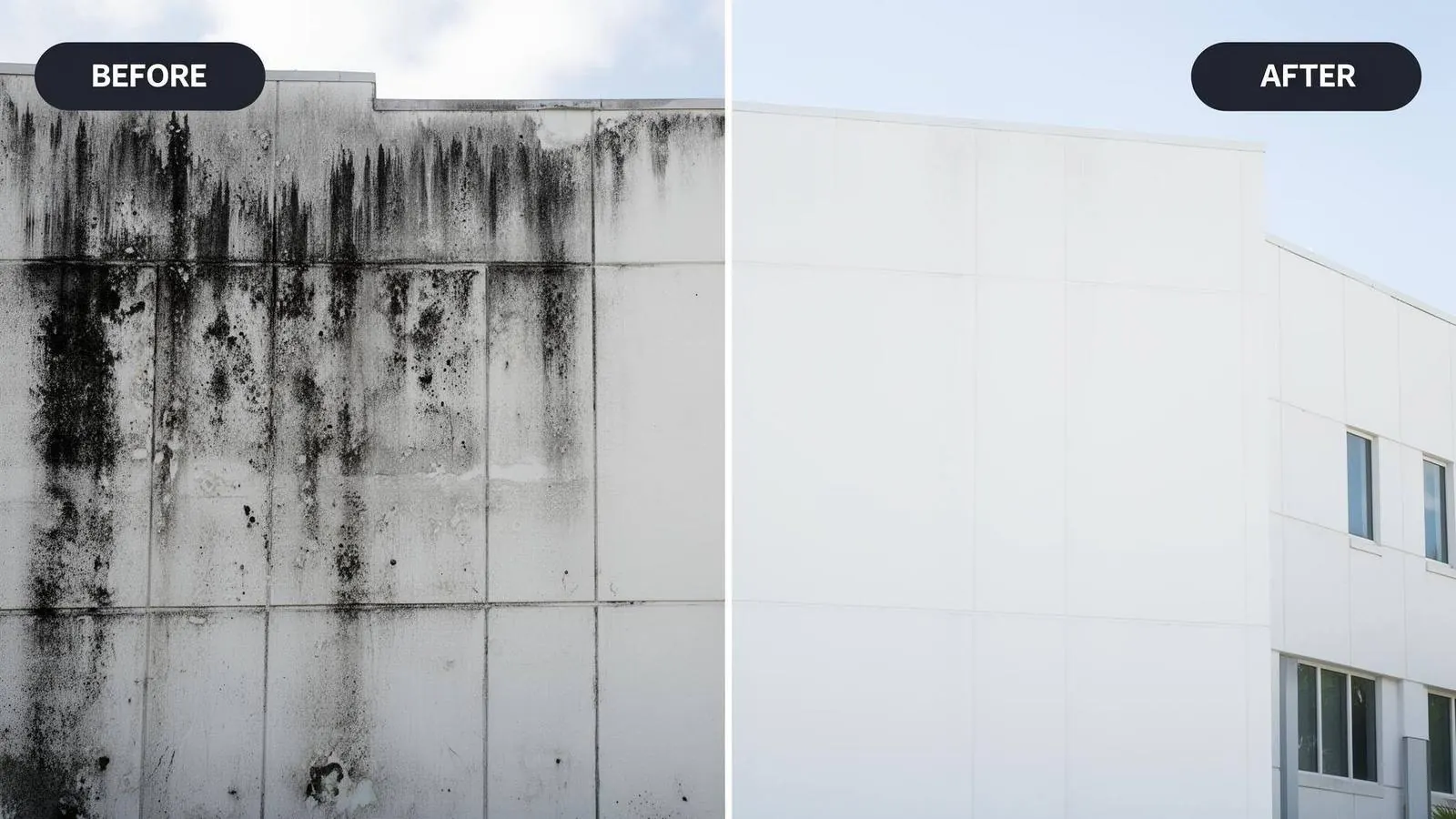
Yes, and this is where the drone works. Garage exteriors collect exhaust soot, salt drift, and biological growth on precast panel, painted concrete, and metal screen, the surfaces the public actually judges the property on. We fly them with low-pressure soft-wash from grade, with no lift blocking a lane and no deck taken out of service. Bundling the facade with the deck in one mobilization is materially cheaper than contracting the two separately.
Do you clean the stairwells and elevator lobbies?
Yes, as part of the wall and ceiling scope at the same per-square-foot rate. Stairwells are usually the worst-smelling and worst-reviewed part of a garage and the part a property manager hears about most, so they are rarely worth leaving out. They are hand-worked with hot water and chemistry, and we treat them as an occupied interior: controlled water volume, contained runoff, and dry before the space reopens.
What if my garage is smaller than 100,000 sq ft?
We still clean it. We just quote it rather than publish a rate. On a smaller structure, mobilizing the truck, the hot box, and the crew is a much larger share of the job, so a single per-square-foot number would either overcharge some properties or misquote others. The site survey is free and the resulting price is fixed, so a smaller garage costs you a walkthrough to find out. Portfolios of several small garages often price close to the $0.06 rate, because they share one mobilization.
How often should a parking garage be cleaned?
Most structures land on an annual deck wash, with the ground level and entry ramp done twice a year because that is where traffic film and public perception concentrate. Coastal garages within a few miles of the water need the exterior facade more often than the deck, since salt drift drives that surface rather than tire traffic. Garages attached to a retail or restaurant tenant usually move to a semi-annual cycle on the deck.
Are you insured and licensed for work inside an occupied structure?
Yes. $2M commercial general liability plus dedicated UAS aviation liability for the drone portion, with certificates naming the owner, operator, and property manager issued before we mobilize. Drone flights run under 14 CFR Part 107 with an FAA-licensed commercial pilot, and LAANC airspace authorization is filed where a garage sits in controlled airspace near a major airport.
How do you measure the square footage you bill?
Deck area is the gross drive-on surface of every level, ramps included, taken from the structural or as-built drawings and confirmed on the walkthrough. We do not bill by stall count, and we do not bill the same square foot twice. Wall, column, and ceiling surface is measured separately because it is a different unit of work. A column is hand-worked, a deck is machine-worked. If your drawings are missing, we measure on site and show you the take-off with the proposal, so you can check the number rather than take it on trust.
Is the $0.06 rate really flat, or does condition move it?
It is genuinely flat at 100,000 sq ft and up. Condition does not move it, level count does not move it, and a heavier first clean does not move it. That is a deliberate difference from how garage work is normally bid, where a "from" price gets revised upward once someone sees the oil. The rate absorbs condition because at this volume the machine time is the cost, and a dirtier deck does not change how fast a surface cleaner walks. The survey exists to confirm coatings, drains, and access, not to find a reason to reprice.
What is actually included in the deck price, and what is extra?
Included: heated surface cleaning of every deck and ramp, degreaser treatment on oil and tire marks, coned section work so the structure stays open, drain inlet protection and runoff handling, 4K documentation of the finished structure, and a certificate of insurance naming the owner and manager before we mobilize. Separate line items: walls, columns, ceilings, stairwells, and elevator lobbies at $0.06–$0.08 per square foot; the exterior facade; line re-striping; and any recoating of a failed traffic membrane, which is a coatings trade, not a cleaning one.
Can I phase the work across budget years?
Yes, and on large structures most owners do. A common split is decks in year one and walls, columns, and stairwells in year two, or ground level and the top deck first because those carry the most visible wear. Phasing costs slightly more in total than a single mobilization, because the truck and crew set up twice. The survey shows you both numbers so the trade-off is explicit rather than discovered later.
Do you re-stripe the parking lines after cleaning?
Not as part of the cleaning scope, but cleaning is the right moment to decide. Heated surface cleaning will lift loose and already-failing paint, which makes faded striping look worse before it looks better. That is the paint failing, not the cleaning damaging it. If your striping is near end of life we will flag it at the survey so you can line up a striping contractor for immediately after, while the deck is clean and the layout is clearly visible.
What does a maintenance schedule change about the price?
The deck rate is already flat and already at the bottom of what we quote for any surface, so a recurring garage schedule does not discount below $0.06. What a schedule does buy is a locked rate across the term, priority scheduling around your events and tenant calendar, and a much lighter clean each visit, a deck on an annual cycle never accumulates the built-up film that makes a first clean slow. The saving shows up in the wall and facade scopes and in not needing a heavy reset.
Who handles traffic control, signage, and tenant notice?
We do the cones, barricades, and section signage as part of the job. Tenant notice is a joint effort: we give you the shift-by-shift plan far enough ahead that your team can post it through the normal channels, because a notice from the property manager gets read and a notice from a contractor does not. On structures with valet or a parking operator, we build the sequence with the operator directly so stall counts stay workable each night.
Do you work around EV chargers, gates, and access equipment?
Yes, and they are mapped at the survey. EV charging equipment, gate arms, ticket spitters, card readers, cameras, and sub-panels all get no-spray buffers and, where the exposure warrants it, physical covering before water is applied nearby. Anything already damaged or with a compromised enclosure is photographed and flagged to you before the shift rather than after: a pre-existing fault found afterwards becomes an argument, and we would rather it be a record.
What documentation do I get for the board or the owner?
4K aerial and deck-level footage of the finished structure, before and after, delivered with the project. Boards and asset managers use it the same way they use the case-study documentation on our building work: to show the spend produced a visible result, and to date-stamp the condition of the deck and the coating. On structures heading into a recertification or an insurance inspection, that record is often worth more than the clean.
How do I know the price will not move after you start?
Because the proposal is a fixed price, not an estimate, and it is issued after the survey rather than before. The survey is where the variables get resolved (deck area, coating type, drain routing, access windows) so there is nothing left to discover once we mobilize. The only thing that changes a fixed price is you changing the scope. If we get the measurement wrong, that is our error to absorb, not a change order to send you.
How do I compare parking garage cleaning bids fairly?
Put every bid on the same unit before you compare totals. Ask each contractor for the deck rate per square foot, the deck area they measured, and whether walls, columns, ceilings, and stairwells are in or out. Bids that quote a lump sum without a measured area cannot be compared to anything, and a low lump sum usually means a smaller assumed scope. At $0.06 per sq ft our number is trivially checkable: multiply it by your own deck area and see whether the total matches the proposal.
Why is the cheapest garage cleaning bid often the most expensive?
Because the two ways to make a garage bid cheap both cost the owner later. The first is cutting scope, quoting the deck only, then adding walls, stairwells, and the facade once the crew is on site. The second is cutting method: cold water and high pressure move faster and cost less per hour, but cold water does not lift embedded oil, and high pressure on an elastomeric traffic coating chalks it. A recoat is an order of magnitude more expensive than the cleaning that caused it.
What should I ask a garage cleaning contractor before signing?
Five questions settle it. What deck area did you measure, and can I see the take-off? Is the price fixed or an estimate? What is your process on a coated deck specifically? Where does the wash water go, and who is responsible if the discharge is questioned? And will you name the owner and the management company on the certificate of insurance before mobilizing? A contractor who cannot answer the coating and the runoff questions has not surveyed your structure.
Is drone cleaning more expensive than traditional garage cleaning?
For the deck, the question does not apply. The deck is ground work either way, and our deck rate is the value proposition on its own. Where the drone changes the arithmetic is the exterior facade. Traditionally that is a second contractor, a second mobilization, and a lift parked in a traffic lane for days. Flown from grade in the same mobilization as the deck, it avoids the lift rental, the lane closure, and the permit cycle entirely.
Do you clean parking garage portfolios across multiple properties?
Yes, and portfolios are where the pricing works hardest. Several garages under one owner or one management company share a mobilization and a schedule, which is what lets structures below the published threshold reach the same rate as the large ones. We sequence a portfolio so no two properties are disrupted in the same week, and issue one consolidated documentation package for the asset file.
Can garage cleaning be scheduled around events and peak occupancy?
Yes. The schedule is built around your calendar, not ours. Retail and stadium-adjacent structures get cleaned mid-week and overnight; office garages are usually weekends; hospital and hotel garages run in small sections continuously because they never really empty. Because we work section by section rather than closing levels, there is no minimum block of downtime we need you to surrender.
How long do the results last on a garage deck?
Visually, most structures hold up for roughly a year before traffic film returns to where an owner notices it, with the entry ramp and ground level greying first because that is where every vehicle brakes and turns. Oil accumulation is driven by your tenants' vehicles rather than by the weather, so a garage with older cars or a service tenant loads faster. Coastal structures lose the exterior facade to salt drift well before the deck needs attention again.
Does cleaning the garage actually pay for itself?
It is the cheapest square footage on the property to improve and the first thing a tenant touches. A dark, stained, sour-smelling garage is a recurring complaint in tenant surveys and a live objection during a leasing tour, and neither is expensive to remove relative to the rest of an exterior budget. Cleaning also surfaces the things that are genuinely costly if missed (a failing traffic coating, a blocked drain, a spalling slab edge) while they are still small.
Our core services
Get a fixed parking garage price
Send the address and deck area if you know it. We measure the structure, walk the site and reply with a fixed proposal for the deck, walls and facade.