
Building exterior cleaning in New York, scheduled around the permit
Facade, window, roof, solar and parking-garage cleaning for co-ops, condominiums and commercial buildings across the five boroughs, Long Island, Westchester and Upstate New York. In New York City every drone takeoff and landing needs a city permit with at least 30 days' notice, so we plan flights around that process and put water-fed poles and ground crews on the work that cannot wait. Free site survey, then a fixed price.
- Metro
- New York City
- Season
- Roughly early April to mid-November
- National line
- (561) 945-0337
Florida project · delivered by Vista Drone Cleaning, run by our founders
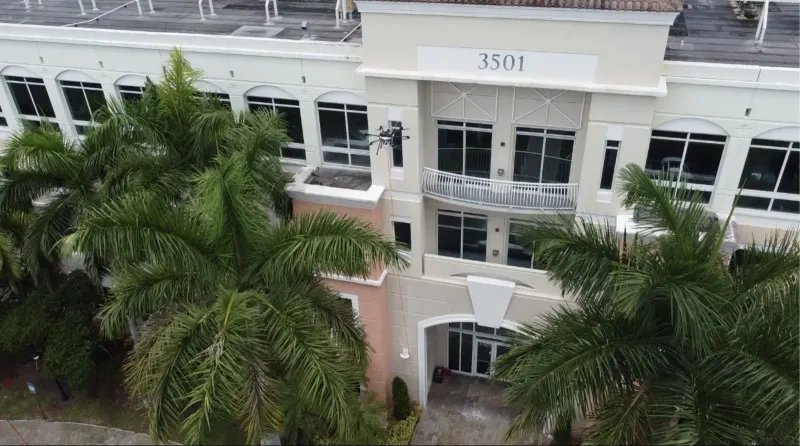
Miramar Centre II, Miramar, FL
- 48 hours to complete the entire building
- ~29% below traditional pricing for the same scope
- Zero lifts or scaffolding on site
- Minimal disruption to tenants and daily operations
How we operate in New York City
New York City is the one market where the rules decide the schedule, so they come before anything else on this page. Every one of these applies to every job in the city:
New York City requires an NYPD/DOT permit for every drone takeoff and landing (38 RCNY Chapter 24), with at least 30 days' notice, a $150 fee, proof of insurance and Part 107 certification, community-board notice and posted signage. Drone flights are scheduled around that process and are never promised on a same-week basis.
Much of Manhattan sits on LaGuardia's Class B grids, where LAANC ceilings run from 0 to 400 ft block by block; a zero-ceiling block needs a manual FAA authorization, which can take up to about 90 days.
Work that cannot wait for a permit is done with water-fed poles and ground crews, the pole-and-ground side of the hybrid method used on the Miramar Centre II project.
Cleaning a landmarked building or one in a historic district needs a Landmarks Preservation Commission permit, which caps water pressure.
Wash water discharged to the sanitary sewer needs DEP approval; it is captured and disposed of accordingly.
In plain language: a drone cannot take off or land anywhere in the five boroughs without an NYPD/DOT permit, the application goes in at least 30 days ahead, and launches happen only from designated sites. On many Manhattan blocks the FAA's automated LAANC system gives no altitude at all, so a flight there also needs a manual FAA authorization that can take up to about 90 days. We build both into the plan and schedule the flight days around them. We do not promise same-week drone work in New York City. Work that cannot wait, a facade that must be presentable for a closing or an inspection next month, is done with water-fed poles from the ground and a ground crew, the pole-and-ground side of the hybrid method used on the Miramar Centre II project. A landmarked building or one in a historic district adds a Landmarks Preservation Commission permit, which caps water pressure; soft washing already sits below that cap. And wash water going to the sanitary sewer needs DEP approval, so it is captured and disposed of accordingly, with the plan written into the proposal.
Where we work in New York
We serve all of New York State, from the five boroughs, Long Island and Westchester to the Hudson Valley, Albany, Rochester and Buffalo. Inside the five boroughs the city permit process above governs every drone flight. In Nassau, Suffolk, Westchester and the Hudson Valley the city permit does not apply, but FAA airspace rules still do, along with each municipality's own rules, and we confirm all of it at the site survey before quoting a flight day. Buffalo, Rochester and Albany are named as metros we serve without a documented project there yet. Each job is handled by a local crew, with a fixed quote after a free site survey and no travel charge.
We do not publish a New York street address or a local phone number. Every New York request comes through the national line or the form above, and the same team quotes and schedules it.
The New York working season
Water-based washing runs roughly early April to mid-November; in New York City the average last spring frost falls around April 1 and the first autumn frost around November 11, and upstate the window is shorter.
Drone washing is water work, and water that runs down a facade in freezing weather becomes ice on the sidewalk below, so we do not run water-based washing once overnight temperatures sit near freezing. The dates above are averages, checked against the forecast rather than the calendar. New York's season is long compared with some other states, but the permit lead time in New York City eats into it: a flight that needs 30 days of city notice and possibly up to about 90 days of FAA processing has to be applied for while the ground is still cold if it is going to happen in spring.
For a board or a managing agent, that means planning drone work a season ahead: decide in winter, file in late winter, fly in spring or summer. Water-fed pole and ground-crew work does not carry the permit lead time and can be scheduled with more flexibility inside the same window, which is why most New York City proposals combine the two.
Building types in New York
New York City's exterior maintenance runs on the Facade Inspection and Safety Program, the inspection cycle most owners still call Local Law 11. Every cycle, a qualified exterior wall inspector has to see the facade, and a facade under decades of soot and biological staining is harder to read than a clean one. Boards that clean ahead of the inspection give the engineer a clear view of the masonry and the joints. We schedule around your inspection date and coordinate with your engineer on scope.
The customer is most often a co-op or condominium board and its managing agent. Boards need a written scope, a fixed price, a certificate of insurance and a plan that keeps the lobby and the sidewalk open, and they need it all in writing before a vote. Our proposals are built for that: which elevations are drone work and which are pole or ground work, when the permit applications go in, how the wash water is handled and what the building staff needs to do on the day.
Landmarked buildings and historic districts are a large share of the pre-war stock in Manhattan and Brooklyn. Brick, limestone, brownstone and terra cotta all respond well to low-pressure soft washing, and the Landmarks Preservation Commission permit that governs the work caps pressure at a level soft washing already sits under. Alongside these, the stock also includes post-war glass and brick towers, flat commercial roofs with setbacks, rooftop solar, and parking structures in the outer boroughs, Long Island and Upstate New York.
Services offered in New York
Every service below is quoted as a hybrid in New York City. The proposal states which surfaces are drone work, scheduled around the permit, and which are water-fed pole or ground-crew work that can begin sooner.
- Facade and building cleaningBrick, limestone, terra cotta, glass and metal panel. Drone where permitted, water-fed pole and ground crew where it is not.
- Window cleaningPure-water glass cleaning without swing stages or rope access, scheduled around the permit process.
- Roof cleaningSoft-wash for flat commercial roofs and setbacks with no foot traffic on the membrane.
- Solar panel cleaningPure-water rinse for rooftop arrays, priced per panel.
- Parking garage cleaningGround crews on the decks; the exterior is cleaned by drone only where a permit allows.
Pricing in New York
We publish our prices. The commercial rate of $0.12–$0.25 per square foot, fixed after a free site survey, is our published national rate. New York jobs are quoted after the same survey using the same model: surface area, condition, the access plan and the water-handling plan set the price, and in New York City the proposal separates drone elevations from pole and ground work so the board can see exactly what it is approving. Bigger jobs get lower rates.
Recurring work is cheaper per visit. A maintenance contract runs 20–30% below the one-off price; ask for the equivalent when we survey your building. The full model is on how we price.
The proof behind the hybrid method is on the case studies page. We do not yet have a documented New York project or a permitted New York City cleaning flight to show you, and we will not claim one until we do.
New York questions
How is drone cleaning priced in New York?
Fixed price after a free site survey, quoted per square foot of surface cleaned. $0.12–$0.25 per square foot is our published national commercial range; the proposal states which elevations are drone work and which are pole or ground work.
Can you fly a cleaning drone at my building in New York City this week?
No, and nobody can lawfully promise that. New York City requires an NYPD/DOT permit for every drone takeoff and landing, with at least 30 days' notice, and many Manhattan blocks sit on zero-ceiling LAANC grids that need a manual FAA authorization. We schedule drone flights around that process. Work that cannot wait is done with water-fed poles and ground crews.
What does the permit process involve?
An application to the NYPD/DOT under 38 RCNY Chapter 24 at least 30 days before the flight, a $150 fee, proof of insurance and Part 107 certification, notice to the community board and posted signage at the site. Takeoff and landing happen only from designated sites. We prepare and file the application; you supply building access and sign-off.
When is the season for exterior washing in New York?
Water-based washing runs roughly early April to mid-November; in New York City the average last spring frost falls around April 1 and the first autumn frost around November 11, and upstate the window is shorter. We do not run water-based washing in freezing weather. Combined with the permit lead time, that means a New York City drone job should be planned a season ahead; water-fed pole and ground work has more flexibility inside the same window.
Which parts of New York State do you cover?
We serve all of New York State, from the five boroughs, Long Island and Westchester to the Hudson Valley, Albany, Rochester and Buffalo. Outside the five boroughs the city permit does not apply, but airspace authorizations and local rules still do, and we confirm them at the site survey.
My building is landmarked. Can it still be cleaned?
Yes, with a Landmarks Preservation Commission permit, which caps the water pressure that may be used on the facade. Soft washing is low-pressure by design, and we prepare the LPC application as part of the job. The permit is a schedule item, not an obstacle.
More general answers are on the national FAQ. See every state on the states directory.
Cities in New York
Each city page covers the local building stock, the airspace and city rules a flight has to plan around, how wash water is handled and what a job there costs at our published national rate.
States bordering New York
A building near a state line is quoted under the rules of the state it stands in. Each page below lists that state's own airspace, city drone rules, stormwater rules and freeze dates.
Our core services
- High-rise window cleaningTower and commercial glass washed by drone with purified water, no scaffolding or swing stage.
- Facade & building cleaningWhole-building exterior washing by drone: stucco, EIFS, concrete, metal panel and glass.
- Roof cleaningLow-pressure roof washing from the air, so nobody walks on tile, metal, shingle or membrane.
- Parking garage cleaningDecks and drive lanes on large garages at a flat per-square-foot rate; walls and stairwells priced alongside.
Plan a New York City job a season ahead
Tell us the building and your inspection or closing date. We survey for free, file the permits, and send a fixed price.