
Standards Backed Exterior Maintenance Schedules for Facilities Teams
· Exterior Drone Washing

For most commercial properties, use these recurring bands: façade inspections every 6 to 12 months, window cleanings quarterly to annually, roof and drain checks quarterly, and solar cleaning once or twice a year or as triggered by monitoring data. Guidance from ASTM and the Department of Energy informs these bands, and Exterior Drone Washing can survey your building for free to help set the cleaning calendar.
TL;DR:
- Façade inspections should occur every 6 to 12 months, with annual cleaning unless environmental soiling requires more frequent service.
- Window cleaning varies from quarterly for high-traffic or coastal buildings to annually for lower-exposure sites.
- Roof and drain inspections should happen quarterly, plus after storms, to prevent leaks and damage, with gutter checks following seasonal patterns.
- Solar array cleaning should be based on performance data and soiling thresholds, typically one to two times annually, rather than fixed schedules.
- Drone-based cleaning and inspection can reduce costs and safety risks for high-rise surfaces, provided FAA and insurance requirements are met.
Table of Contents
- Recommended recurring schedules by building component
- How to set a site-specific schedule: a decision framework
- Solar arrays: cleaning triggers, monitoring, and the economic tradeoff
- Documentation, contracts, and compliance essentials
- Sample annual schedule and quick implementation checklist
- Lessons from preventive programs and the role of technology
- Client solution: how drone-based preventive maintenance fits the schedule
- FAQ
- Sources
Recommended recurring schedules by building component
Each exterior asset wears differently, so treating them as one line item on a maintenance budget wastes money and misses warning signs. Breaking the schedule into component bands lets you budget accurately and catch problems before they become capital expenses.
Façades need two separate clocks: an inspection clock and a cleaning clock. ASTM E2270 and E2841 give a framework for periodic façade inspections for unsafe conditions. The formal interval is set by your local façade ordinance or your engineer and is usually measured in years. Between those, a visual walk-through every 6 to 12 months catches staining, sealant failure and loose material early. Cleaning cadence can run less often, often annually, unless soiling or environmental exposure pushes it higher.

Windows on mid-rise and high-rise buildings generally get cleaned quarterly to twice a year for street-facing glass in urban or coastal settings, and annually for lower-traffic elevations. Roofs and drains deserve quarterly checks at minimum, with walk-throughs after major storms to catch ponding, debris blockage, or membrane damage before it becomes a leak claim. Gutters and scuppers follow a similar seasonal rhythm, with extra event-driven checks after heavy wind or leaf-drop periods.
Solar arrays sit on their own curve. A baseline of one to two cleanings per year works for many sites, but IEA PVPS soiling research shows that fixed intervals often underperform monitoring-triggered schedules in dusty or high-pollen climates.
- Façade: inspect every 6 to 12 months, clean annually or as soiling dictates.
- Windows: clean quarterly to annually based on height, traffic, and coastal exposure.
- Roof and drains: inspect quarterly, plus after every major storm event.
- Solar arrays: clean 1 to 2 times per year, adjusted by soiling or output data.
IEA analysis finds soiling is a major driver of PV yield loss, and cleaning economics vary enough by climate that a fixed calendar date is rarely the most efficient trigger.
How to set a site-specific schedule: a decision framework
Generic bands are a starting point, not a final answer. Your actual schedule should reflect the building’s material, exposure, and risk profile, not a calendar template copied from another property.
- Score exposure: rate each façade or roof section low, medium, or high based on sun, salt air, pollution, or bird activity.
- Score criticality: weigh assets by replacement cost and tenant impact, since a lobby entrance or rooftop array carries more risk than a service stairwell.
- Score access difficulty: factor in height, obstruction, and whether powered platforms or drones are needed to reach the surface safely.
- Map scores to bands: a high-exposure, high-criticality, hard-to-access asset moves toward the shorter end of the inspection range, while a low-risk, easy-access asset can sit at the longer end.
- Record findings: log photos, exact locations, and any recommended interval change after every visit, not just after major incidents.
Pairing this scoring matrix with ongoing monitoring, rather than a one-time inspection, shifts the program from reactive to predictive, which BOMA’s maintenance guidance ties directly to longer asset life and fewer emergency repairs.
Pro Tip: Keep a single running spreadsheet of interval scores per asset so a new property manager can see the reasoning behind every schedule change, not just the current date.
Solar arrays: cleaning triggers, monitoring, and the economic tradeoff
Solar cleaning is where fixed schedules most often waste money. DOE guidance on PV operations and maintenance recommends a comprehensive O&M plan that includes scheduled preventive cleaning, but also clear record-keeping and response-time standards tied to actual performance data, not just a calendar.
IEA PVPS research presented at Intersolar found that soiling monitors and simple energy-loss thresholds often outperform fixed intervals as cleaning triggers, since dust and pollen accumulation vary widely by site and season. A property in a dusty inland corridor may need quarterly cleaning, while a coastal rooftop array with regular rain might go a full year between services.
- Track output against a clean-panel baseline to spot soiling-driven losses early.
- Set a soiling-ratio or percentage-drop threshold as your cleaning trigger instead of a fixed date.
- Compare the cost of a cleaning visit against the value of recovered energy output before approving the work order.
DOE’s PV O&M framework notes that a well-run maintenance plan protects system performance across a 20 to 30 year service life, which makes the cleaning trigger decision a long-term budgeting question, not a one-off expense.
Documentation, contracts, and compliance essentials
A maintenance schedule without paperwork is just a guess with a date attached. Facility managers should require specific documentation from every vendor, not just a completed work order.
- Chronological O&M log: inspection reports, work orders, and before-and-after photos filed in one place, which DOE guidance identifies as core to preserving system performance and enforcing warranties.
- Inspection versus repair distinction: ASTM E2270 practice calls for separating routine maintenance findings from safety-critical repair needs so budgets prioritize urgent hazards correctly.
- Safety compliance proof: for suspended powered platforms, OSHA’s directive on powered platforms sets anchor, stabilization, and monitoring requirements that contractors must meet or document an engineered alternative. For drone-based cleaning, require proof of FAA compliance and current insurance before work begins.
- Contract breakpoints: specify response times for corrective repairs, access and staging rules, and permitted working hours in the written agreement.
These items also protect warranty coverage. A vendor’s own record on inspection intervals for drainage and exterior systems, and a structured fire door inspection checklist, both show how documented intervals and clear compliance checkpoints reduce disputes across other building systems, a pattern that holds for façade and roof contracts too.
Sample annual schedule and quick implementation checklist
A written calendar turns scattered vendor visits into a program you can budget against. The sample below fits a typical mid-rise commercial property and can be adjusted using the scoring framework above.
- January and February: winter storm damage walk-through on roof and drains.
- March: façade inspection and spring glass cleaning.
- June: solar array check against output baseline, cleaning if soiling threshold is met.
- July and August: mid-year window cleaning for high-traffic elevations.
- September: roof and drain inspection ahead of fall and winter storms.
- November: annual façade inspection and full-building exterior cleaning before year-end reporting.
On every visit, capture a consistent record so the log stays usable over multiple years.
- Timestamped photos of each elevation or array section.
- A defect list with exact location and severity.
- Any recommended change to the next interval, with reasoning.
When issuing an RFQ, require proof of insurance, a description of access method, documented safety procedures, and, where drones are proposed, FAA compliance paperwork before accepting a bid.
Lessons from preventive programs and the role of technology

The properties that avoid expensive emergency repairs are rarely the ones with the most frequent cleanings. They are the ones with the best records. A documented interval history lets you catch a drifting trend, like a roof membrane degrading faster than expected, long before it becomes a capital project.
Drone-based cleaning fits naturally into this kind of program because it can reduce worker-at-height exposure and often compresses a multi-day façade or rooftop job into a single visit, which makes more frequent, lower-risk inspections practical rather than disruptive.
— Eliot
Client solution: how drone-based preventive maintenance fits the schedule
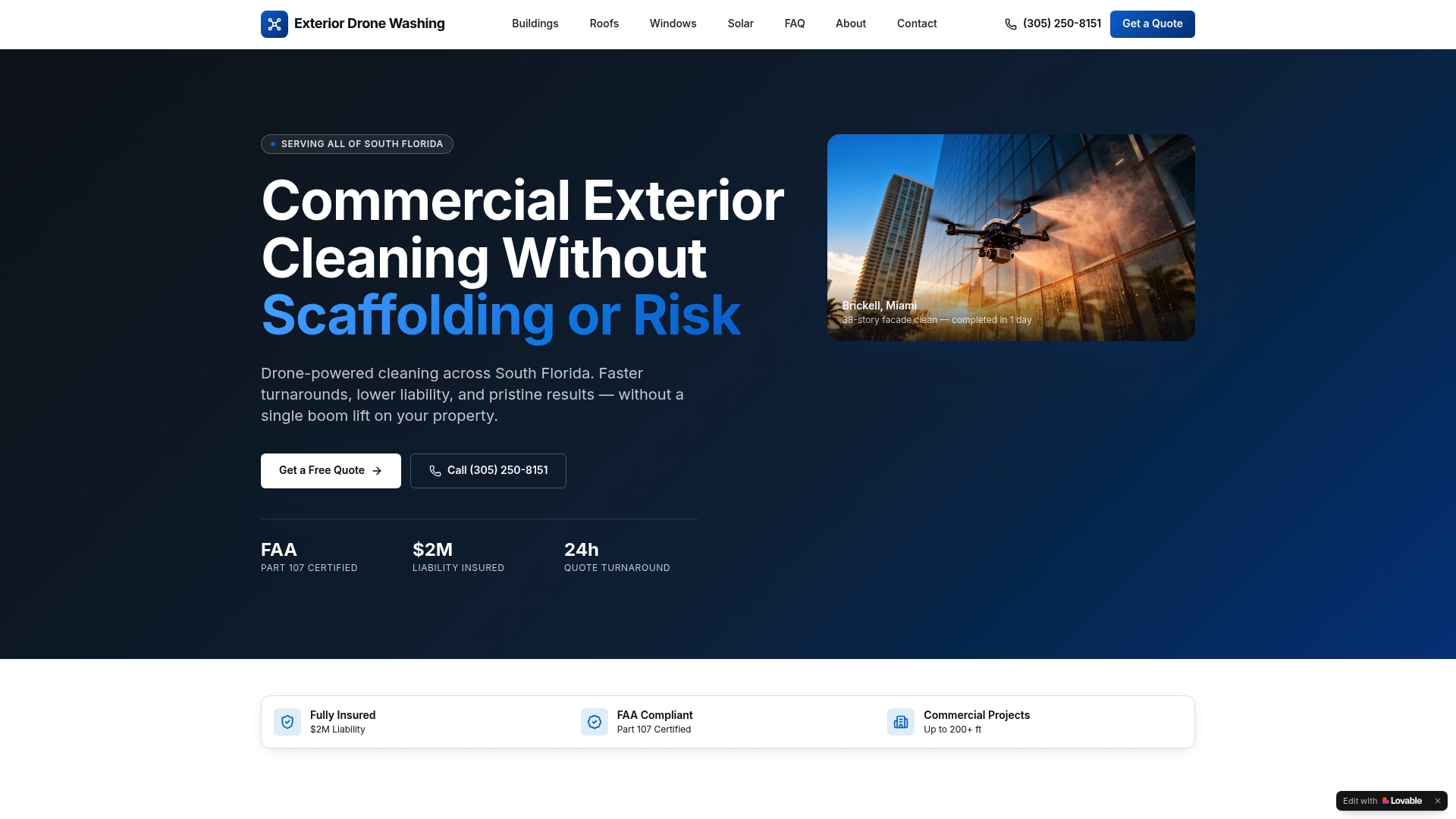
Many of the schedules above depend on reaching surfaces 100, 150, or 200 feet up, which is exactly where traditional scaffolding and lift access slow a project down and raise tenant complaints. Exterior Drone Washing uses industrial drones flown by FAA Part 107 certified pilots with soft-wash systems and de-ionized water to clean facades, windows, roofs, and solar arrays up to 320 feet (about 29 stories) per staging position, without scaffolding or lifts. That setup fits the inspection-and-cleaning bands in this schedule particularly well for high-rise facades and rooftop solar, where access is normally the limiting factor on frequency. Visit Exterior Drone Washing to request a free site survey and a fixed-price quote.
FAQ
How often should a commercial building’s exterior be inspected?
Visual façade walk-throughs typically run every 6 to 12 months, with the shorter interval for high-exposure or high-criticality assets. Formal inspections under ASTM E2270 follow the interval your local ordinance or engineer sets. Roof and drain checks should happen quarterly, with an added walk-through after any major storm.
Does a preventive maintenance schedule actually save money?
Shifting from reactive to predictive, documented maintenance reduces emergency repairs and helps avoid premature replacement of expensive systems like roofs and windows, according to BOMA’s maintenance guidance. A written inspection and cleaning log also supports warranty claims, since most manufacturers require proof of scheduled care.
How often should solar panels be cleaned?
A baseline of once or twice a year works for many sites, but IEA PVPS research shows that soiling-based or output-monitoring triggers often perform better than a fixed date, especially in dusty or high-pollen climates. DOE’s O&M guidance recommends building cleaning into a broader preventive plan that tracks system performance over its full service life.
Is drone-based exterior cleaning safe and compliant for commercial buildings?
Drone cleaning operations must comply with FAA regulations and carry appropriate insurance, which facility managers should verify before awarding any contract. This differs from suspended powered platform work, which falls under OSHA’s directive on powered platforms and its anchor and training requirements, so the two access methods are governed by separate compliance frameworks.
What should a maintenance contract include to protect warranties?
A contract should specify preventive versus corrective scope, response times, and a requirement for a chronological inspection log with photos and work orders, points that DOE’s O&M framework ties directly to warranty enforcement. It should also define access methods and safety procedures so compliance responsibility is clear if a dispute arises.