
Pollution-Resistant Facade Washing: A Property Manager's Guide
· Exterior Drone Washing

Pollution-resistant facade washing is a set of preservation-grade cleaning methods designed to remove atmospheric pollutants, biological growth, and chemical deposits from building exteriors without damaging the substrate or driving contaminants deeper into the material. The core techniques include low-pressure soft washing with biocidal agents, superheated steam cleaning (DOFF-style systems), targeted neutralized chemical cleaning, and the application of self-cleaning coatings such as photocatalytic titanium dioxide (TiO2) and hydrophobic anti-soiling treatments. Done correctly, this approach reduces surface erosion, moisture entrapment, freeze-thaw spalling, and long-term lifecycle costs, making it a capital planning decision, not merely a cosmetic one.
Table of Contents
- Why property managers should prioritize pollution-resistant washing
- How pollution-resistant washing differs from routine facade cleaning
- What are the main pollution-resistant cleaning methods?
- Substrate-specific guidance and precautions
- How do self-cleaning coatings reduce maintenance frequency?
- Inspection, test patch protocol, and documentation
- What does pollution-resistant facade washing cost, and how often is it needed?
- Environmental, safety, and U.S. regulatory considerations
- Why drone-based cleaning works for pollution-resistant facade work
- How to write RFP language for pollution-resistant facade washing
- Quick on-site decision checklist for managers
- Key Takeaways
- A practitioner’s honest take on cost versus preservation
- Exterior Drone Washing brings drone precision to preservation-grade cleaning
- Useful sources
- FAQ
Why property managers should prioritize pollution-resistant washing
Most facility teams treat facade cleaning as a line item that gets cut when budgets tighten. That’s the wrong frame. Atmospheric pollutants, carbon deposits, and biological growth don’t just look bad. They trap moisture against the substrate, accelerate freeze-thaw spalling in porous masonry, and corrode the metal support elements embedded in curtain walls and cladding systems. Left unchecked, the repair bill dwarfs the cleaning cost by an order of magnitude.
The operational case for prioritizing preservation-grade cleaning maps directly to what property managers actually care about:
- Asset life extension: Removing trapped pollutants before they penetrate the substrate prevents the moisture-related structural failure modes that experts identify as the primary driver of premature facade replacement.
- Tenant perception and occupancy: Visibly clean, well-maintained exteriors signal active management and directly affect lease renewal conversations.
- Regulatory risk reduction: Failing facades can trigger municipal notices of violation; documented maintenance schedules provide defensible evidence of due diligence.
- Insurance and liability mitigation: Spalling masonry and corroding cladding anchors create falling-hazard liability. A documented cleaning and inspection program reduces exposure.
Statistic: For glass facades in high-pollution or industrial areas, industry guidance recommends regular cleaning to prevent permanent staining and surface degradation.
The Pollution Degradation Modifier (PDM), a design concept proposed in recent structural research, formalizes this risk by suggesting that allowable deflection limits for aluminum facades in high-SO2 environments should be reduced to as low as 85% of conventional code values to account for long-term pollutant-driven degradation. That’s a structural engineering signal that pollution exposure isn’t a maintenance nuisance; it’s a serviceability threat.
Pro Tip: Schedule facade washing to coincide with your planned exterior repair cycles. Cleaning can expose hairline cracks and failed sealants that are invisible under soiling, and coordinating the two prevents water from entering freshly cleaned but unrepaired masonry.
How pollution-resistant washing differs from routine facade cleaning
Standard facade cleaning and pollution-resistant facade washing share a pressure washer in the same way that a household sponge and a surgical instrument share the concept of “cleaning.” The goals, chemistry, pressures, and verification steps are fundamentally different.
Routine facade cleaning:
- Goal is cosmetic: remove visible surface dirt and improve curb appeal
- Typically uses high-pressure water jets without substrate-specific chemistry
- No test patches, no contaminant sampling, no documentation protocol
- No consideration of what happens to pollutants driven into porous substrates
Pollution-resistant facade washing:
- Goal is preservation: remove contaminants without damaging the substrate or embedding them deeper
- Uses material-matched chemistry at controlled pressures, often well below 500 PSI for sensitive masonry
- Requires pre-inspection, test patches on each substrate, and documented before/after records
- Includes runoff containment and chemical neutralization to meet EPA discharge requirements
- May incorporate preventative coatings after cleaning to extend the maintenance interval
The single most damaging default in routine cleaning is high-pressure jetting on porous masonry. Research confirms that jet washing can force pollutants deeper into porous substrates, increasing embedded contamination and accelerating freeze-thaw spalling. Once particulates are driven past the surface layer of sandstone or soft brick, no subsequent cleaning method retrieves them without abrasive intervention that causes its own damage.
What are the main pollution-resistant cleaning methods?
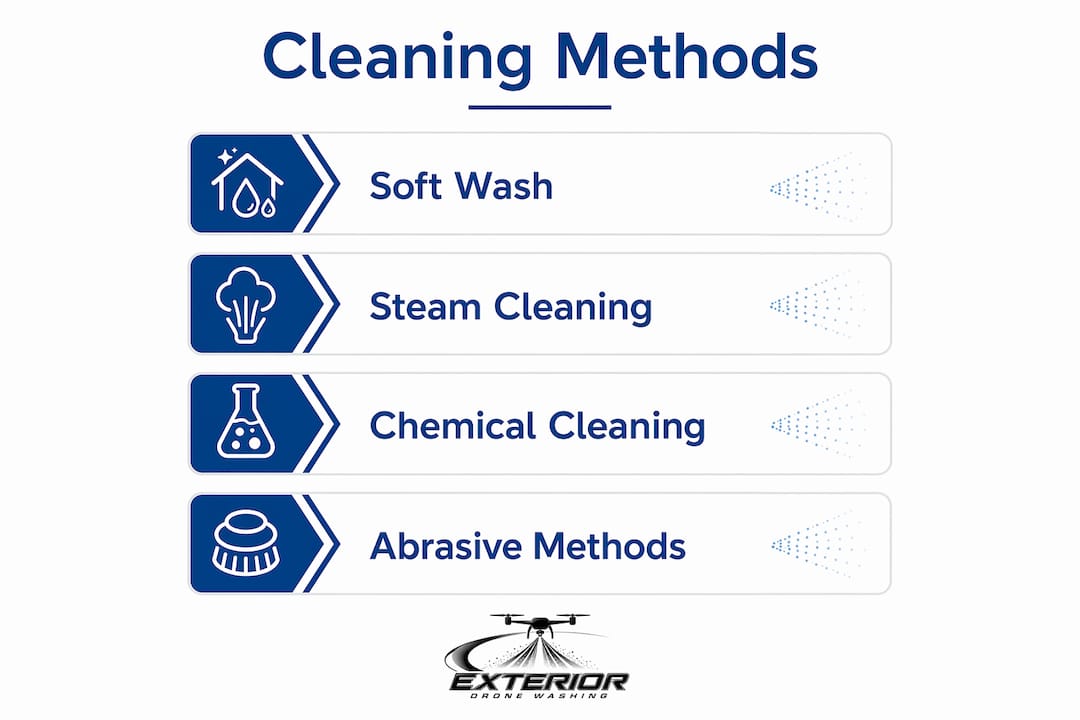
Four methods form the core of preservation-grade facade cleaning. Each has a specific mechanism, a set of substrates it suits, and hard limits that define when it stops being appropriate.
Low-pressure soft washing with biocidal agents
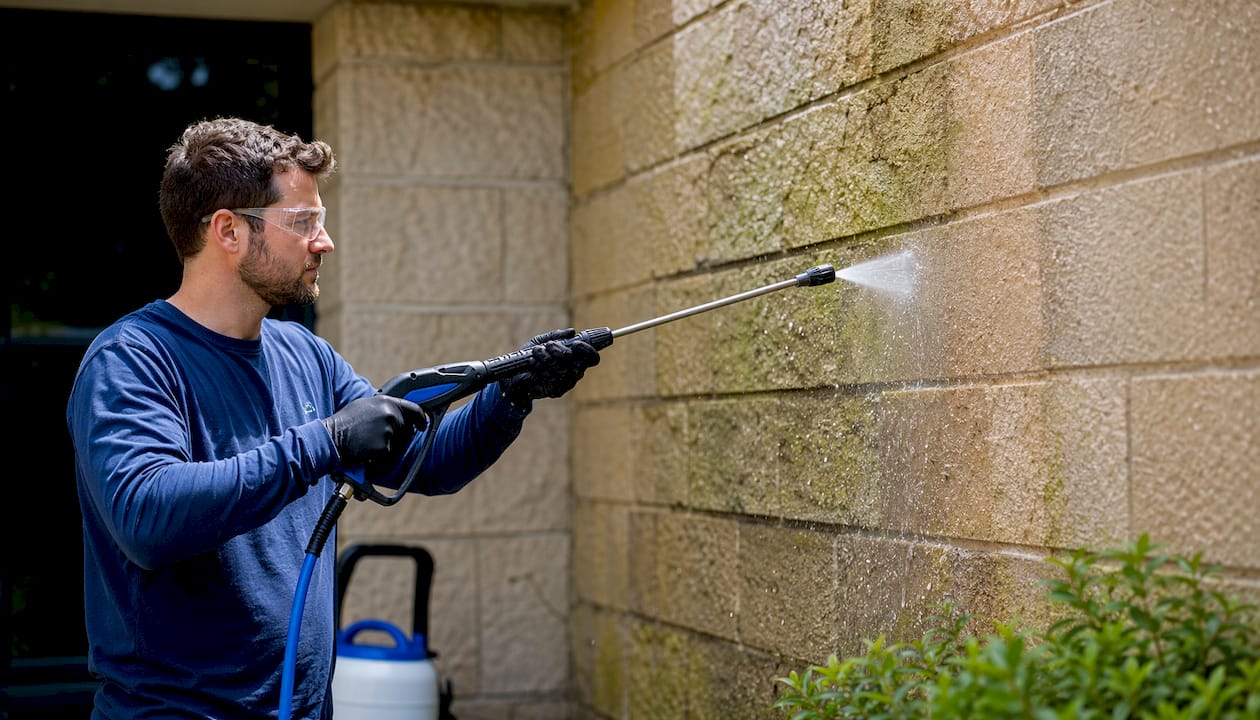
Soft washing delivers cleaning solution at pressures low enough to avoid substrate damage, typically under 500 PSI, relying on dwell time and chemistry rather than mechanical force. Biocidal agents kill algae, lichen, and mold at the root rather than shearing them off the surface, which prevents rapid regrowth. This method suits painted surfaces, EIFS, fiber cement, and any substrate where high pressure would strip coatings or open pores.
Superheated steam cleaning (DOFF-style systems)
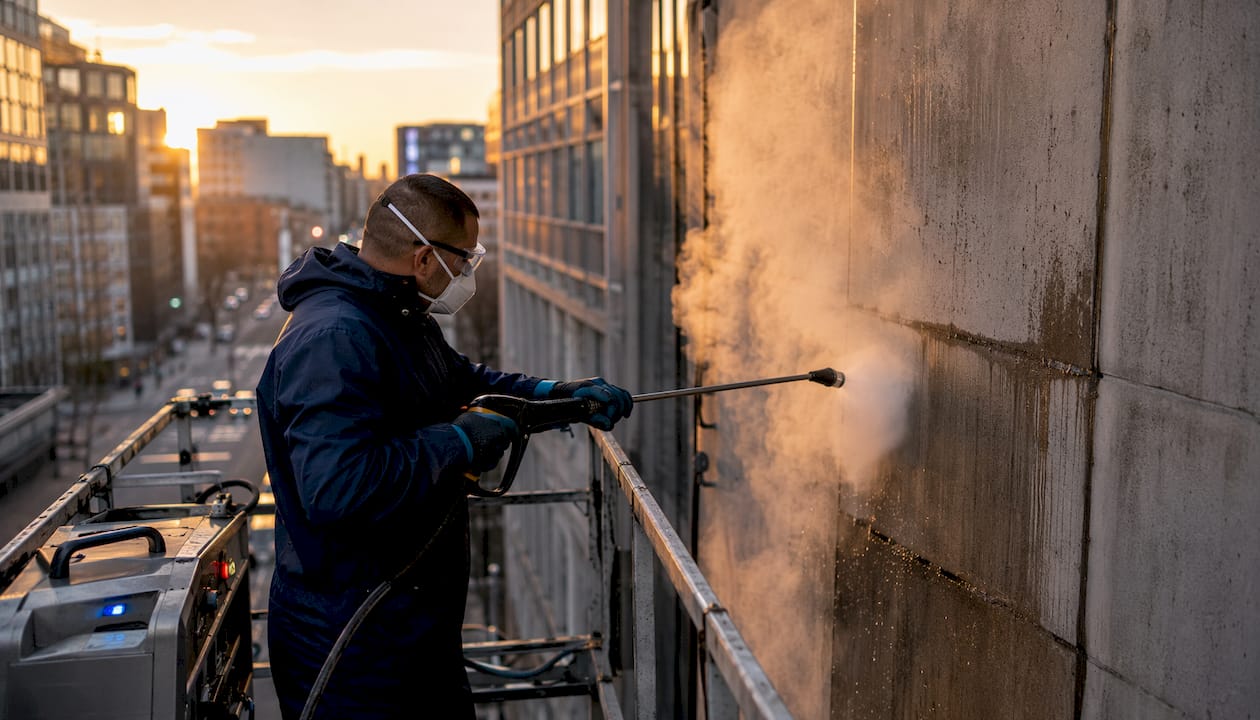
DOFF and similar superheated steam systems deliver steam at temperatures up to 150°C at very low pressure, typically under 100 PSI. The heat softens and loosens organic growth, carbon deposits, paint, and biological soiling without saturating the substrate. Because water volume is minimal, the risk of driving moisture into the masonry is significantly lower than with conventional pressure washing. This is the preferred method for historic masonry, delicate stonework, and terracotta where any mechanical abrasion is unacceptable.
Targeted neutralized chemical cleaning
Chemical cleaning uses acidic or alkaline solutions matched to the specific contaminant and substrate. Alkaline cleaners address carbon and organic deposits; dilute acidic solutions target calcium carbonate efflorescence and metallic stains. The critical discipline is neutralization: residual chemistry left on the surface continues reacting with the substrate and can cause staining or accelerated weathering. Water-based treatments should always be attempted first, with chemical intervention reserved for contaminants that don’t respond to gentler methods.
A note on abrasive and blasting methods
Dry abrasive blasting and wet abrasive techniques are generally discouraged for pollution-resistant work. They remove surface material along with the contaminant, permanently altering texture and porosity. On historic facades or any substrate with decorative elements, the damage is irreversible. Reserve these methods only for heavy industrial carbon deposits on robust substrates, and only after a specialist assessment.
| Method | Best for | Substrates | Key precaution |
|---|---|---|---|
| Soft wash (biocidal) | Algae, mold, lichen, light carbon | Painted, EIFS, fiber cement, composite | Verify biocide compatibility with substrate coating |
| Superheated steam (DOFF) | Organic growth, carbon, paint removal | Historic masonry, stone, terracotta, brick | Control dwell time; avoid saturating open joints |
| Neutralized chemical | Efflorescence, metallic stains, heavy carbon | Concrete, metal, glass (pH-matched) | Full neutralization required; test patch mandatory |
| Abrasive/blasting | Heavy industrial carbon on robust substrates | Dense brick, concrete (specialist only) | Last resort; irreversible surface alteration risk |
Pro Tip: Always start with the gentlest effective method and build an escalation plan in writing before work begins. A tested escalation protocol, moving from water-based to chemical to steam, is standard best practice and protects you if a contractor skips steps.
Substrate-specific guidance and precautions
Material compatibility is where most facade cleaning mistakes happen. The same chemical that safely removes carbon from dense concrete will dissolve the surface of limestone. Here’s what to specify by substrate:
- Masonry (brick, concrete block): High porosity means pollutants penetrate quickly. Avoid high-pressure jetting, which drives contaminants deeper. Use soft wash or steam, and confirm that cleaning chemistry won’t react with mortar joints. Always perform a test patch in an inconspicuous area and wait 24–48 hours before proceeding.
- Stone (limestone, marble, sandstone): These are acid-sensitive. Never use acidic cleaners on limestone or marble; the acid dissolves the calcium carbonate matrix, causing irreversible surface loss. Sandstone is mechanically fragile; even moderate pressure can erode the surface. Steam or very low-pressure water washing is the starting point.
- Metal (steel, aluminum, copper): Corrosion risk is the primary concern. Use chemistry formulated for the specific metal; alkaline cleaners can attack aluminum, and chloride-containing products accelerate steel corrosion. Rinse thoroughly and inspect for existing rust before cleaning, as water infiltration under rust accelerates failure.
- Glass: Glazing manufacturer guidance is explicit: never use products containing hydrofluoric acid or strong acids and alkalines on glass. These etch the surface permanently. Use pH-neutral or manufacturer-approved cleaners, and clean from top to bottom to prevent dirty runoff re-soiling cleaned panes.
- Composite cladding and ACM panels: Check sealant and coating compatibility before applying any chemistry. Many composite panels have factory-applied coatings with specific prohibited chemistries listed in the manufacturer’s maintenance guide. Require the contractor to produce that documentation before work starts.
Pro Tip: Require a written test patch report for every distinct substrate on the building, not just one patch for the whole facade. A result that’s safe on the brick may be destructive on the adjacent limestone trim.
A warning worth repeating: using highly acidic cleaners on acid-sensitive stone, or running high-pressure water across soft sandstone, causes damage that no subsequent treatment reverses. These are the mistakes that generate insurance claims and legal disputes.
How do self-cleaning coatings reduce maintenance frequency?
Photocatalytic TiO2 coatings and hydrophobic anti-soiling treatments work by different mechanisms, but both aim at the same outcome: reducing how quickly a cleaned facade re-soils and extending the interval between manual cleaning cycles.
Photocatalytic TiO2: When UV light hits a TiO2-coated surface, it triggers a chemical oxidation reaction that breaks down organic pollutants deposited on the facade. Rain then washes the decomposed material away, a process enhanced by the UV-induced superhydrophilic state of the surface. The practical result is that organic soiling, the algae, carbon films, and atmospheric grime that accumulate fastest in urban environments, adheres less aggressively and washes off more completely during rain events. A 36-month field study on cladding materials including cement, terracotta, and laminated composites found that TiO2-based sol-gel coatings produced significantly limited color variation over the monitoring period, with the strongest performance on south-facing facades receiving direct UV exposure.
Hydrophobic and anti-soiling treatments: Silicon dioxide-based hydrophobic coatings repel water and reduce the adhesion of particulate soiling. They don’t decompose pollutants the way TiO2 does, but they prevent the moisture-pollutant bonding that creates stubborn staining films. In environments with low precipitation and low UV, hydrophobic treatments often outperform photocatalytic coatings because they don’t depend on rain or sunlight to function.
Limitations to communicate clearly to your team:
- TiO2 coatings lose effectiveness on north-facing or shaded facades where UV exposure is insufficient
- Neither coating type eliminates the need for periodic washing; they extend the interval, not remove it
- Surface preparation before coating application is critical; applying a coating over residual contamination traps pollutants and reduces adhesion
- Ask vendors for 3–5 years of field performance data on comparable substrates, not just lab results
- Confirm compatibility with the existing substrate and any previous coatings before specifying
Inspection, test patch protocol, and documentation
A professional survey and test patch are non-negotiable before any preservation-grade cleaning begins. Here’s the sequence to require in your scope of work:
- Initial condition survey: Walk the entire facade with the contractor. Photograph all existing defects, staining patterns, failed sealants, and areas of concern. Note substrate types and transitions.
- Contaminant identification: Identify the primary contaminant types (biological, carbon, metallic, efflorescence) by visual inspection and, where necessary, surface sampling. This determines which chemistry is appropriate.
- Test patch on each substrate: Apply the proposed cleaning method and chemistry to a minimum 1 sq ft area on each distinct substrate. Document the chemistry used, dwell time, application pressure, and observed effects.
- Wait and evaluate: Allow 24–48 hours minimum before assessing test patch results. Check for color change, surface texture alteration, joint erosion, or staining.
- Agree on remediation escalation: Before full application, confirm in writing what the contractor will do if the primary method proves insufficient or causes unexpected effects.
- Runoff and containment plan: Require a written plan for capturing and disposing of chemical runoff. This is both an EPA compliance requirement and a practical necessity to prevent re-soiling lower facade sections.
- Final acceptance criteria: Define visual cleanliness thresholds and any substrate-condition benchmarks the completed work must meet before final payment is released.
Documentation to require at job completion:
- High-resolution before/after photographs of the full facade and each test patch location
- Chemical Safety Data Sheets (SDS) for every product used on site
- PPE roster confirming worker protection compliance
- Completion report noting any substrate changes observed during work
- Waste disposal manifests for chemical runoff
What does pollution-resistant facade washing cost, and how often is it needed?
Cost is driven by six variables, and any bid that ignores them is either guessing or padding.
- Facade area and geometry: Larger, more complex facades with recesses, projections, and multiple substrate types cost more per square foot than flat, uniform surfaces.
- Height and access complexity: Work above 40 feet typically requires scaffolding, suspended access platforms, or rope access, each adding significant cost. Drone-based systems can reduce or eliminate this cost driver for many high-rise applications.
- Contamination severity: Light atmospheric soiling requires less chemistry and dwell time than heavy industrial carbon deposits or biological growth that has been accumulating for years.
- Method required: Steam cleaning and chemical neutralization cost more than soft washing due to equipment, operator training, and disposal requirements.
- Containment and disposal: Chemical runoff must be captured and disposed of per local EPA and municipal discharge rules. This adds cost that varies significantly by jurisdiction.
- Testing and documentation: Test patches, SDS management, and photo documentation add time and overhead that preservation-grade work requires but basic pressure washing skips.
Recommended cleaning frequency by exposure and substrate:
| Exposure type | Glass | Masonry | Painted metal |
|---|---|---|---|
| Urban / high-traffic | Every 6 months | Annually | Annually |
| Industrial / coastal | Every 6 months | Every 6 months | Every 6 months |
| Suburban / low-pollution | Every 6 months | Annually | Annually |
The six-month minimum for glass in high-pollution areas reflects glazing manufacturer guidance and is consistent with industry practice for preventing permanent surface staining. Masonry in coastal environments faces salt deposition that accelerates corrosion of embedded metal ties, making annual inspection and cleaning a defensible minimum.
Environmental, safety, and U.S. regulatory considerations
Facade washing generates chemical-laden runoff, puts workers at height, and, when drones are involved, operates in regulated airspace. Each of those dimensions has a compliance requirement attached.
- EPA stormwater rules: Cleaning runoff containing biocides, surfactants, or neutralized acids is a regulated discharge under the Clean Water Act. Most jurisdictions require containment and disposal through a licensed waste hauler or a permitted discharge point. Require your contractor to produce a written runoff management plan before work starts.
- OSHA worker safety: Workers applying chemicals at height must comply with OSHA 29 CFR 1926 Subpart M (fall protection) and 29 CFR 1910.132 (PPE requirements). Require the contractor’s safety plan and PPE roster as contract deliverables.
- Local discharge permits: Many municipalities require a permit for any chemical discharge to storm drains, even if the chemistry is pH-neutral. Verify local requirements before work begins.
- FAA regulations for drone operations: When drone-based cleaning systems are used near buildings, the operator must hold an FAA Part 107 Remote Pilot Certificate and comply with any applicable airspace authorizations. In urban areas, this may require coordination with the FAA’s LAANC system for low-altitude authorization.
Statistic: The PDM framework notes that in high-SO2 pollution zones, structural performance parameters for aluminum facades may need to be reduced to 85% of conventional code values, underscoring that regulatory and maintenance compliance in polluted environments carries structural, not just cosmetic, consequences.
Contractor documentation to require before signing any scope of work: proof of general liability and workers’ compensation insurance, all applicable local permits, SDS sheets for every chemical on site, a written PPE and exposure control plan, and, for drone operations, a copy of the FAA Part 107 certificate and the operational safety plan.
Why drone-based cleaning works for pollution-resistant facade work
Drone-enabled soft-wash systems address the two biggest friction points in preservation-grade facade cleaning: access cost and worker safety. For high-rise commercial buildings, the scaffolding or suspended platform required for traditional access often costs more than the cleaning itself, and every worker-at-height day adds liability exposure.
- Elimination of worker-at-height risk: FAA-compliant industrial drones carry soft-wash systems up to 320 feet without putting a single worker on a rope or scaffold. That’s not a marginal safety improvement; it removes the exposure category entirely.
- Precise chemical application: Drone delivery systems apply biocidal soft-wash solutions at controlled dilutions and pressures, reducing the risk of over-application that damages coatings or generates excess runoff.
- Access to difficult geometry: Setbacks, cantilevered sections, and irregular cladding profiles that require expensive rigging for human access are straightforward for a drone operator with the right equipment.
- Reduced project timelines: Jobs that take multiple days with scaffolding crews often complete in a single day with drone systems, reducing tenant disruption and traffic impact around the building.
- Before/after documentation: Drone-mounted cameras capture high-resolution imagery of the full facade before and after cleaning, providing the photo documentation that preservation-grade work requires.
FAA compliance is non-negotiable. Any drone cleaning operation near a commercial building must operate under Part 107 rules, with appropriate airspace authorization and line-of-sight protocols. Ask any drone cleaning contractor for their Part 107 certificate, their operational safety plan, and their LAANC authorization records for the specific site before work begins.
Pro Tip: When evaluating drone cleaning bids, ask for area coverage metrics (square feet cleaned per hour), chemical dilution records, and the resolution specs of the before/after camera system. These three data points tell you whether the contractor is running a documented, preservation-grade operation or just flying a pressure washer.
How to write RFP language for pollution-resistant facade washing
Vague scope language produces vague bids. Here’s what to specify:
Required pre-work (include in scope):
- Full facade condition survey with photographic record prior to mobilization
- Written test patch protocol identifying chemistry, pressure, dwell time, and success criteria for each substrate
- Runoff containment and disposal plan submitted for review before work begins
- SDS sheets for all proposed chemicals submitted with the bid
Permitted chemistries (specify by substrate):
- Biocidal soft-wash agents: list approved active ingredients or require manufacturer data sheet
- Chemical cleaners: specify pH range and prohibited compounds (e.g., no hydrofluoric acid on glass, no chloride-containing products on aluminum)
- Neutralization agents: require documentation of neutralization steps and verification testing
Documentation deliverables:
- High-resolution before/after photographs of the full facade and all test patch locations
- Completed PPE roster and safety sign-off
- Waste disposal manifests
- Completion report noting any substrate changes or defects discovered during work
Warranty and remediation clause:
- Contractor is responsible for remediation of any substrate damage caused by non-compliant chemistry or pressure
- Remediation scope and timeline must be agreed in writing before final payment is released
Bidder qualification checklist:
- Proof of general liability insurance (minimum $2 million per occurrence recommended)
- Workers’ compensation certificate
- References from at least three comparable facade cleaning projects
- Equipment specifications including pressure ratings and chemical delivery systems
- FAA Part 107 certificate and operational safety plan (if drone operations are proposed)
- Local discharge permit or written confirmation of permit status
Contract acceptance criteria: visual cleanliness meeting the agreed photographic benchmark, no substrate damage beyond the pre-existing condition survey, all documentation deliverables received, and written sign-off on the test patch results.
Quick on-site decision checklist for managers
Before authorizing any facade cleaning work, walk the building and run through this checklist:
- [ ] Substrate types identified and documented (masonry, stone, glass, metal, composite)
- [ ] Existing structural defects noted (spalling, cracking, failed sealants, corroding anchors)
- [ ] Recent repairs identified (new mortar, patched sections, fresh sealant) that may be incompatible with cleaning chemistry
- [ ] Drainage and runoff paths mapped to confirm containment is feasible
- [ ] Required local permits confirmed (discharge, access, airspace if drones)
- [ ] Test patch requirement included in contractor scope
- [ ] Before-condition photo log completed
If any structural defects are present, pause cleaning and address repairs first. Water introduced during cleaning into open cracks or failed joints causes more damage than the soiling it removes.
Pro Tip: Schedule facade washing to avoid periods when overnight temperatures drop below 40°F. Residual moisture in masonry that freezes before it can evaporate accelerates spalling. Also coordinate with any nearby trades doing concrete, painting, or roofing work to prevent fresh contamination landing on a freshly cleaned facade.
Key Takeaways
Pollution-resistant facade washing is a preservation-grade discipline that requires material-matched methods, documented test patches, and regulatory compliance, not a pressure washer and a schedule.
| Point | Details |
|---|---|
| Definition and scope | Pollution-resistant washing removes atmospheric pollutants using soft wash, steam, or matched chemistry without damaging the substrate. |
| Six-month glass minimum | Glass facades in high-pollution areas require cleaning at least every six months to prevent permanent staining. |
| Test patch is mandatory | Require a written test patch report for every distinct substrate before full application begins. |
| Specify, don’t assume | RFP language must name permitted chemistries, containment requirements, and documentation deliverables to get preservation-grade bids. |
| Drone option for high-rises | Exterior Drone Washing delivers FAA-compliant drone soft-wash with before/after documentation, eliminating worker-at-height risk for commercial facades. |
A practitioner’s honest take on cost versus preservation
The tradeoff I see most often isn’t between methods. It’s between the manager who wants a fast, cheap clean and the building that requires a careful one. Soft washing takes longer than pressure washing. Steam cleaning costs more per square foot than a water rinse. The test patch adds a day to the schedule. Every one of those steps feels like friction until you’re looking at etched limestone or spalled brick that a contractor’s shortcut caused, and you’re explaining to ownership why the repair bill is ten times the cleaning quote.
The decision between steam and soft wash usually comes down to the contaminant and the substrate, not the budget. Organic growth on historic masonry gets steam. Algae on a painted composite panel gets biocidal soft wash. The mistake is picking the method based on what the contractor already has on the truck rather than what the substrate actually needs.
On test patches: I’ve seen contractors skip them on “simple” jobs and get away with it most of the time. The times they don’t get away with it are memorable. Document the patch, wait the full dwell period, and get the result in writing. It is the only evidence you have if something goes wrong.
Exterior Drone Washing brings drone precision to preservation-grade cleaning
For commercial property managers across the United States managing high-rise facades, hotels, office towers, and condos, the access problem is often the biggest obstacle to consistent facade maintenance. Scaffolding and suspended platforms are expensive, slow, and disruptive. Exterior Drone Washing operates industrial drones flown by FAA Part 107 certified pilots equipped with soft-wash systems and de-ionized water delivery, reaching facades up to 320 feet without a single worker on a rope.
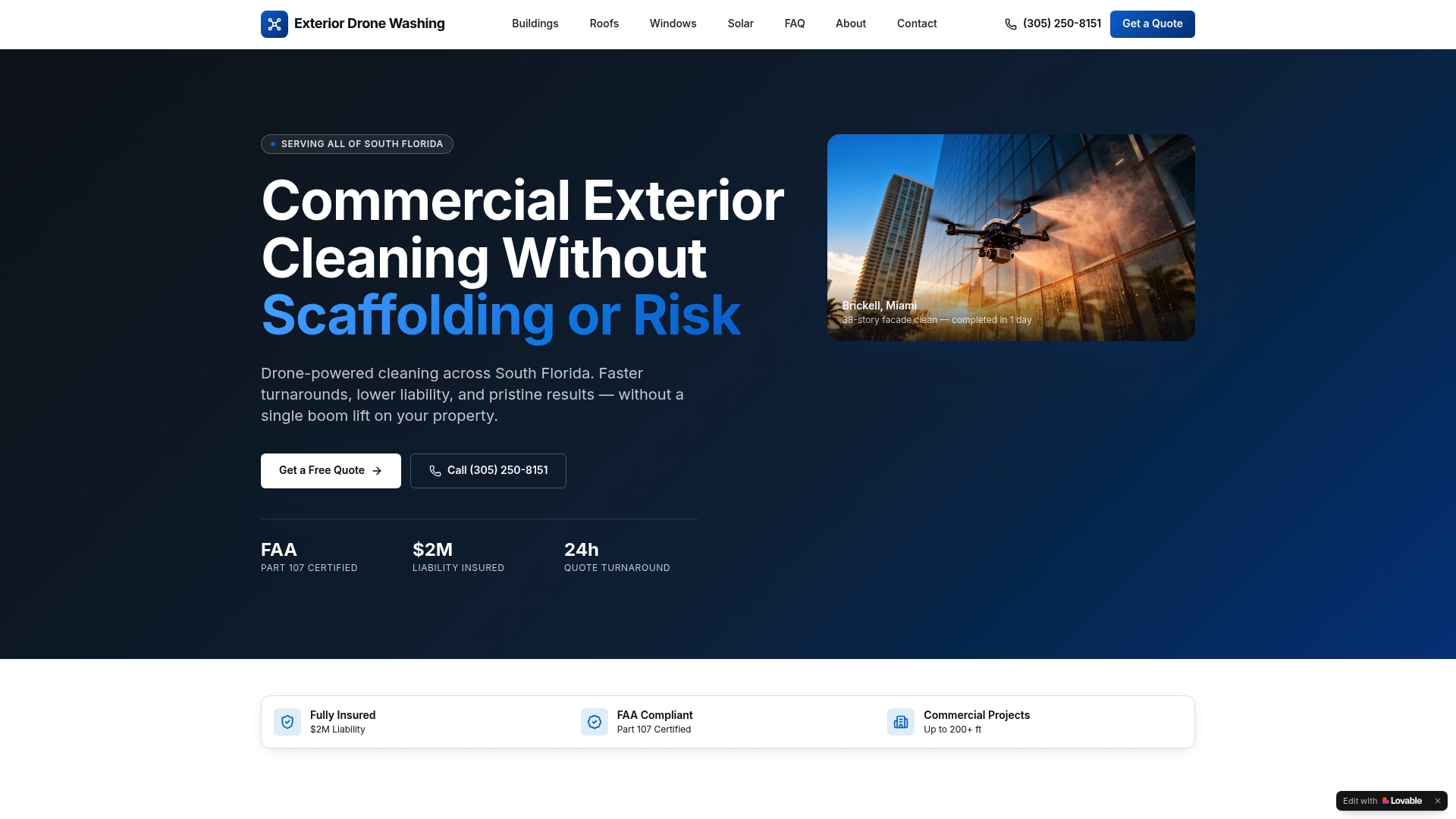
Jobs are documented with before-and-after photos. A fixed price after a free site survey, and timelines that are often a single day, make it straightforward to budget and schedule around tenant operations. For facility teams ready to move from reactive cleaning to a documented maintenance program, drone facade cleaning is the practical next step. Request an on-site survey or RFP response at exteriordronewashing.com/contact.
Useful sources
- Facade Cleaning: Protecting Structural Integrity, Aesthetic and Investment — frequency guidance and preservation case for property managers
- Building Facade Maintenance (Rimkus) — method-by-method technical guidance, test patch protocols, and best practice escalation procedures
- A Conceptual Framework for Pollution-Resilient Aluminium Façades: Introducing the PDM — structural design implications of pollutant exposure for engineers and spec writers
- Photocatalytic Self-Cleaning Coatings for Building Facade Maintenance (36-month field study) — TiO2 coating performance data across cladding substrates
- AGC Facade Glazing Cleaning and Maintenance Guide — glazing manufacturer guidance on permitted chemistries and minimum cleaning frequencies
- Facade Cleaning (RAND Engineering & Architecture) — escalation-from-gentle methodology and historic masonry guidance
- Westminster City Council: Facade Cleaning Guide — authoritative reference on water washing, chemical methods, and post-cleaning maintenance
- Chemical-Resistant Cleaning Equipment Guide (Lightning Cleaning) — equipment and chemical-resistant systems for procurement and spec writers
FAQ
What are the different types of facade cleaning?
The main types are water washing (low-pressure rinse), soft washing with biocidal agents, superheated steam cleaning (DOFF-style), targeted chemical cleaning (acidic or alkaline matched to the contaminant), and abrasive methods reserved for heavy industrial deposits on robust substrates. Preservation-grade work uses the gentlest effective method first.
What is the best thing to wash exterior walls with?
The best approach depends on the substrate and contaminant. For organic growth on sensitive materials, biocidal soft wash or superheated steam is preferred. For efflorescence or metallic stains, a pH-matched chemical cleaner with full neutralization is appropriate. High-pressure water alone is rarely the right answer for preservation-grade work.
How much does facade cleaning cost?
Cost varies by facade area, height and access complexity, contamination severity, method required, and containment and disposal requirements. Drone-based systems can reduce access costs significantly for high-rise buildings compared to scaffolding or suspended platforms.
What chemicals are used to clean facades?
Common chemicals include biocidal agents (for algae, lichen, and mold), alkaline cleaners (for carbon and organic deposits), dilute acidic solutions (for efflorescence and calcium carbonate staining), and pH-neutral surfactants for general soiling. Hydrofluoric acid and strong acids are prohibited on glass; chloride-containing products must not be used on aluminum. Always require SDS sheets for every chemical used on site.
How often should a commercial facade be cleaned?
Glass facades in high-pollution or industrial areas need cleaning at minimum every six months to prevent permanent staining. Masonry in urban environments typically requires annual cleaning, while lower-exposure suburban buildings should be cleaned at least every six months for glass and annually for masonry to prevent long-term damage.