
FAA Proofs Every Buyer Needs in a High-Rise Cleaning Risk Assessment
· Exterior Drone Washing
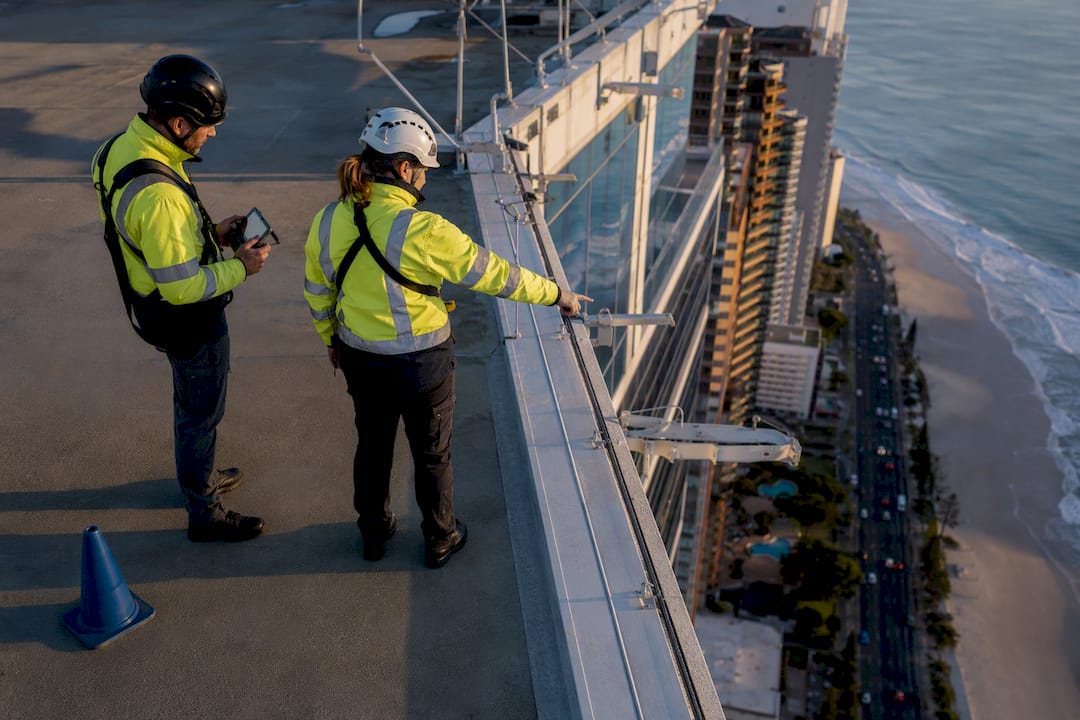
A defensible high-rise cleaning risk assessment for drone-based exterior work proves five things: airspace and pilot certification are current, site hazards and perimeters are mapped, the operator has fail-safe equipment and defined crew roles, an emergency plan exists, and the job ends with photo-verified acceptance paperwork. This article covers drone-based cleaning risk only, not rope-access or suspended-platform work.
TL;DR:
- Drone operators must have current Part 107 certification, aircraft registration, and proper airspace authorizations, especially in controlled areas requiring waivers.
- The risk assessment should identify building-specific hazards like electrical systems, legacy rigging, and surface irregularities, not just generic checklists.
- Ground crews need PPE including eye protection, non-slip footwear, and fall protection when handling manual tasks at height, with documented protocols for safety.
- Airspace waiver processing times can range from near-instant for LAANC to over 60 days for complex requests, impacting project schedules significantly.
- Proper documentation, including preflight forms, authorization proof, maintenance logs, and before-and-after photos, is essential to verify safe job completion.
Table of Contents
- Defining the Scope of a Drone Cleaning Risk Assessment
- What Part 107 and Airspace Rules Should the Vendor Show You?
- What Site Hazards Should the Assessment Identify?
- How Do Crews and Equipment Reduce Operational Risk?
- What Belongs in the Emergency Response Plan?
- What Documentation Confirms the Job Was Done Safely?
- How Exterior Drone Washing Approaches Assessment in Practice
- What Training Do Drone Cleaning Personnel Actually Need?
- What Compliance Applies Beyond FAA Rules?
- How Should Vendors Coordinate With Building Management and Occupants?
- Why Does a Post-Job Review Matter for Future Risk Assessments?
- What Hazards Are Specific to High-Rise Exterior Work?
- What PPE Do Ground Crews Actually Need?
- What Timeline and Cost Signals Should You Expect?
- The Gap Between a Compliance Checklist and a Real Risk Assessment
- How to Request a Risk Assessment From Exterior Drone Washing
- Sources
- FAQ
Defining the Scope of a Drone Cleaning Risk Assessment
Before anyone signs a contract, both sides need to agree on exactly what the assessment covers. A vague scope statement is how disputes happen six weeks later over a scratched panel or a missed corner.
A proper scope document should spell out:
- Assets covered: facade materials (glass curtain wall, EIFS, metal panel, precast), windows, rooftop membranes (TPO, EPDM, metal, tile), and solar arrays
- Height range: the maximum working height the vendor’s equipment reaches from each staging position (Exterior Drone Washing: up to 320 feet, about 29 stories)
- Primary objectives: protecting people and property below, documenting regulatory compliance, and completing the job with minimal tenant or traffic disruption
- Explicit exclusions: rope access, swing-stage rigging, and suspended platform work fall outside this assessment framework entirely
Property managers who skip this step often find themselves comparing bids that aren’t actually comparable, because one vendor quoted the facade only while another included solar arrays. Nail the scope first.
What Part 107 and Airspace Rules Should the Vendor Show You?
Every legitimate drone cleaning operator should be able to produce three things without hesitation: a current remote pilot certificate, current aircraft registration, and a clear answer about which airspace class covers your building.
Part 107 allows routine commercial drone flights for aircraft under 55 pounds, but it flags certain operations that typically require a waiver:
- Flights over people outside the four Subpart D categories
- Beyond visual line of sight (BVLOS) flights
- Beyond visual line of sight (BVLOS) flights
- Controlled airspace near airports, which needs an authorization (LAANC or FAADroneZone) rather than a waiver
If your building sits in controlled airspace, the vendor needs an authorization through LAANC or FAADroneZone. LAANC handles most requests in near-real-time through the UAS Facility Map grid system. FAADroneZone covers manual authorizations and non-LAANC airports, and complex requests sometimes need 60 or more days of lead time. Build that into your scheduling conversation early, not the week before the job.
When a waiver is required, the FAA expects a Waiver Safety Explanation that details the operation, the specific hazards, and how the operator mitigates each one. Ask to see the vendor’s WSE template. A thin, generic document is a red flag; a detailed one that names your building’s specific risks is a good sign the operator has done this before.
What Site Hazards Should the Assessment Identify?
Every high-rise site has its own fingerprint of risk, and a good assessment treats the building as unique rather than running through a boilerplate checklist. Walk the perimeter with your vendor before the quote, not after.
Hazards worth flagging on any pre-job walk-through:
- Pedestrian and vehicle traffic patterns at ground level, including loading docks and valet lanes
- Adjacent structures, power lines, and rooftop equipment (cooling towers, satellite dishes, antenna arrays)
- Wind funneling effects between towers, which can be worse than open-air forecasts suggest
- Scheduled events, pool decks, or outdoor amenity spaces in active use during the job window
Perimeter controls should scale with operational altitude, including planning for site controls and traffic management to keep the area safe during operations. The industry standard for UAV cleaning operations recommends conservative ground-level exclusion zones tied to how high the drone is flying, paired with visible signage and, where needed, temporary traffic control. Weather limits matter just as much: most operators halt work above a set wind threshold and suspend entirely during precipitation or lightning within a defined radius.
Pro Tip: Ask the vendor for their written wind and precipitation thresholds before the job, not during it. An operator who can’t quote a specific number probably doesn’t have one.
How Do Crews and Equipment Reduce Operational Risk?
The equipment and the people running it are where most of the actual risk gets absorbed or created. A risk assessment that doesn’t name specific hardware safeguards and specific human roles is missing its core content.
On the equipment side, look for:
- Emergency stop and automatic return-to-home functions
- Redundant communication links between pilot and aircraft
- Anti-collision lighting for low-light conditions
- Secured payload mounts and calibrated nozzle-distance controls that keep soft-wash pressure consistent against glass and facade materials
On the crew side, a compliant operation typically runs with:
- A remote pilot in command, certificated and responsible for flight decisions
- A dedicated visual observer maintaining line of sight when the pilot’s attention is on controls or the camera feed
- Ground crew managing perimeter, hoses, and water recovery
- A named responsible party who building management can reach directly during the operation
No single person should be running the aircraft, watching the perimeter, and managing water containment simultaneously. Preflight checks, battery rotation logs, and facade-approach corridors that keep the drone at a fixed minimum distance from the building all belong in the written procedure, not just in the pilot’s head.
What Belongs in the Emergency Response Plan?
Ask any vendor one direct question: what happens if the drone loses signal 150 feet up? If the answer is vague, that’s disqualifying.
A written emergency plan should cover:
- Lost-link and flyaway procedures, including the aircraft’s programmed failsafe behavior
- Dropped-object response, including how ground crew clears and secures the area below
- First-aid routing and the nearest medical facility, noted before the job starts, not looked up after
- A chain-of-command contact list with names, roles, and phone numbers, shared with building management in advance
Insurance minimums should be confirmed in writing, and the vendor should know their FAA reporting obligations cold. Serious injury, loss of consciousness, or property damage of $500 or more triggers a mandatory report within 10 days. If a vendor doesn’t know that threshold off the top of their head, that’s worth noting.
What Documentation Confirms the Job Was Done Safely?
Closing out a drone cleaning contract without proper documentation is how invoice disputes drag into a second billing cycle. The paperwork isn’t bureaucratic overhead. It’s the evidence that the risk assessment actually worked.
- Preflight assessment forms covering weather, airspace status, and site conditions on the day of the job
- Screenshots or confirmation numbers from LAANC or FAADroneZone authorizations, plus current pilot certificates
- Equipment maintenance logs and battery cycle records
- Before-and-after photo sets showing facade, window, or solar panel condition, checked for scratches or uneven cleaning
- Wastewater and runoff handling records, especially for jobs using soft-wash chemicals near storm drains
- A signed acceptance form from facilities management confirming the scope was completed
A concise package like this speeds up invoice approval and gives your legal team something concrete if a dispute ever surfaces months later.
How Exterior Drone Washing Approaches Assessment in Practice
Exterior Drone Washing’s FAA Part 107 certified pilots fly industrial drones running soft-wash systems with de-ionized water, capable of reaching facades, roofs, and solar arrays up to 320 feet without putting a worker on a rope or a lift. Before-and-after photo documentation is standard practice, and many jobs that would take a rope-access crew several days compress into a single day. Removing workers from the facade entirely is the mechanism behind that speed. Pilot certificates and insurance certificates are available on request.
What Training Do Drone Cleaning Personnel Actually Need?
A drone hovering next to a 20th-floor window and a rope-access technician suspended from the roof are solving the same cleaning problem with entirely different training pipelines, and a risk assessment should treat those pipelines as separate rather than blending them into one vague “trained personnel” line item.
For the drone side, the remote pilot in command needs a current Part 107 certificate, which requires passing an FAA knowledge test and staying current on recurrent training every 24 months. Beyond the certificate itself, competent operators train pilots specifically on soft-wash payload handling, since flying a camera drone and flying one with a pressurized water system and nozzle assembly attached are different skill sets. Visual observers need training on communication protocols with the pilot, not just “watch the sky.”
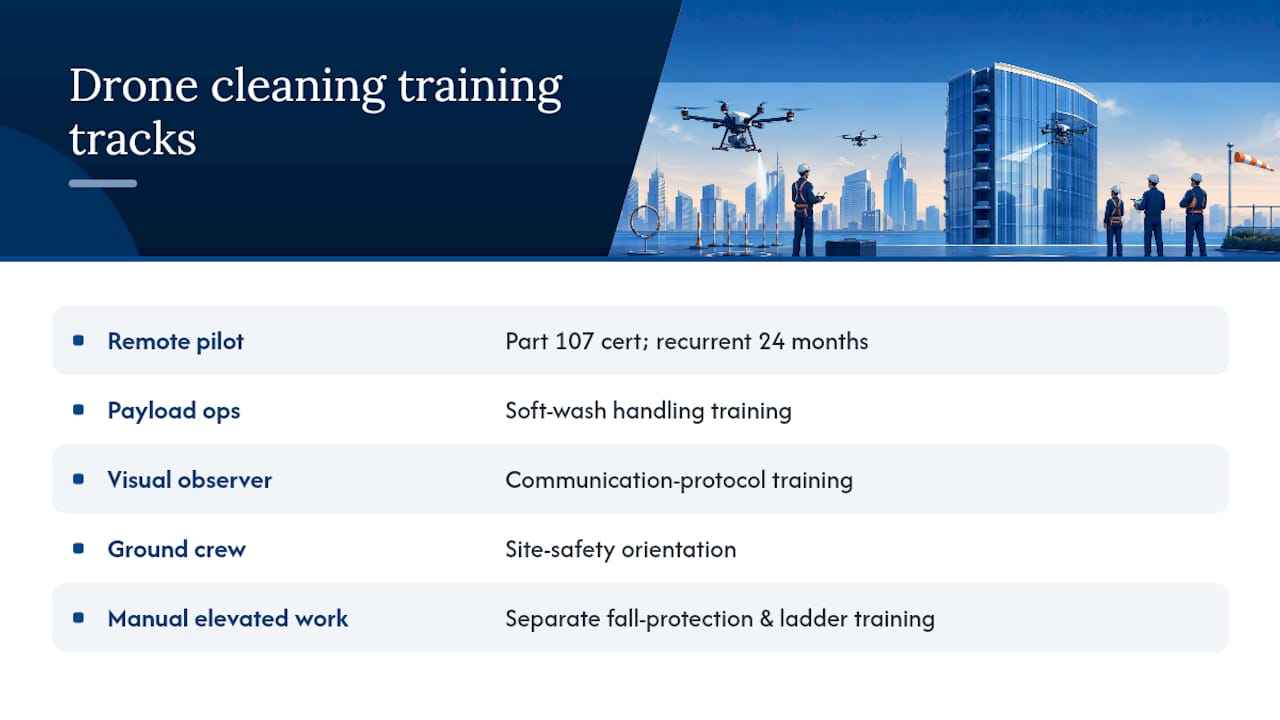
Ground crew handling hoses, water recovery, and perimeter control need site-safety orientation covering electrical hazards, wet-surface footing near the building base, and traffic control basics if the perimeter touches a public sidewalk or roadway.
If a vendor’s crew ever performs any manual high-touch or detail work alongside the drone pass, such as hand-wiping a stubborn stain or checking a solar panel connector, that person needs separate fall-protection and ladder-safety training distinct from the drone operation entirely. Mixing those two skill sets under one training record is a common gap in vendor documentation. Ask specifically whether the crew on your job has ever performed manual elevated work, and if so, request their separate certification for that task.
What Compliance Applies Beyond FAA Rules?
FAA clearance covers the airspace. It says nothing about what happens on the ground, and that’s where OSHA standards, local building codes, and municipal ordinances take over.
OSHA’s general duty clause still applies to any ground crew member, meaning the operator must maintain a workplace free of recognized hazards, from wet pavement near the water recovery station to electrical panels exposed during setup. If any crew member performs elevated manual work as a supplement to the drone job, OSHA’s fall protection standards for elevated work kick in for that specific task, separate from the drone operation itself.
Local building codes matter too, particularly around water discharge. Many municipalities regulate how wastewater and runoff from exterior cleaning can be discharged, especially near storm drains, and a vendor operating without a wastewater handling plan on file may be creating a compliance gap the building owner ends up owning. HOAs and condo associations often layer their own governing documents on top, restricting operating hours or requiring advance notice to residents.
Certificates of insurance should list the building or management company as an additional insured, and the coverage should explicitly address aerial operations, not just general commercial liability. A standard liability policy without an aviation endorsement can leave a real gap. Ask for the endorsement page, not just the declarations summary.
How Should Vendors Coordinate With Building Management and Occupants?
The best risk assessment in the world falls apart if nobody tells the tenants on the 22nd floor that a drone is about to pass their windows carrying pressurized water.
Coordination should start at least a week before the job with written notice to building management covering the date, time window, and affected areas. Buildings with active tenants, whether office towers or condos, benefit from resident or tenant notices posted in common areas and, where practical, sent by email, since a drone hovering outside a window without warning generates far more complaint calls than one that was announced in advance.
On the day of the job, a single point of contact from building management should be reachable for the full operating window, ideally the same person named in the vendor’s emergency contact chain. This avoids the common failure mode where a security guard fields a tenant complaint but has no way to reach the crew.
Building management should also confirm which amenity spaces, walkways, or parking areas need temporary closure, and communicate that internally before the crew arrives rather than discovering the conflict mid-operation. For HOAs specifically, board approval and a resident notification timeline should be settled during the proposal stage, not the week of the job, since association governance documents often require longer notice periods than a typical commercial lease.
Why Does a Post-Job Review Matter for Future Risk Assessments?
The job isn’t actually finished when the drone lands for the last time. The debrief that happens afterward is what makes the next risk assessment sharper than this one.
A structured post-operation review should capture what the preflight assessment predicted versus what actually happened on site, including any wind delays, unexpected obstacles, or tenant complaints that weren’t anticipated. One published trade standard for drone cleaning operations frames this kind of review as a core part of a mature operation, not an optional add-on.
Property managers should request a short written summary after each job: what went according to plan, what deviated, and what the vendor would change for the next visit to the same building. Buildings with recurring maintenance contracts benefit the most here, since a facade’s wind behavior or a particular corner’s pedestrian traffic pattern becomes documented knowledge rather than something the crew has to relearn every quarter.
This is also where insurance claims and FAA-reportable incidents, if any occurred, get formally closed out with documentation attached to the file. A vendor who treats the post-job review as a formality rather than a real feedback loop is signaling that their next risk assessment will look identical to their last one, hazards and all.
What Hazards Are Specific to High-Rise Exterior Work?
Generic risk language doesn’t capture what actually goes wrong on a specific tower, and a serious assessment names the building’s specific hazard profile rather than reusing boilerplate from the last job.
Facade type changes the entire risk calculation. Glass curtain wall systems reflect sunlight in ways that can interfere with a pilot’s visual tracking at certain times of day. Precast concrete and EIFS facades have surface irregularities, ledges, and decorative elements that create unexpected obstacles for a drone flying a close pass. Metal panel systems can carry static charge or reflect radio signals in ways that occasionally interfere with control links, which is why redundant communications matter more on these buildings than on a simple glass tower.
Electrical installations deserve their own line item. Rooftop equipment, satellite arrays, lightning rods, and building-mounted signage often carry live electrical connections that aren’t always mapped on public building plans. A pre-job survey should specifically ask facilities management for as-built drawings showing electrical runs near the facade and roofline.
Legacy window-washer rigging, davit arms, anchor points, and track systems bolted to older buildings, sometimes protrude further from the facade than they appear from ground level and can create unexpected obstacles for a drone flying a tight approach pattern. Even though this article covers drone-based risk rather than rope-access risk, an assessment should still note where that rigging physically sits on the building, since it’s a real object the drone has to fly around. A vendor who has walked the roof and identified every one of these obstacles before flying is doing the job right; one who hasn’t is flying blind on the first pass.
What PPE Do Ground Crews Actually Need?
Nobody on a drone cleaning crew is dangling from a harness at height, but that doesn’t mean the job runs without protective equipment. It just moves the requirement to ground level.
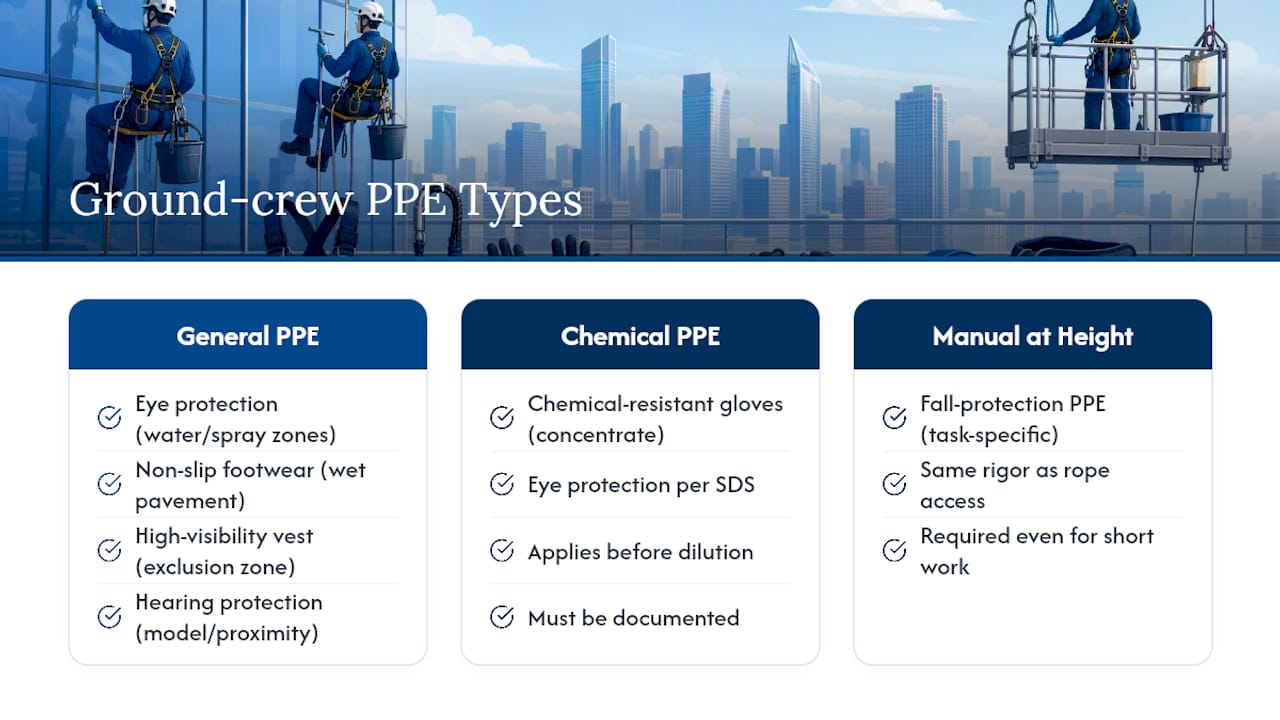
Standard ground crew PPE should include eye protection near the water recovery and spray zones, non-slip footwear given how wet the pavement gets during a wash cycle, and high-visibility vests for anyone working within or near the perimeter exclusion zone. Hearing protection may be warranted depending on the specific drone model and proximity to the operator during high-power soft-wash cycles.
If any crew member handles cleaning solution concentrate before dilution, chemical-resistant gloves and eye protection specific to that product’s safety data sheet apply, separate from the general ground-crew kit. This is a frequently overlooked gap: a crew might have vests and eye protection covered but no documented chemical handling PPE for whoever mixes the solution.
For any crew member performing supplemental manual work at height, whether checking a solar connector or wiping a stubborn spot the drone couldn’t fully clear, fall protection PPE appropriate to that specific task applies with the same rigor as any other elevated work, regardless of how briefly that task takes. A risk assessment that requires fall protection for a rope-access job but skips it for a five-minute manual touch-up during a drone job is applying the safety standard inconsistently, and that inconsistency is exactly the kind of gap an insurer or OSHA inspector will flag.
What Timeline and Cost Signals Should You Expect?
Airspace approval timing is the single biggest variable in scheduling a drone cleaning job, for buildings near airports; most other sites need little or no lead time.
For buildings in uncontrolled airspace or LAANC-enabled grids, authorization often comes through in near-real-time. For buildings requiring a full waiver or manual FAADroneZone submission, complex requests can take 60 or more days, so a building near a major airport or in dense controlled airspace should start that conversation well ahead of the desired cleaning date, not the week before.
Once airspace clearance is in hand, the operational job itself tends to run far faster than traditional methods. Many facade, window, or roof cleaning jobs that would require several days with rope-access or lift crews can often be completed much faster with drone cleaning, due to reduced setup and operational logistics. That compression is also where the cost efficiency shows up: eliminating scaffolding rental, lift mobilization, and multi-day labor scheduling is typically what drives the total project cost down compared to traditional methods.
The trade-off worth flagging honestly: a first-time client working through waiver paperwork on a complex airspace situation should budget lead time into the project calendar, even though the actual cleaning day itself is fast. Building that lead time into your capital planning calendar, rather than treating drone cleaning as a same-week service, avoids the most common scheduling friction property managers run into.
The Gap Between a Compliance Checklist and a Real Risk Assessment
Most vendor “risk assessments” in this space are compliance theater dressed up as safety documentation. They list Part 107 certification, note that insurance exists, and call it done. That’s not a risk assessment. That’s a cover sheet.
A real risk assessment names the specific hazards of your specific building: which corner catches the worst wind funneling, where the electrical runs sit on your roofline, what your municipality requires for wastewater discharge. If a vendor hands you a document that could apply to any building in the country, you haven’t been given an assessment. You’ve been given a template.
The conventional wisdom in this industry treats FAA compliance as the finish line. It’s the entry requirement, not the deliverable. The waiver history and the Waiver Safety Explanation quality matter more than the certificate itself, because they reveal whether an operator has actually thought through failure modes or is simply checking a box. An operator who has navigated a 60-day complex authorization and documented every mitigation in detail has been tested by the process in a way that a routine LAANC approval never tests anyone.
What property managers should prioritize first isn’t price. It’s the paper trail: ask for a sample assessment before you ask for a quote. If the vendor can’t produce one that reads like it was written for a real building rather than pulled from a folder, that tells you more than any bid comparison will.
— Eliot
How to Request a Risk Assessment From Exterior Drone Washing
Getting a real answer on cost and timeline starts with a site walk, not a phone quote. A typical site-specific package before work begins includes a facade and roof plan noting height and material types, airspace authorization status for the building’s location, current pilot credentials, and a before-and-after documentation plan tied to acceptance criteria.
When comparing vendors for an upcoming RFP, ask each one for three things: a sample risk assessment for a building similar to yours, proof of their LAANC or waiver history rather than just a certificate number, and a current certificate of insurance with an aviation endorsement listed. Vendors hesitant on any of those three may warrant further scrutiny.
For facade and window cleaning on towers up to 320 feet, Exterior Drone Washing’s drone facade cleaning service page covers what’s typically included in a proposal, and the drone cleaning company page is the direct path to scheduling a site walk and getting a fixed-price quote for your building’s specific scope. Larger portfolio owners planning phased maintenance across multiple properties should request the site walk first. It’s the fastest way to see whether the airspace timeline and the cleaning window actually line up with your maintenance calendar.
Sources
- Small Unmanned Aircraft Systems (UAS) Regulations (Part 107) | Federal Aviation Administration
- Industry Standard general requirements for drone cleaning operations (EAUAV TSZUAVIA-004-2025)
FAQ
What Does a High-Rise Cleaning Risk Assessment Cover?
It covers regulatory clearance (Part 107, LAANC or waiver status), site-specific hazards and perimeter controls, equipment and crew mitigations, an emergency response plan, and documentation required for job acceptance.
Do All Drone Cleaning Jobs Need an FAA Waiver?
No. Routine operations under Part 107 don’t require a waiver, but flights over people, at night, beyond visual line of sight, or in certain controlled airspace typically do.
How Long Does Airspace Authorization Take?
LAANC authorizations often clear in near-real-time, while complex waiver requests through FAADroneZone can take 60 or more days.
What Documentation Should I Require Before Accepting the Job?
Preflight assessment forms, airspace authorization proof, current pilot certificates, equipment maintenance logs, before-and-after photos, and a signed acceptance form from facilities management.
Is Drone Cleaning Faster Than Traditional High-Rise Methods?
Many jobs that take several days with rope-access or lift crews can compress into a single day with drone cleaning, since there’s no rigging setup or lift mobilization required.