
Facility Managers: Stop Hard Water Stains on Windows with Drone RO/DI
· Exterior Drone Washing
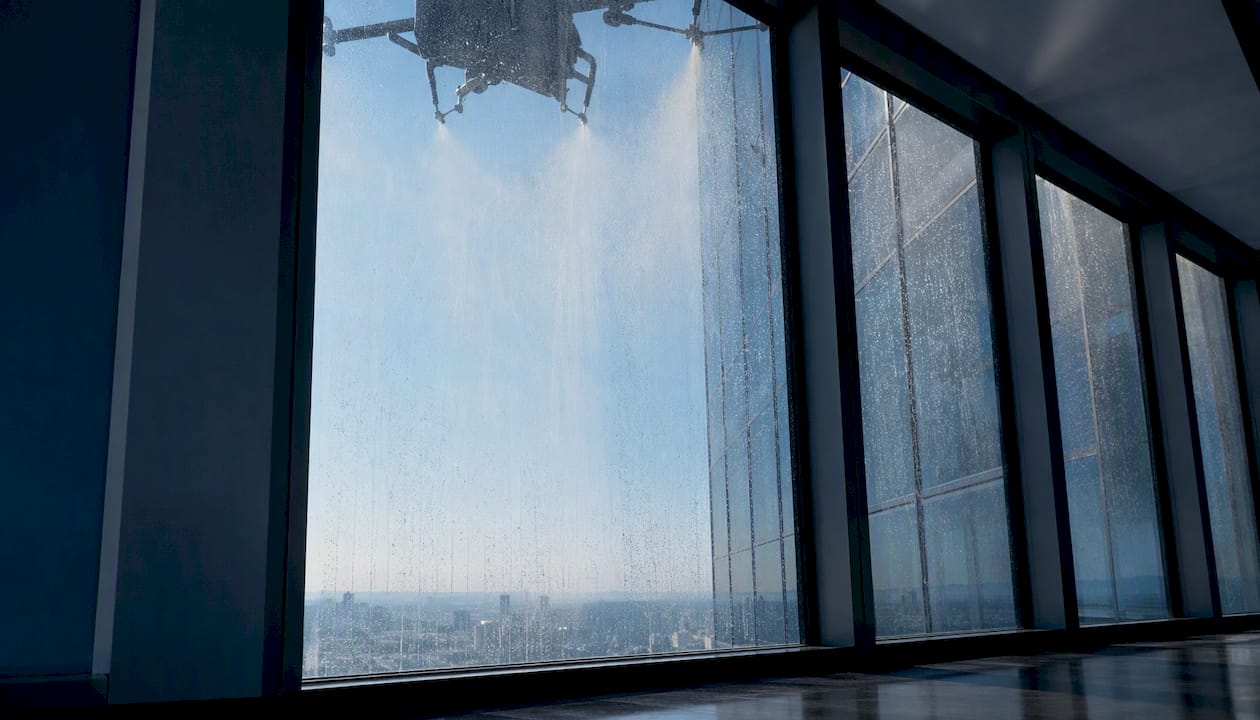
For multi-story windows, a drone-mounted deionized water soft-wash is a fast, low-risk way to remove hard-water mineral film; deposits that have bonded to the glass need separate restoration polishing. This approach clears mineral film without leaving spots, avoids putting workers on ropes or lifts at height, and typically finishes in a fraction of the time traditional access methods require. The sections below cover how to assess your building’s deposits, what a proper vendor workflow looks like, and what to demand in terms of safety proof, cost expectations, and prevention.
TL;DR:
- Drone-mounted deionized water soft-wash can remove mineral deposits at heights up to 320 feet without scaffolding or rope access, reducing time by 30 to 60 percent.
- Fresh mineral films can typically be cleared with a simple RO/DI rinse, while bonded or etched deposits may require additional polishing and restoration.
- Confirm water quality with parts-per-million measurements, ensuring dissolved solids stay below 10 PPM to prevent re-deposits or spotting.
- Proper vendor safety documentation includes FAA Part 107 certification, insurance, exclusion zones, emergency procedures, and safety data sheets for cleaning agents.
- Cost varies based on height, deposit severity, scope, and site logistics, with drone cleaning offering significant efficiency savings over traditional access methods.
Table of Contents
- How Do You Remove Hard Water Stains From Windows on a High-Rise?
- How Do You Know If Windows Need Restoration or Just a Rinse?
- What Does a Professional Drone Cleaning Workflow Look Like?
- What Safety and Regulatory Proof Should You Require From a Vendor?
- What Does Commercial Hard Water Stain Removal Cost?
- How Do You Prevent Hard Water Stains From Coming Back?
- Why Building Owners Underestimate This Problem
- How Exterior Drone Washing Handles Hard-Water Mineral Removal
- Where to Learn More About Pure-Water Cleaning and Drone Systems
- Sources
- FAQ
How Do You Remove Hard Water Stains From Windows on a High-Rise?
For most commercial buildings, deionized (RO/DI) water applied through a drone-mounted soft-wash system is the right first move against hard-water mineral deposits. RO/DI water strips out the dissolved calcium, magnesium, and silica that cause spotting in the first place, so it dries completely clear with nothing left behind to streak the glass. Regular tap water carries those same minerals, which is exactly why it re-deposits the problem it’s supposed to solve.
When deposits are fresh or light, a straight RO/DI rinse is often enough. When minerals have baked onto the surface, glass-safe detergent or light soft-polishing gets added to the sequence before the final rinse.
- Fresh mineral film from sprinklers or irrigation overspray: RO/DI rinse alone
- Cloudy haze that resists a fingernail scratch test: detergent pass, then RO/DI rinse
- Crusted white deposits at sill lines or curtain wall joints: polishing restoration before rinse
Drones extend this method to heights and angles that would otherwise require boom lifts or rope access, and they do it without shutting down sidewalks or disrupting tenants for days at a stretch.
Pro Tip: Ask any bidder whether their water is measured in parts-per-million (PPM) before each job. Anything above 10 PPM dissolved solids risks spotting, no matter how good the drone or nozzle setup is.
How Do You Know If Windows Need Restoration or Just a Rinse?
Not every mineral stain needs the same fix, and guessing wrong wastes budget either way. Run this quick decision sequence before you request quotes.
- Look at the deposit pattern. White, powdery crystalline buildup near sills or below balconies usually means recent hard-water exposure that hasn’t bonded yet.
- Check for etching. Run a fingernail across the haze. If it’s smooth to the touch but visually cloudy, it’s likely surface mineral film. If you feel roughness or pitting, the deposit may have started etching the glass itself, which professional restoration services describe as a lifecycle risk that gets worse the longer it sits.
- Run a test patch. Have the vendor clean a two-foot-square section with RO/DI rinse only and let it dry. Clear glass means proceed with a full rinse job. Persistent haze means you’re looking at restoration.
- Escalate only when needed. If restoration polishing doesn’t fully clear etched glass, replacement becomes the last resort, not the first assumption.
Most buildings never reach step four. A documented test patch before committing to full-scale work protects both sides of the contract and gives you a clean before-and-after baseline.
What Does a Professional Drone Cleaning Workflow Look Like?
A competent vendor follows a repeatable sequence, not an improvised spray-and-hope routine. Here’s what to expect from a well-run job.
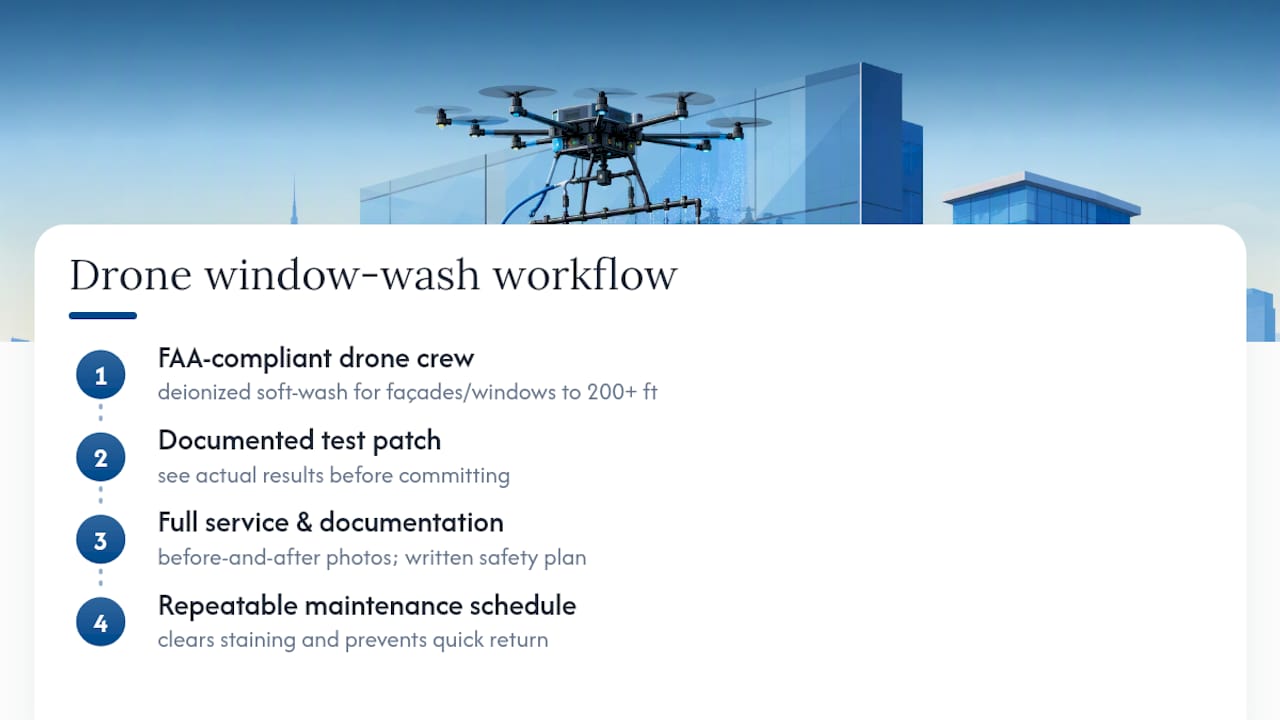
The crew starts with a pre-job survey of the façade, noting glass type, coatings, seal condition, and deposit severity by elevation. A test patch confirms the water quality and pressure settings before any full pass begins. Water sourcing matters here: most commercial jobs run either onboard RO/DI tanks for shorter jobs or tethered hose-fed systems pulling from a ground-based purification unit for continuous, all-day operation on larger façades.
- Ground crew sets up the pump, hose reel, and RO/DI filtration before the drone launches
- Pilot flies a mapped pattern, adjusting nozzle angle and fan spread for each glass section
- Foam or soft-clean agent gets introduced only on sections that failed the test patch
- Final pass is always a straight RO/DI rinse for the spot-free finish
- Crew photographs each elevation before and after for the client file
Tethered systems solve a real limitation of drone cleaning: onboard water tanks run out fast. A 26-story façade cleaning case study in Hangzhou showed that hose-fed delivery from a ground pump kept the drone working continuously instead of cycling down for battery and tank swaps, which is where a lot of traditional job-day estimates go sideways.
Quality control should include a final walk-through comparison against the test patch, not just a visual once-over from the ground.
What Safety and Regulatory Proof Should You Require From a Vendor?
Any vendor flying drones over or near your building needs to hand you paperwork before you hand them a contract, not after.
- FAA Part 107 remote pilot certification for every operator flying the job, plus airspace authorization (LAANC) where the building sits in controlled airspace
- Certificate of insurance naming your property, with commercial general liability limits appropriate to a high-rise job (get the actual number in writing, not a verbal assurance)
- Documented exclusion zones around the flight path to keep pedestrians, tenants, and vehicle traffic clear during operation
- Emergency stop procedures the crew can execute immediately if wind, equipment failure, or a bystander incident occurs
- Safety data sheets (SDS) for any detergent or soft-clean agent used, especially near landscaping, HVAC intakes, or storm drains
A vendor who can’t produce this documentation on request is a liability risk you don’t need to take on, regardless of how good their pricing looks.
What Does Commercial Hard Water Stain Removal Cost?
Pricing swings on a handful of variables, and any quote that doesn’t break these out is worth questioning.
- Height and access complexity: upper floors and setback façades cost more per square foot than ground-accessible walls
- Glass area and deposit severity: a light rinse job prices very differently from full restoration polishing across multiple elevations
- Traffic control and site logistics: sidewalk closures, tenant notifications, and parking restrictions add coordination time
- Restoration scope: mineral crusts that need mechanical polishing take longer per pane than a straight rinse
As a rough benchmark, a small low-rise façade rinse job might run a single day, a typical mid-rise multi-story job spans one to two days, and heavy-deposit restoration across a full curtain wall can stretch to a multi-day project. Because drone delivery eliminates scaffold setup and rope-access rigging time, buildings switching to this method commonly see efficiency and cost savings in the 30 to 60 percent range compared with traditional access methods, largely from labor and mobilization time alone.
How Do You Prevent Hard Water Stains From Coming Back?
Removing the current buildup only solves half the problem. The other half is stopping mineral deposits from reforming on the same schedule.
- Specify water quality in your maintenance contract. Require RO/DI or pure-water systems for every scheduled clean, not just the initial restoration job, since pure water is the preventative standard while spot removers only treat symptoms after the fact.
- Redirect sprinklers and irrigation heads away from façade lines. Overspray hitting windows repeatedly is the most common cause of recurring hard-water film on lower floors.
- Fix drainage and runoff points near rooflines and balconies where mineral-heavy water pools and drips down glass repeatedly.
- Set a maintenance cadence, typically quarterly for standard exposure, more often for buildings near sprinkler zones or hard-water irrigation sources.
Pro Tip: Log which elevations show staining fastest. If it’s always the same three floors, you likely have a fixable irrigation or drainage issue, not a glass problem.
Why Building Owners Underestimate This Problem
Most property managers treat hard-water staining as a cosmetic annoyance until a tenant complaint or a lease renewal forces the issue. That’s backwards. Left alone, mineral deposits don’t stay cosmetic. They etch. And etched glass on a curtain wall isn’t a cleaning problem anymore. It’s a capital expense.
The industry has also been slow to separate “spot remover” products from actual prevention. A chemical spot treatment can clear a bad patch today, but it doesn’t touch the water source causing the problem, so the same panel is cloudy again in six months. Exterior Drone Washing built its process around FAA Part 107 certified pilots, soft-wash systems, and deionized water delivery up to 320 feet, specifically because that combination addresses both problems at once: it clears existing deposits and it’s repeatable often enough to actually prevent recurrence, without putting a crew on ropes every quarter.
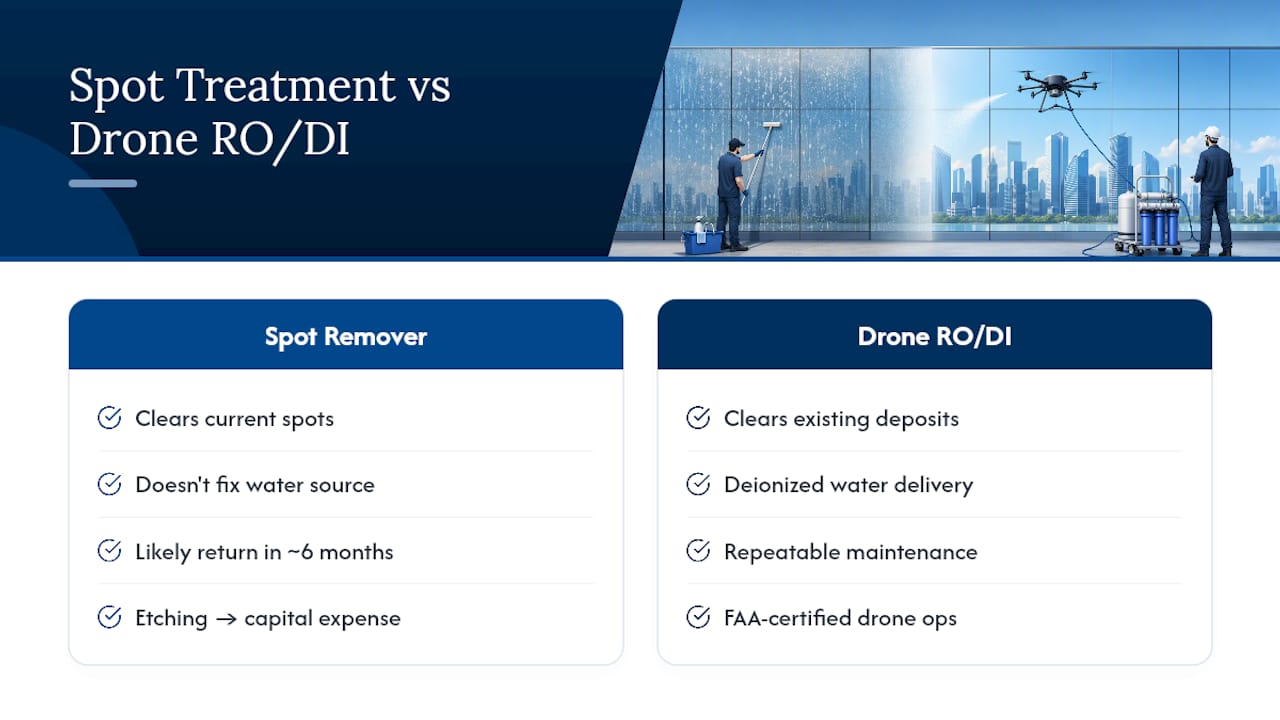
The result buildings actually notice is fewer worker-at-height incidents, faster turnaround, and, per published industry efficiency comparisons, cost savings in the 30 to 60 percent range against scaffold or rope-access jobs.
If you’re vetting a vendor, ask three things before you sign anything: Is this building in controlled airspace, and do you have the authorization? Can I see before-and-after documentation from a job at comparable height? And what water quality, in PPM, will you actually be spraying on my glass?
— Eliot
How Exterior Drone Washing Handles Hard-Water Mineral Removal
Exterior Drone Washing runs FAA-compliant drone crews using deionized soft-wash systems built for façades and windows up to 320 feet, without scaffolding, lifts, or rope crews tying up your building for days.
Every quote starts with a free site survey and a fixed price, and jobs are documented with before-and-after photos. That’s the difference from a spot-treatment contractor: you’re not buying a one-time chemical fix, you’re buying a repeatable process that clears mineral film and can be repeated on a maintenance schedule.
If your building has visible mineral film, cloudy curtain wall sections, or a maintenance contract that’s due for renewal, request a drone window washing quote or ask about a high-rise assessment for your specific façade. Buildings with solar arrays facing similar mineral buildup can also review commercial solar panel cleaning as part of the same site visit.
Where to Learn More About Pure-Water Cleaning and Drone Systems
A few technical resources worth bookmarking if you’re building an RFP or training an in-house facilities team:
- Karcher’s commercial window cleaning know-how covers why pure-water rinsing dries spot-free at a technical level
- Unger’s guide to hard-water spot remover options breaks down short-term chemical fixes versus long-term pure-water prevention
- DroneBase’s drone façade cleaning system page shows the hardware side, including nozzle sets and hose configurations
- Property groups running solar arrays alongside window glass may also find SolarZA’s professional solar panel cleaning guidance useful for parallel maintenance planning
Sources
- Commercial window cleaning — Karcher professional know-how
- Hard water spot remover options when it comes to your windows — Unger
- Case study: battery + hose system revolutionizes façade cleaning — EAUAV
FAQ
What Causes Hard Water Stains on High-Rise Windows?
Dissolved calcium, magnesium, and silica in tap water or irrigation runoff dry on the glass surface and leave behind a mineral film that clouds the pane over time.
Can Hard Water Stains Be Removed Without Scaffolding?
Yes. Drone-mounted deionized water soft-wash systems reach façades up to 320 feet without scaffolding, lifts, or rope access crews.
Is Deionized Water Better Than Regular Tap Water for Window Cleaning?
Yes. RO/DI water has the dissolved minerals removed, so it dries completely clear, while tap water carries the same minerals that cause spotting in the first place.
How Long Does a Commercial Mineral Removal Job Take?
Timelines vary by height, glass area, and deposit severity. A small façade rinse can finish in a single day, while heavy-deposit restoration across a full curtain wall may take multiple days.
What Should Be in a Drone Cleaning Vendor’s Safety Documentation?
Require FAA Part 107 remote pilot certification, a certificate of insurance with adequate liability limits, documented exclusion zones, and safety data sheets for any cleaning agents used.