
Drone Operations Over People: U.S. FAA Rules and 4 Category Docs
· Exterior Drone Washing

Yes — under FAA Part 107 Subpart D, you may operate small drones over people when the aircraft and mission qualify for Category 1 through 4. The remote pilot still has to confirm category eligibility, keep proof of compliance on hand, and verify Remote ID status before flying. Anything causing serious injury or property damage of $500 or more has to be reported to the FAA within 10 days.
TL;DR:
- Drones in categories 2 and 3 require manufacturer declarations and impact testing to meet injury thresholds of 11 and 25 foot-pounds respectively.
- Remote ID must be functioning and verified before any sustained flight over crowds, regardless of category compliance.
- Flying over moving vehicles is only permitted within restricted sites or if the flight is not sustained over the vehicles, with proper signage and permission.
- Reporting incidents involving injuries or property damage of $500 or more must occur within 10 days, with comprehensive documentation to avoid enforcement actions.
- Pre-flight checks include verifying category classification, Remote ID status, labeling, insurance, and having all compliance paperwork readily accessible.
Table of Contents
- Why the FAA Replaced Waivers With Categories
- Categories 1 Through 4: What Each One Actually Requires
- Remote ID Rules for Flying Over Crowds
- Operating Over Moving Vehicles and Closed Sites
- When and How to Report an Incident
- Proving Compliance: Declarations, Labels, and Manuals
- Pre-Flight Checklist for Missions Over People
- Safety Protocols That Actually Reduce Risk
- Legal Exposure When Something Goes Wrong
- Insurance Coverage Operators Actually Need
- Training That Goes Beyond the Part 107 Test
- Drone Design Features That Make Flying Over People Safer
- What Compliant Contractors Actually Do Before Every Job
- A Compliant Alternative for Commercial Exterior Work
- Where to Verify These Rules Yourself
- Sources
- FAQ
Why the FAA Replaced Waivers With Categories
Before 2021, flying a drone over a crowd usually meant applying for a Part 107 waiver and waiting on the FAA to review your specific mission. That process was slow, and it didn’t scale as commercial drone use expanded into cities, stadiums, and construction sites. The Operation of Small Unmanned Aircraft Systems Over People final rule changed the approach entirely, replacing most individual waivers with four standing categories tied to aircraft design and risk level.
The logic is simple: instead of the FAA approving each flight, manufacturers and operators now document that their aircraft meets a defined safety threshold, and that documentation becomes the operator’s proof of legal flight.
That said, qualifying for a category doesn’t erase your other Part 107 duties. Two rules still apply on every flight, regardless of category:
- §107.19 requires the remote pilot to ensure the aircraft poses no undue hazard to people or property, even mid-flight.
- §107.39 governs the specific mechanics of flying over human beings and moving vehicles, and it works alongside whichever category your drone falls under.
Category compliance is the entry ticket. Ongoing judgment is what keeps you legal once you’re in the air.
Categories 1 Through 4: What Each One Actually Requires
The four categories scale with the drone’s potential to hurt someone on impact, and the thresholds are specific enough that guesswork gets operators in trouble.
Category 1 covers drones weighing 0.55 pounds or less, including any payload, with no exposed rotating parts capable of lacerating skin. No FAA declaration is required here. It’s the simplest tier, but sustained flight over open-air assemblies still triggers Remote ID rules, which trip people up constantly.
Category 2 allows heavier drones that meet a performance-based injury threshold: they can’t be capable of causing injury with a severity of more than 11 foot-pounds of force on impact. Manufacturers must label the aircraft, provide remote pilot operating instructions, and file a Declaration of Compliance.
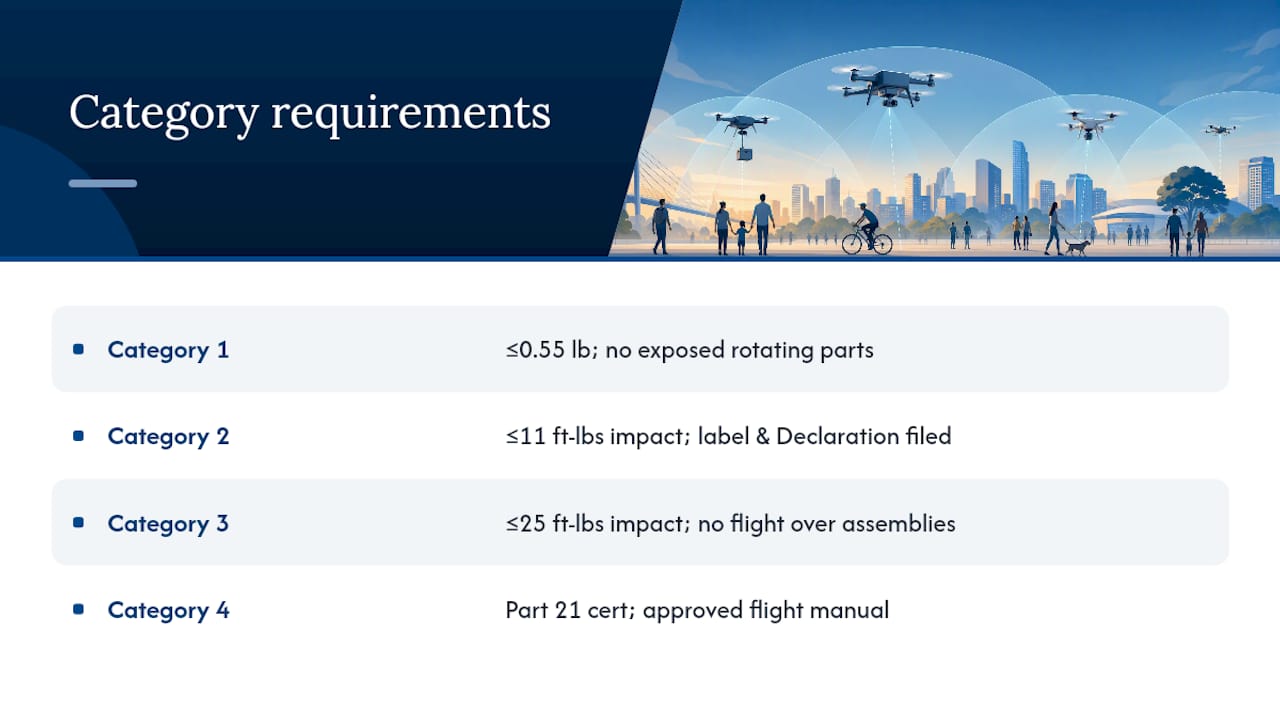
Category 3 raises that ceiling to 25 foot-pounds, but the tradeoff is heavier operating restrictions. Category 3 aircraft cannot fly over open-air assemblies of people, and the manufacturer’s declaration has to be accepted and listed by the FAA.
Category 4 is different in kind, not just degree. It requires a Part 21 airworthiness certificate, and the aircraft’s approved flight manual dictates exactly what operations over people are allowed.
Compliance callout: Category 2 and 3 thresholds (11 ft-lbs and 25 ft-lbs) are performance-based injury limits, not simple weight caps. A common mistake is assuming propeller guards or a “consumer-looking” frame automatically qualifies a drone for Category 1 — only weighing 0.55 pounds or less with no exposed rotating parts that could lacerate skin does that.
Remote ID Rules for Flying Over Crowds
Remote ID acts like a digital license plate for your aircraft, and it becomes a gating requirement the moment you plan sustained flight over an open-air assembly. There are three compliance paths:
- Standard Remote ID built into the aircraft, broadcasting identification and location automatically.
- Broadcast module attached to an aircraft that lacks built-in Remote ID, transmitting the same data externally.
- FRIA operation, meaning the flight happens inside an FAA-Recognized Identification Area, where Remote ID broadcast isn’t required.
Category 1 and 2 aircraft (and Category 4 where its flight manual allows) need functioning Remote ID before sustained flight over an open-air assembly is legal; Category 3 aircraft may not fly over assemblies at all.
Pro Tip: Test your Remote ID broadcast on a receiver app before every job near a public gathering. A dead module or a firmware bug can ground an otherwise fully compliant mission, and finding that out mid-flight is worse than finding out in the parking lot.
Operating Over Moving Vehicles and Closed Sites
Flying over moving vehicles is allowed under the same category framework, but only when the operation stays within a closed or restricted-access site, or the flight is not sustained over the vehicles. Open public roads are a different story entirely.
Documenting a closed site matters more than most operators realize:
- Post visible signage marking the restricted-access boundary.
- Brief anyone on-site (tenants, maintenance crews, security) before the flight starts.
- Get written permission from the property manager confirming restricted access.
For commercial jobs like facade or window cleaning, this typically means coordinating with building management to limit foot traffic near the work zone during the flight window.
When and How to Report an Incident
Reporting isn’t optional once certain thresholds are crossed, and missing the window is its own violation on top of whatever caused it.
- Determine if the threshold is met: serious injury, loss of consciousness, or property damage of $500 or more.
- File within 10 days of the incident, not 10 business days.
- Include the date, location, aircraft registration, injuries or damage, and a factual description of what happened.
Property damage claims tied to construction and facility work are common enough that industry safety data consistently shows documentation gaps, not the incidents themselves, as the biggest driver of enforcement action. Operators who can’t produce a compliance packet after an incident face harder scrutiny than operators who can.
Enforcement usually doesn’t start with the accident. It starts with an operator who can’t produce paperwork, didn’t report on time, or was flying carelessly regardless of category status.
Proving Compliance: Declarations, Labels, and Manuals
An inspector or a nervous property manager will ask for paperwork, not a verbal assurance. Keep these together as one packet:
- Declaration of Compliance (DOC), filed by the manufacturer for Category 2 or 3 aircraft, stating the aircraft meets its injury threshold.
- Physical labeling on the aircraft matching the DOC, plus remote pilot operating instructions available at time of sale or transfer.
- Part 21 airworthiness certificate and flight manual for Category 4 aircraft, spelling out exactly what’s permitted over people.
Pro Tip: Photograph your aircraft’s label and keep a digital copy of the DOC on your phone before every job. If a property manager or FAA inspector asks for proof mid-project, pulling it up in seconds looks a lot better than promising to email it later.
Reviewing the flight manual matters more for Category 4 than people expect. A single limiting sentence buried in the manual can prohibit exactly the operation you planned, even with an active airworthiness certificate.
Pre-Flight Checklist for Missions Over People
Run this before every job that puts a drone anywhere near occupied space:
- Confirm the aircraft’s category and re-check the weight and payload math yourself.
- Inspect for exposed rotating parts that could break skin on contact.
- Verify Remote ID is broadcasting or confirm FRIA status.
- Confirm labeling matches the Declaration of Compliance on file.
- Assign a visual observer for any flight near foot traffic.
- Set a conservative altitude and a contingency landing zone away from people.
- Confirm insurance coverage applies to the specific job site and aircraft.
- If any answer is uncertain, pause and get compliance advice before flying.
Safety Protocols That Actually Reduce Risk
Category compliance sets the legal floor. Real risk reduction happens in the operational details that Part 107 doesn’t spell out line by line.
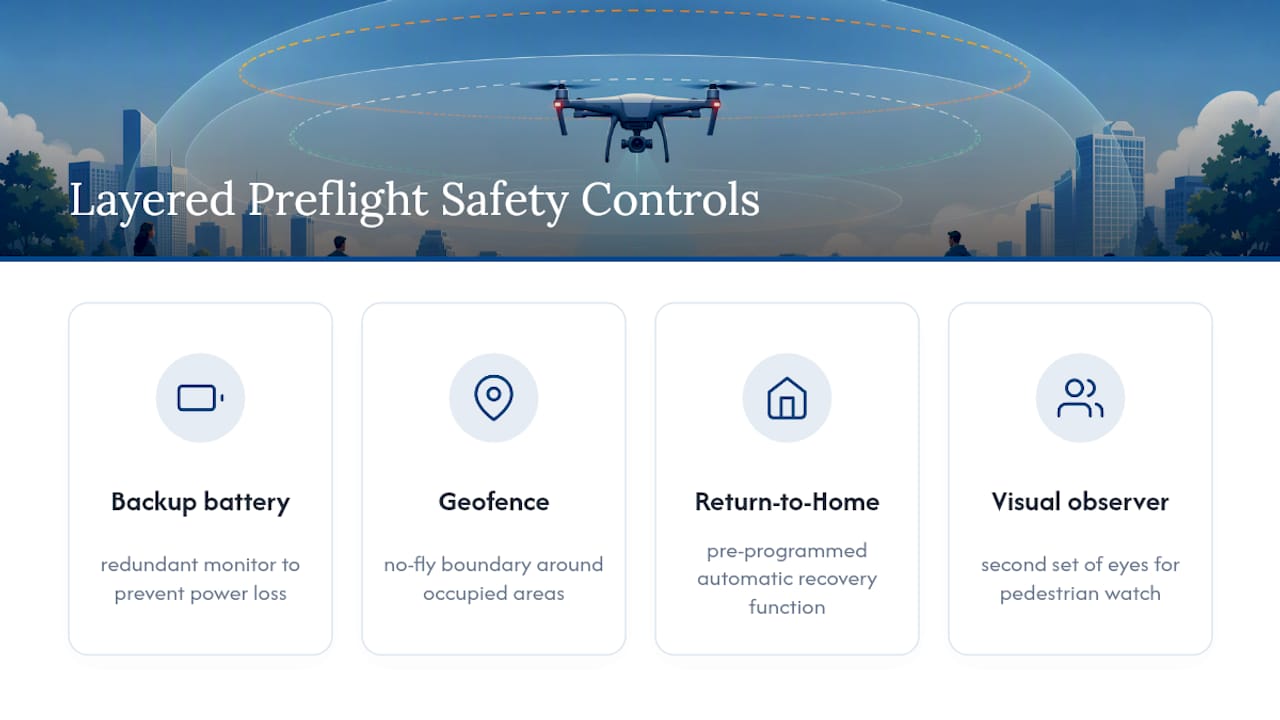
Redundant systems matter more than most new operators assume. A drone with a backup battery monitor, a geofenced no-fly boundary around occupied areas, and a pre-programmed return-to-home function gives the pilot multiple chances to prevent a bad outcome before it happens. Visual observers add a second set of eyes specifically to watch for pedestrians entering the flight path, something a single pilot focused on the aircraft can miss.
Altitude choices deserve more thought than “as high as legally allowed.” Lower, slower passes near a building facade often carry less kinetic risk than a faster pass at a greater height, because impact force scales with speed, not just distance.
Weather discipline is where a lot of otherwise careful pilots get careless. Wind gusts that are survivable over an empty lot become a real hazard over a sidewalk or a rooftop crew. Building a hard wind-speed cutoff into your pre-flight checklist, and actually respecting it, removes the temptation to push through marginal conditions on a tight schedule.
For work involving occupied buildings or active job sites, Exterior Drone Washing’s risk mitigation guide walks through mitigation steps specific to structures and construction environments, where the margin for error tends to be thinner than open-field flying.
Legal Exposure When Something Goes Wrong
Category compliance protects you from a federal violation. It doesn’t protect you from a civil lawsuit if your drone drops on someone’s car or a person gets hurt.
Liability in drone incidents typically runs on ordinary negligence principles: did the pilot exercise reasonable care given the conditions? A pilot who followed every Part 107 rule but flew in high winds over a crowded sidewalk anyway can still be found negligent in civil court, even with a clean FAA record.
Commercial operators carry more exposure than hobbyists, both because clients expect a higher standard of care and because contracts often shift liability explicitly. A property management contract that doesn’t address drone incident liability leaves both parties guessing about who pays for damage, which is a bad position for either side to be in after the fact.
Documentation is your best legal defense, not just your regulatory one. A pilot who can produce a pre-flight checklist, weather log, and Remote ID confirmation from the day of an incident has a much stronger position than one who can’t, regardless of how the FAA ultimately rules on the reporting side.
Insurance Coverage Operators Actually Need
Standard general liability policies frequently exclude aircraft operations entirely, which catches commercial operators off guard when they assume their existing business coverage extends to drone work. It usually doesn’t without a specific endorsement.
Drone-specific liability coverage is the baseline for anyone flying over people commercially. Coverage amounts of $1 million per occurrence are common in commercial contracts, particularly for work near high-value property like building facades, solar arrays, or public infrastructure. Hull coverage, which protects the aircraft itself, is separate from liability coverage and worth carrying if the drone represents a real capital investment.
Property managers hiring drone contractors should ask for a certificate of insurance naming them, or the property, as an additional insured before work begins. That single request closes a gap that causes real disputes after an incident: without it, the property owner has no direct claim against the contractor’s policy.
Insurance requirements also intersect with category status. A contractor operating Category 3 aircraft near occupied buildings carries more inherent risk than one on Category 1 equipment, and insurers increasingly price policies accordingly. Ask any drone contractor what category their fleet operates under before assuming their coverage matches the job.
Training That Goes Beyond the Part 107 Test
Passing the Part 107 knowledge test qualifies you to fly commercially. It doesn’t teach you how to fly safely over people, and the gap between those two things is where most incidents happen.
Recurrent training matters because airspace rules, Remote ID requirements, and category classifications have all changed materially since the Subpart D rule took effect. A pilot who certified years ago and never revisited the regulations is operating on outdated assumptions about what’s legal.
Manufacturer-specific training on the exact aircraft being flown matters just as much as regulatory knowledge. Weight limits, exposed rotating parts, and category classification are all specific to that aircraft’s build, not a general Part 107 concept a pilot can apply loosely across different drones.
For operators working near buildings, crews, or tenants, hands-on training in confined-space flying and emergency landing procedures closes a gap that classroom study alone can’t. Commercial contractors serious about this work typically build a documented training record for every pilot on staff, covering both the regulatory side and the aircraft-specific side, so a new hire or a client can see exactly who is qualified for what.
Drone Design Features That Make Flying Over People Safer
Regulatory categories exist because of physical risk, and the aircraft’s design determines how much of that risk it carries into the air.
Parachute recovery systems are becoming a common feature on commercial-grade drones intended for over-people work. A functioning parachute can turn a free fall into a controlled descent, directly reducing the impact force that Category 2 and 3 thresholds are built around. Some systems trigger automatically on loss of control or critical battery failure, others require manual pilot activation.
Frame design matters just as much as any add-on system. Enclosed rotor guards, softer frame materials, and lower overall mass all reduce the kinetic energy a drone delivers on impact, which is exactly what the foot-pound thresholds in Categories 2 and 3 are measuring.
Redundant flight controllers and dual-battery systems reduce the odds of the kind of total power loss that turns a controlled landing into a fall. For high-value commercial work, like inspecting a facade or cleaning a solar array near tenants, that redundancy is often what separates equipment built for over-people operations from equipment that merely happens to be light enough to qualify.
What Compliant Contractors Actually Do Before Every Job
Commercial drone contractors who take this seriously build a repeatable process: confirm the aircraft’s category, verify pilot certification and insurance are current, and pull the Declaration of Compliance and Remote ID status before the crew ever leaves the shop.
Property managers hiring a drone contractor should ask for that proof upfront, not after signing a contract. A contractor who can hand over a DOC, current insurance certificate, and Remote ID confirmation without hesitation has clearly done this before. One who can’t produce it quickly probably hasn’t.
— Eliot
A Compliant Alternative for Commercial Exterior Work
Property managers weighing scaffolding, lifts, or rope access against drone-based cleaning are really weighing crew risk against paperwork. Exterior Drone Washing cleans facades, windows, roofs and solar arrays by drone across the United States, and settles the compliance questions above (pilot certification, Remote ID, insurance, documentation) before the crew arrives on site.
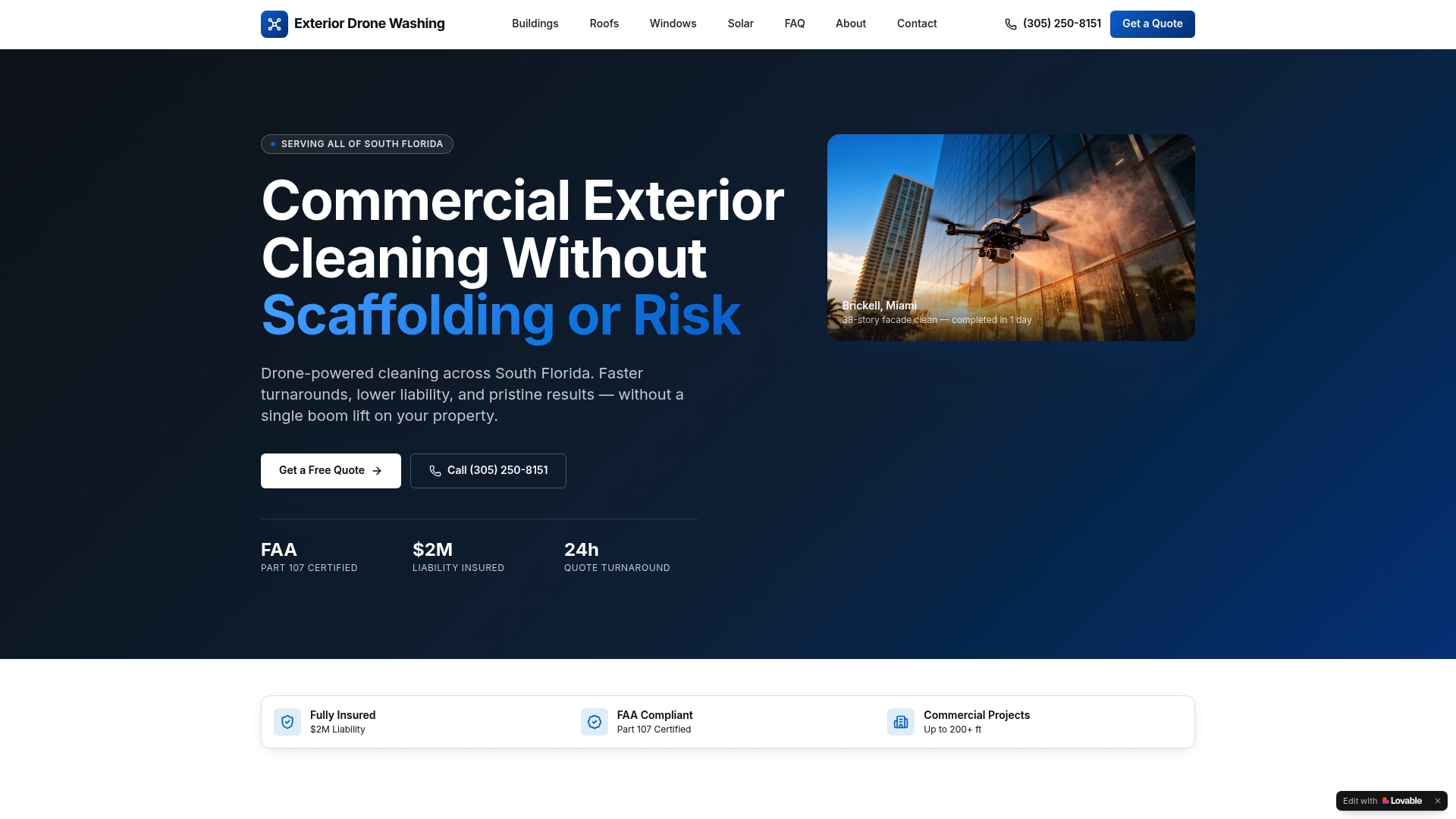
For buildings up to 320 feet, that compliance-first approach translates into a faster job with no workers suspended over a sidewalk or parking lot. Jobs are documented with before-and-after photos, and proof of insurance and pilot certification is available on request. Explore the drone facade cleaning service or request a quote through the commercial cleaning page to see current pricing and scheduling for your property.
Where to Verify These Rules Yourself
Confirm current requirements directly: the FAA Operations Over People overview, the Federal Register final rule, and 14 CFR Part 107 Subpart D on eCFR.
Sources
- Operation of Small Unmanned Aircraft Systems Over People — Federal Register final rule
- 14 CFR Part 107 - Subpart D - Operations Over Human Beings | eCFR
- Small Unmanned Aircraft Systems (UAS) Regulations (Part 107) | Federal Aviation Administration
FAQ
Can You Legally Fly a Drone Over People?
Yes, when the aircraft and operation qualify under Category 1 through 4 of Part 107 Subpart D, and Remote ID requirements are met where applicable.
Can You Fly Drones Over Crowds of People?
Only under specific conditions: Category 1 and 2 aircraft can fly over open-air assemblies with proper Remote ID, while Category 3 aircraft are prohibited from open-air assemblies entirely.
Do I Need an FAA Waiver to Fly Over People?
Not if your aircraft meets one of the four Subpart D categories. Waivers are still needed for operations that fall outside all four category conditions.
Can You Stop Someone From Flying a Drone Over Your Property?
Federal law governs airspace and drone operations, but you can restrict access to your physical property, which is why compliant commercial contractors document permission and site access before flying over private buildings.
What Happens if a Drone Injures Someone or Damages Property?
The operator must report the incident to the FAA within 10 days if there’s serious injury, loss of consciousness, or property damage of $500 or more.