
7 Contractor COI Checks U.S. Owners and GCs Must Run
· Exterior Drone Washing

A contractor COI, almost always the ACORD 25 form, is a one-page proof of coverage summarizing active insurance policies. It is not the policy itself. The single compliance step that separates real protection from a false sense of security is confirming the required endorsements exist and are backed by endorsement pages, not just referenced in the description box.
TL;DR:
- Confirm that endorsed coverage pages, especially for ongoing and completed operations, are attached to avoid gaps in long-term defect claims.
- Ensure the legal entity name, project dates, and certificate holder details exactly match the contract before requesting a COI.
- Verify endorsements such as CG 20 10, CG 20 37, CG 24 04, and CG 20 01 are actual attached pages, not just references in descriptions.
- Regularly track and re-verify pilot and specialty vendors’ certificates, especially for height risks like drone work, with additional documentation beyond standard policies.
- Conduct independent calls to the issuing broker using sourced contact info to confirm policy validity and carrier rating before mobilization.
Table of Contents
- What Contractor COI Requirements Actually Cover
- COI Policy Details: Fields, Coverages, and Typical Limits
- Endorsements That Actually Determine Whether You’re Protected
- Getting a COI Issued Without Losing a Week to Paperwork
- Verifying a COI: The Checklist That Catches Real Problems
- Keeping COIs Current Without Losing Track
- Vetting Specialty Vendors: What a Standard COI Doesn’t Cover
- Do COI Requirements Change by State or Project Type
- Handling Subcontractor COIs and Flow-Down Requirements
- A Practical COI Review Template for Owners and GCs
- Why Strict COI Checks Protect Budgets, Not Just Paperwork
- Drone Cleaning With Part 107 Pilots and Documented Insurance
- Where to Confirm Forms and Endorsement Standards
- Sources
- FAQ
What Contractor COI Requirements Actually Cover
A COI does one job: it tells whoever requested it that a contractor’s insurance is active, and roughly what it covers. The ACORD 25 form is the industry standard, and it summarizes General Liability, Workers’ Compensation, and Commercial Auto coverage on a single page. It is a summary document produced by a broker, not the insurance contract itself, and that distinction trips up plenty of otherwise careful project managers.
On a typical commercial job, several parties will ask for one before a contractor sets foot on site:
- Property owners and asset managers, before signing a service agreement
- General contractors, before allowing a subcontractor to mobilize
- Municipal permitting offices, for certain licensed trade work
- Lenders, as part of construction loan conditions
- Property management companies, as a condition of the lease or access agreement
A COI request usually shows up at one of four moments: bid submission, contract award, lease signing, or permit application. Miss any of them, and the project stalls while a broker scrambles to issue paperwork under deadline pressure.
COI Policy Details: Fields, Coverages, and Typical Limits
Every ACORD 25 form follows the same layout, and knowing what each field means saves time when you’re staring at one under deadline pressure. The producer (broker) and insured entity appear at top, followed by a grid of coverage lines, each listing the insurer, policy number, effective and expiration dates, and dollar limits. The description box, often overlooked, is where endorsement language and project-specific wording actually live. The certificate holder field at the bottom names whoever requested the COI, but that name alone does not confer any legal rights.
Commercial construction contracts typically require four coverage types, and the limits scale with project risk. The four are general liability, workers’ compensation, commercial auto and umbrella.
High-rise, structural, or specialty trade work often pushes GC’s umbrella requirements to higher limits. A construction risk checklist is worth keeping handy, since baseline limits shift with contract size, building height, and the client’s own insurance requirements for contractors on that specific job.
Endorsements That Actually Determine Whether You’re Protected
Limits get the attention, but endorsements do the real legal work. An endorsement modifies the base policy to extend, restrict, or clarify coverage, and four of them show up constantly in contractor insurance requirements:
- Additional insured, ongoing operations (CG 20 10): adds the project owner or GC as an insured party while work is in progress.
- Additional insured, completed operations (CG 20 37): extends that same protection after the job wraps, covering defect claims that surface months or years later.
- Waiver of subrogation (CG 24 04): stops the contractor’s insurer from suing the additional insured to recover a paid claim.
- Primary and non-contributory (CG 20 01): forces the contractor’s policy to pay first, ahead of the owner’s own insurance, in a shared claim.
Each one has a documented purpose and a specific form number that any competent broker recognizes immediately. Skip CG 20 37 and a subcontractor’s coverage might lapse before a roof leak from their work shows up eighteen months later, leaving the owner exposed. Long-tail defect exposure on multi-year projects is where per-project aggregate limits matter most, since a single large claim can otherwise erode the annual aggregate for every other project the sub is working.
Pro Tip: Never accept a COI where the description box just says “additional insured as required by contract.” Ask for the endorsement form number in writing, then request the actual endorsement page.
Getting a COI Issued Without Losing a Week to Paperwork
Most delays on the contractor side come from incomplete information reaching the broker, not from insurer slowness. Give your broker these four things upfront:
- The exact legal entity name as it appears on your contract, not a DBA or shortened version.
- The full insurance exhibit language from the contract, copied verbatim.
- Project start and end dates.
- The certificate holder’s exact legal name and address.
Standard COIs without endorsements typically issue same day. Endorsement requests, especially CG 20 37 completed operations, often take longer and sometimes carry a small per-certificate fee. If your business regularly works with the same GCs, ask your broker about a blanket additional insured endorsement at renewal. It usually costs less annually than paying per-certificate fees project after project, and it means you’re never waiting on a broker the day before mobilization.
Verifying a COI: The Checklist That Catches Real Problems
A COI that looks clean on the surface can still hide a gap. Owners and GCs who verify properly follow roughly the same sequence every time:
- Match the legal entity name on the COI against the signed contract, word for word.
- Call the issuing broker or carrier directly using contact information you look up independently, not the number printed on the certificate.
- Request the actual endorsement pages for every required endorsement, not just a reference in the description box.
- Confirm the carrier’s AM Best rating meets your contract’s minimum, usually A- or better for larger projects.
- Check that policy effective and expiration dates cover the full project timeline.
Rejections cluster around a handful of causes:
| Rejection reason | Fix |
|---|---|
| Legal name mismatch | Request a corrected COI from the broker before work starts |
| Endorsement referenced but not attached | Demand the endorsement page directly from the carrier |
| Policy expires mid-project | Require a renewal COI dated before the current one lapses |
| Limits below contract minimum | Request an umbrella endorsement or reject the bid |
When a COI fails review, the decision is binary: stop work until it’s fixed, or formally document that leadership accepted the risk knowingly. There is no safe middle ground where work proceeds on a verbal promise that “the paperwork is coming.” A partner guide on verifying contractor insurance walks through the same verification call script property managers use before granting site access.
Keeping COIs Current Without Losing Track
Insurance lapses quietly. A contractor’s policy expiring mid-project rarely comes with a warning, which is why tracking has to be proactive rather than reactive.
- Set renewal alerts at 30, 14, and 3 days before every policy expiration date on file.
- Re-verify endorsements at each renewal. A renewed COI doesn’t automatically carry forward the same endorsements from the prior term.
- Keep a centralized file with the COI, every endorsement page, and the broker’s contact information for each active subcontractor.
Pro Tip: A spreadsheet works fine for a handful of subs. Past roughly fifteen to twenty active vendors, a dedicated COI management platform pays for itself in avoided lapses and audit-ready recordkeeping.
Vetting Specialty Vendors: What a Standard COI Doesn’t Cover
Specialized work often needs proof that goes beyond the standard contractor COI. Drone-based exterior cleaning is a clear example: the equipment, airspace rules, and elevated work all carry risk profiles a generic CGL policy doesn’t fully address.
Before hiring a vendor doing elevated or specialty work, ask for:
- FAA Part 107 documentation and operator certifications, alongside the standard COI.
- An equipment floater or scheduled equipment endorsement covering the drones and gear themselves.
- Before-and-after documentation practices, which double as a paper trail if a dispute arises.
- Higher per-project aggregate limits when the work involves height, sensitive facades, or occupied buildings, since one large claim shouldn’t be able to erode coverage across every other job on the vendor’s book.
Avoiding scaffolding for high-rise cleaning removes worker-at-height exposure entirely, but that only reduces your liability if the vendor’s insurance and FAA compliance are verified up front, not assumed.
Do COI Requirements Change by State or Project Type
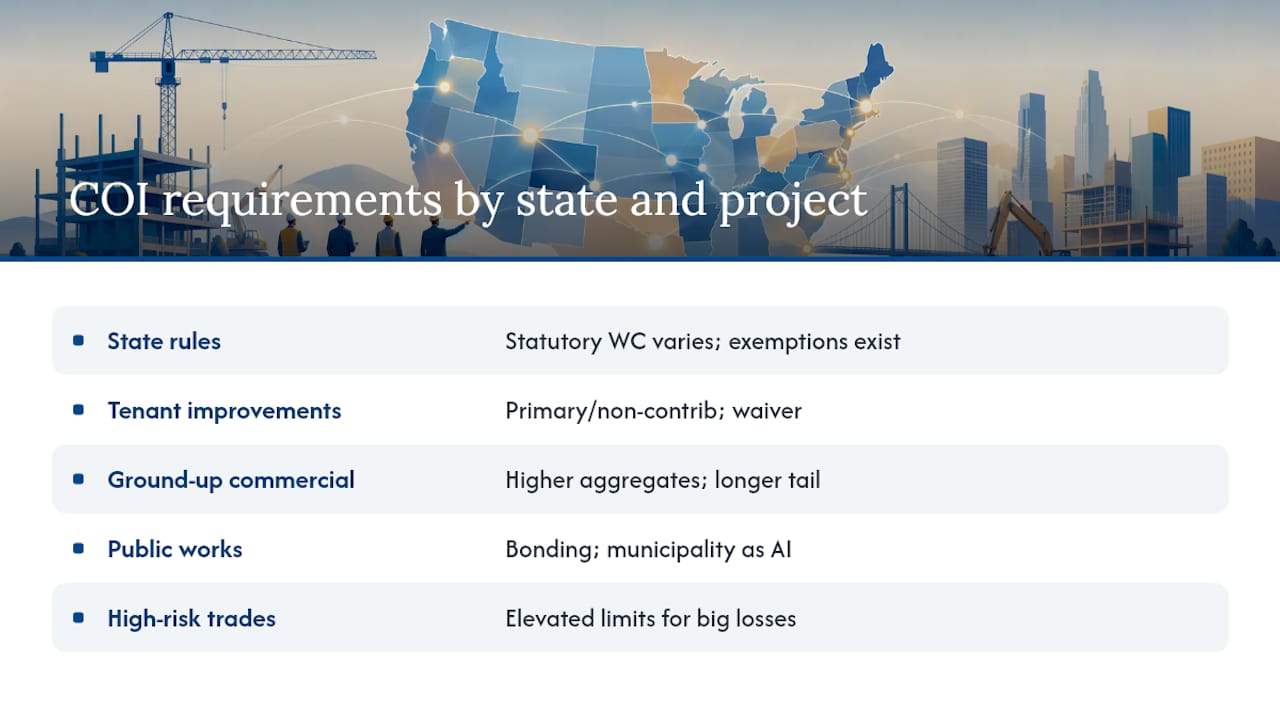
Workers’ Compensation limits are set by state, which means the “statutory” line on a COI means something different in Florida than it does in New York or California. Some states allow narrower exemptions for sole proprietors or very small crews; others require coverage regardless of headcount. A contractor licensed in one state cannot assume their COI automatically satisfies another state’s minimums if they’re working across a border.
Project type shifts requirements just as much as geography. A tenant improvement job inside an occupied office tower typically requires primary and non-contributory language and a waiver of subrogation, since the landlord wants zero exposure from a contractor’s mistake. A ground-up commercial build usually demands higher CGL aggregates and a longer completed-operations tail, because structural defects can surface years after substantial completion. Municipal and public works contracts often add their own bonding and insurance riders on top of standard COI policy details, sometimes requiring the municipality itself as an additional insured with specific per-project aggregate language.
Solar installation, roofing, and façade work frequently carry elevated limit requirements simply because a single incident, a fall, a fire, a dropped panel, tends to produce larger claims than routine interior trade work. None of this shows up automatically on a generic COI template. It shows up only when the certificate holder specifies exact contract language and the broker builds the endorsement to match. Contractors bidding across multiple states or project types should keep a master file of which jurisdictions and job categories require which endorsements, rather than reissuing the same COI everywhere and hoping it clears review.
Handling Subcontractor COIs and Flow-Down Requirements
General contractors carry the insurance risk for their entire crew, which means subcontractor COIs deserve the same scrutiny as the GC’s own certificate, sometimes more. The contract’s insurance exhibit should require every subcontractor, at every tier, to carry limits and endorsements that mirror or exceed what the GC promised the owner. That’s the flow-down principle: coverage obligations pass downward through the subcontract chain, and a gap at tier three can still expose the GC and owner at tier one.
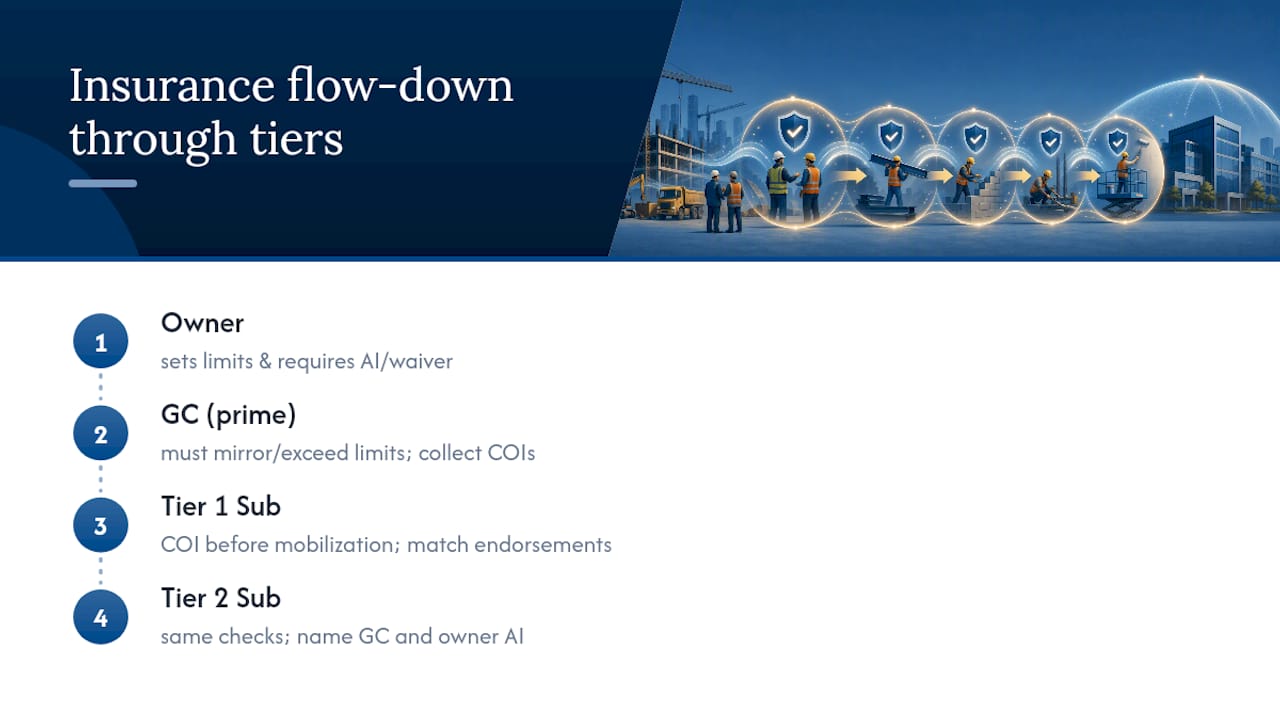
In practice, GCs should collect a COI from each subcontractor before mobilization, not after, and verify the same fields covered earlier: legal name match, active dates, and endorsement pages for additional insured and waiver of subrogation. A sub-subcontractor working under a subcontractor needs the same treatment. Skipping that tier is one of the most common gaps GCs discover only after a claim.
Two practical habits prevent flow-down failures. First, build the insurance exhibit language into every subcontract template so it’s non-negotiable boilerplate, not something renegotiated project by project. Second, require subs to name both the GC and the owner as additional insureds, since owners increasingly expect that protection to extend through the entire contracting chain, not just to the prime contractor. A compliance checklist for cleaning and maintenance vendors applies the same logic to trade-specific subs, where equipment and site access add their own risk layer beyond standard GL coverage.
Contractors managing many subs at once benefit from standardizing the request: same insurance exhibit wording, same certificate holder format, same deadline relative to mobilization date, every time.
A Practical COI Review Template for Owners and GCs
A usable review template doesn’t need to be complicated. It needs to catch the same handful of failure points every single time, regardless of who’s reviewing it.
Run every incoming COI through these checks in order:
- Legal name match. Does the insured name on the COI match the signed contract exactly?
- Coverage lines present. Are CGL, Workers’ Comp, Commercial Auto, and Umbrella (if required) all listed with limits meeting or exceeding contract minimums?
- Dates cover the project. Do effective and expiration dates span the entire anticipated project timeline, including likely delays?
- Endorsements attached, not just referenced. Have you received CG 20 10, CG 20 37, CG 24 04, and CG 20 01 as actual endorsement pages, not a description-box mention?
- Certificate holder correct. Is your organization’s exact legal name and address listed as certificate holder?
- Carrier rating confirmed. Does the AM Best rating meet your contract’s stated minimum?
- Broker contact verified independently. Did you call the broker using a number you sourced yourself, not one printed on the certificate?
Any single failed check should stop mobilization until resolved. Save each completed review alongside the COI and endorsement pages in the project file. That record becomes the evidence you need if a claim surfaces months later and someone asks whether the contractor was properly insured at the time.
Why Strict COI Checks Protect Budgets, Not Just Paperwork
Delayed mobilizations that trace back to a COI issue usually start the same way: someone accepted a certificate that named coverage but never confirmed the endorsement pages existed. That single skipped step is usually cheap to catch and expensive to discover after a claim.
Strict verification isn’t bureaucratic caution. It’s the difference between an owner absorbing a six-figure defect claim and the contractor’s insurer paying it, exactly as the contract intended.
— Eliot
Drone Cleaning With Part 107 Pilots and Documented Insurance
Traditional exterior cleaning on a high-rise means scaffolding, lifts, or rope access crews working at height, which is exactly the kind of exposure that makes COI review so critical in the first place. Exterior Drone Washing offers a different path: industrial drones flown by FAA Part 107 certified pilots with soft-wash systems clean facades, roofs, and solar arrays up to 320 feet without putting a worker on a harness. Exterior Drone Washing carries $1M/$2M general liability, a dedicated drone (UAS) policy, a $5M umbrella and workers’ compensation.
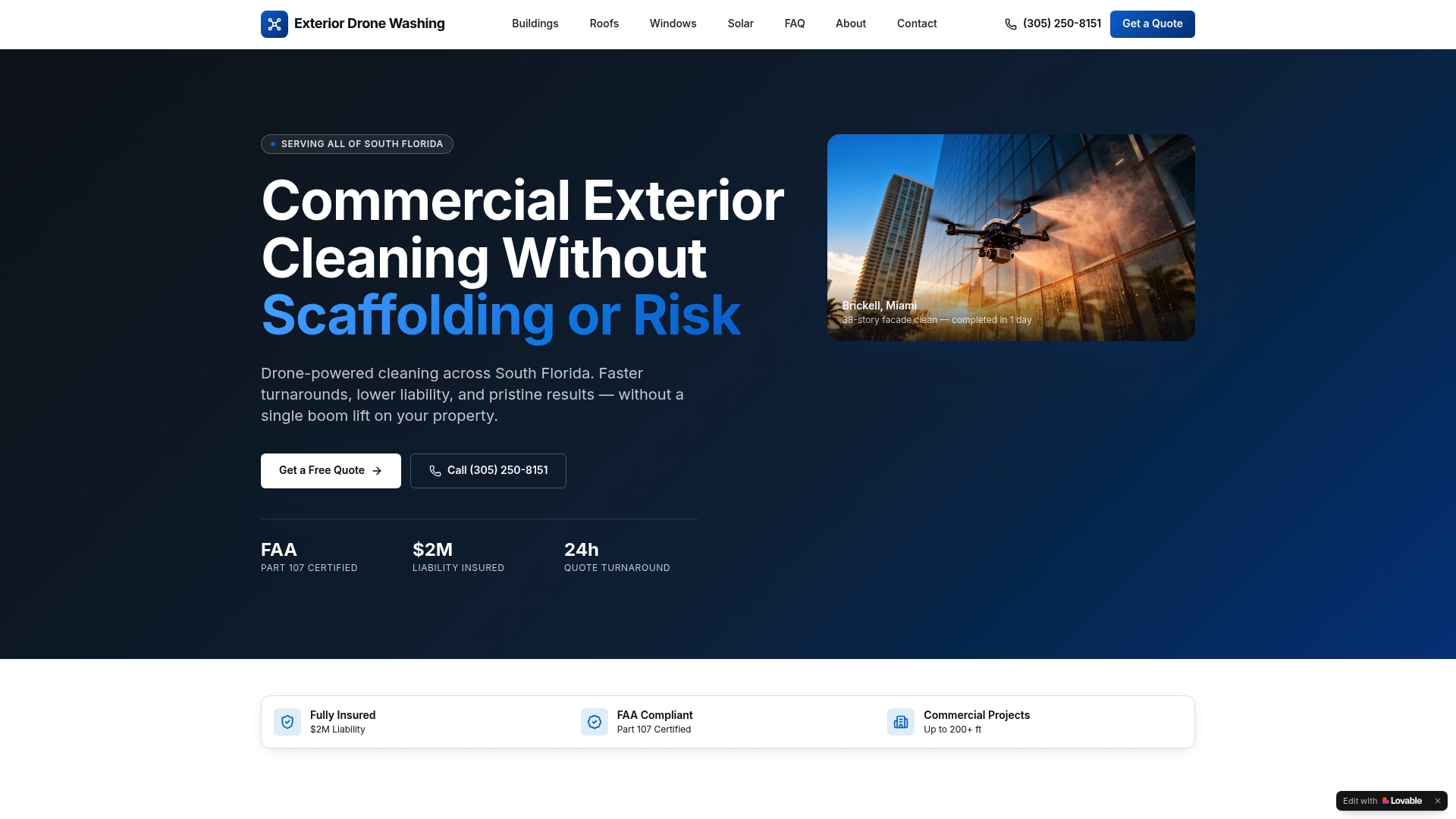
That distinction matters for the same reason this whole article does. Fewer workers at height means less liability exposure for the property owner, tighter documentation on every job, and a faster timeline, often a single day instead of a multi-day scaffolding setup. Before you sign with any exterior cleaning vendor, ask the same questions this article walked through: request their COI, confirm the additional insured and waiver of subrogation endorsements, and ask for equipment coverage documentation on top of the standard policy lines.
Property managers evaluating drone facade cleaning for an upcoming project can request full COI and endorsement documentation directly, before signing anything, through the Exterior Drone Washing services page.
Where to Confirm Forms and Endorsement Standards
Form numbers and endorsement wording change occasionally, so verify against the source rather than a secondhand summary. ACORD maintains the official form library, including current ACORD 25 editions. Insurer and industry checklists, including the construction COI compliance guide referenced throughout this piece, stay updated on typical limits and verification steps. For contractors managing volume, a dedicated COI tracking platform beats a spreadsheet once your subcontractor list grows past a handful of active vendors.
Sources
- Additional insured, primary/non-contributory, waiver of subrogation explained (ContractorsInsured)
- Unifi
- Certificate of Insurance for Contractors (Coverwatch)
- ACORD — association site (ACORD)
FAQ
Do All Contractors Need a COI?
Any contractor working under a contract that requires proof of insurance needs a COI, which in practice covers nearly every commercial job, most municipal permits, and most GC-to-subcontractor relationships.
Who Is Required to Have a COI?
General contractors, subcontractors at every tier, and specialty vendors like drone cleaning operators are typically required to provide a COI before mobilizing on a commercial project.
What Insurance Do Contractors Need to Have?
Most commercial contracts require Commercial General Liability, Workers’ Compensation and Employers’ Liability, Commercial Auto, and often an Umbrella policy, with limits scaling to project size and risk.