
FAA Ready Cleaning Around Balconies: Property Managers' ASTM Checklist
· Exterior Drone Washing
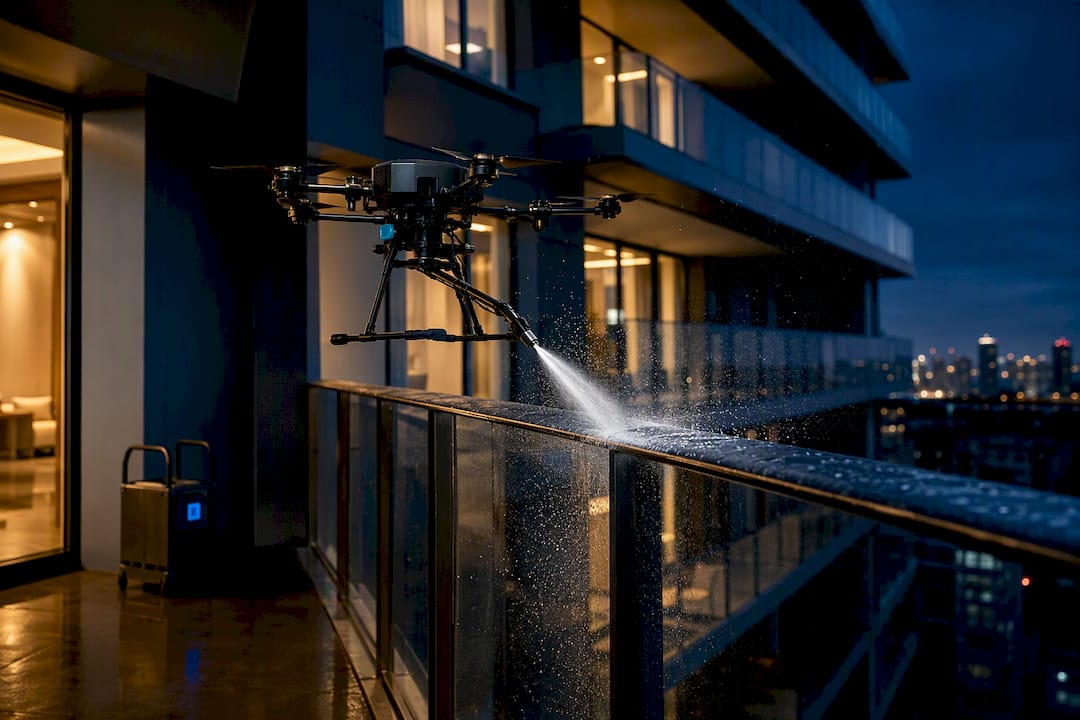
Drone cleaning is a sound option for balcony-adjacent façades on most mid-rise and high-rise properties, provided your vendor meets FAA Part 107 and Operations Over People requirements and can secure the site below. Done right, it cuts worker-at-height risk, finishes in a fraction of the time scaffolding takes, and rarely forces residents off their own balconies. Before signing anything, confirm the vendor’s Part 107 documentation and their plan for keeping people clear of the work zone.
TL;DR:
- Drone cleaning is suitable for buildings with flat, exposed façades like glass and metal panels, but is limited by wind, enclosed spaces, and heavy contamination.
- Vendors must hold FAA Part 107 certification, provide documentation on safety, insurance, and operation category to be legally compliant for balcony work.
- Site preparation involves early resident notifications, establishing exclusion zones, and sharing balcony dimensions and obstructions with the vendor beforehand.
- Equipment options include tethered and untethered drones, with the choice depending on building height, complexity, and the amount of continuous coverage needed.
- Regular cleaning frequency varies from twice a year for coastal or polluted sites to once annually for sheltered inland façades.
Table of Contents
- When Is Drone Cleaning the Right Choice for Balconies?
- What Safety and Regulatory Requirements Should You Confirm?
- How Do You Plan and Prep the Site for a Drone Cleaning Day?
- What Methods, Equipment, and Quality Checks Should You Expect?
- How Often Should Balcony Areas Get Cleaned and Inspected?
- When Should You Skip Drone Cleaning and Use a Different Method?
- What Property Managers Consistently Get Wrong
- How Exterior Drone Washing Handles Balcony-Adjacent Cleaning
- Sources
- FAQ
When Is Drone Cleaning the Right Choice for Balconies?
Curtain-wall towers, buildings with exposed balustrades, and properties with solar arrays tucked near balcony lines are the strongest candidates. The flat, repeatable geometry of glass and metal panels is exactly what soft-wash drone systems handle well, and there’s no need to hang a technician over the edge to reach it.
Not every job fits, though. Heavy vegetation growth, deeply enclosed or recessed balconies, and structures near restricted airspace all complicate or rule out drone work.
Watch for these limiting factors before requesting a quote:
- Wind exposure: Sustained gusts above a drone’s stability threshold can delay or cancel a job, especially on coastal high-rises.
- Enclosed or recessed spaces: Balconies boxed in by adjacent walls often lack the clearance a drone needs to maneuver safely.
- Heavy contamination: Baked-on grime, biological growth, or calcium buildup sometimes needs abrasive action a soft-wash system can’t provide.
- Airport proximity: Part 107’s altitude and right-of-way rules can restrict flight paths near controlled airspace.
- Payload and endurance limits: Larger façades may need tethered rigs or multiple flight sessions rather than a single untethered pass.
What Safety and Regulatory Requirements Should You Confirm?
Every vendor operating a drone commercially in U.S. airspace answers to 14 CFR Part 107, the FAA’s rulebook for small unmanned aircraft. The regulation sets right-of-way rules favoring manned aircraft and caps altitude at 400 feet above ground, except within 400 feet of a structure, where the drone can fly up to 400 feet above that structure’s highest point. For balcony work on tall towers, that provision matters: it’s what lets a drone legally work the upper floors close to the building itself.
The bigger question for balcony jobs is what happens directly over people. The FAA’s Operations Over People rule sorts flights into categories based on the drone’s design and the risk it poses to anyone below. Some categories allow routine flight over occupied areas without a special waiver; others require a closed or restricted-access site to keep residents and pedestrians clear during the work. Ask your vendor which category they operate under and how that translates to your property’s foot traffic.
Before you approve any job, request these documents in writing:
- Proof of the remote pilot’s FAA certification
- A written statement of which Operations Over People category applies
- Current liability insurance naming your property
- A site-specific safety and exclusion-zone plan
- Remote ID compliance confirmation
A vendor who can’t produce these on request isn’t ready for a balcony job on an occupied building.
How Do You Plan and Prep the Site for a Drone Cleaning Day?
Good site prep starts days before the drone ever launches, not the morning of. Property teams that skip this step end up dealing with confused residents, blocked staging areas, or a vendor who shows up and can’t legally start work.
- Notify residents and staff early. Post notices at least 48 to 72 hours ahead, and remind everyone again the morning of the job, so nobody steps onto a balcony mid-clean.
- Set up pedestrian and vehicle control. Cordon off sidewalks and drop-off zones directly below the work area; a resource like pedestrian safety planning for exterior work zones offers useful ground-level control principles that translate well to drone jobs.
- Share balcony geometry with the vendor. Give them dimensions, obstructions (awnings, planters, satellite dishes), and any recessed sections that limit drone access.
- Confirm staging and utility access. Vendors running tethered systems need ground-level space for power and water hookups near the building.
- Get the paperwork before the job, not after. Insist on an operations plan, an exclusion-zone map, insurance certificates, pilot credentials, and a written commitment to before-and-after photo documentation.
What Methods, Equipment, and Quality Checks Should You Expect?
Commercial drone cleaning for façades typically runs on industrial platforms fitted with soft-wash systems and a de-ionized or pure-water rinse for glass, which prevents the mineral spotting you get from tap water evaporating on a hot pane. Research into modern versus traditional window-cleaning methods points to real water-efficiency gains from these systems, though endurance and site conditions still shape how a job actually gets scheduled.
Vendors generally choose between two setups:
- Tethered systems, which pipe power and cleaning solution continuously to the drone, extending flight time and supporting heavier equipment without onboard tanks.
- Untethered drones, which trade some endurance for mobility and faster repositioning across complex façades.
Neither is universally better. A tall curtain wall with consistent geometry often favors tethered rigs for sustained coverage, while a shorter building with varied balcony shapes may move faster untethered.
Pro Tip: Ask to see a sample before-and-after photo set from a comparable building before you sign. A vendor with a real documentation habit will have this ready in minutes, not days.
Quality checks at balcony interfaces should cover streak-free glass, sealant condition around frames, and a look at scuppers and drains where water collects after a wash. Field-tested façade-cleaning robots have shown measurable safety and water-use benefits in controlled trials, but wind sensitivity and complex geometry remain real constraints worth asking your vendor about directly.
How Often Should Balcony Areas Get Cleaned and Inspected?
Exposure level drives frequency more than building age does. Coastal properties dealing with salt spray, or towers near heavy traffic and pollution, generally need attention twice a year. Sheltered inland façades can often stretch to once a year without visible buildup.
- Log every tenant notice sent, with dates and delivery method, in case a dispute comes up later.
- Photograph balcony intersections before and after each job, focusing on drains and scuppers where standing water tends to collect.
- Pair cleaning visits with a façade inspection on the schedule your building’s condition assessment calls for, particularly if ASTM Practice E2270 inspection guidance flags any deferred maintenance.
When Should You Skip Drone Cleaning and Use a Different Method?
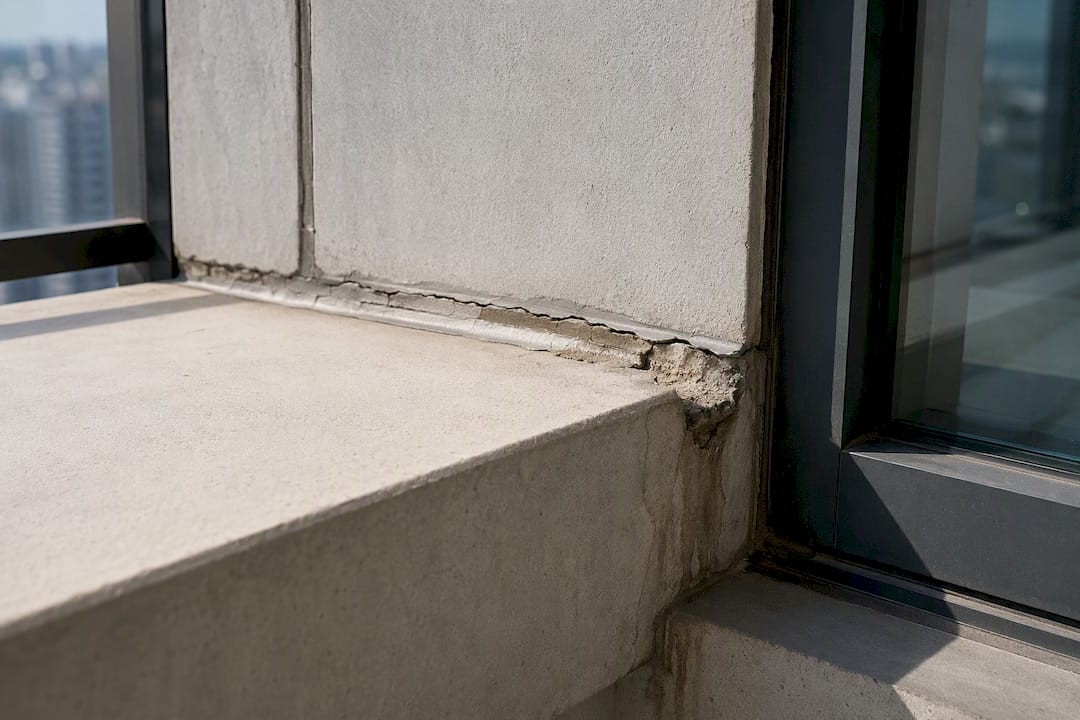
Drones handle surface cleaning well. They don’t fix structural problems. If an inspection turns up cracked sealant, spalling concrete, or active leaks at a balcony-to-wall intersection, that’s a repair job for rope-access technicians or a scaffolding crew, not a cleaning vendor. Guidance on evaluating wall leakage specifically calls out balcony intersections as common trouble spots that need direct, hands-on inspection rather than a wash-and-go visit.
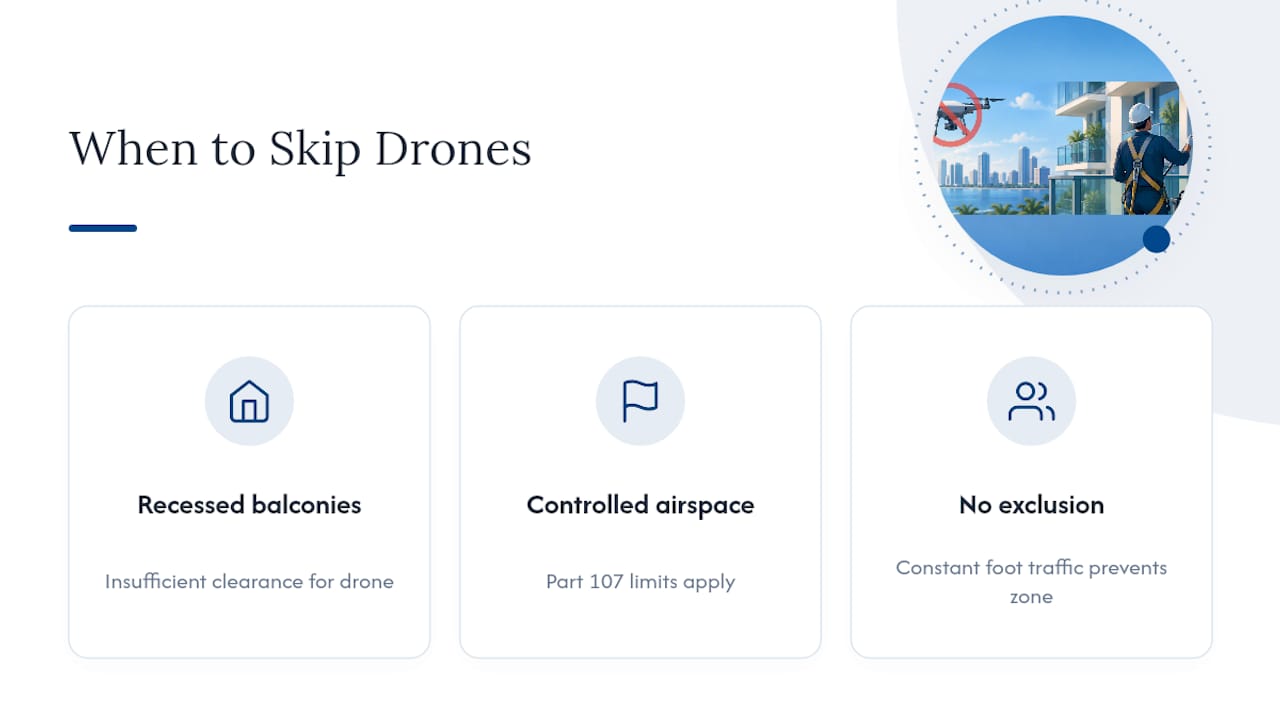
A few other situations point away from drones entirely. Enclosed or heavily recessed balconies may not give a drone the clearance it needs. Properties near restricted or controlled airspace face real limits under Part 107. And any site where you can’t establish a workable exclusion zone, such as a plaza with constant foot traffic and no way to close it off, may not clear the bar for the FAA’s Operations Over People categories.
When a job doesn’t qualify, document why, and give your board or ownership group a clear picture of the timeline and cost difference between drone service and the fallback method. That paper trail matters if the decision gets questioned later.
What Property Managers Consistently Get Wrong
The most common mistake isn’t safety. It’s scope. Property teams often request “a cleaning” without specifying balcony intersections, drain conditions, or which Operations Over People category applies to their site, then get surprised when the quote or the coverage doesn’t match expectations. Ask for the compliance category and the documentation up front, every time, and you’ll avoid most of the friction that derails these projects.
— Eliot
How Exterior Drone Washing Handles Balcony-Adjacent Cleaning
Exterior Drone Washing gives property teams a way to clean balcony-facing glass, façades, and adjacent solar arrays without scaffolding, lifts, or rope crews standing between you and a finished building. That means shorter timelines, far less worker-at-height exposure, and minimal disruption for residents.
Services relevant to balcony-adjacent work include FAA-compliant façade cleaning, soft-wash glass and window service, and solar panel cleaning for arrays mounted near balcony lines. When you request a quote, ask for a site survey, proof of insurance, a written safety plan, and confirmation of which Operations Over People category applies to your building. Get a quote from Exterior Drone Washing and get specifics on scope, timeline, and documentation before you commit to a schedule.
Sources
- eCFR :: 14 CFR Part 107 – Small Unmanned Aircraft Systems (FAR Part 107)
- Operations Over People general overview | Federal Aviation Administration
- ASTM Practice E2270 — periodic inspection of building facades
FAQ
Is Drone Cleaning Legal for Buildings With Occupied Balconies?
Yes, under the FAA’s Operations Over People rule, which permits routine flight over people in specific risk categories with the right equipment and site controls. Your vendor needs to state which category applies and how they’ll manage the exclusion zone for your building.
How Much Does Drone Cleaning Cost Compared to Scaffolding?
Exterior Drone Washing prices commercial work at $0.12 to $0.25 per sq ft, as a fixed price after a free site survey, with no minimum charge and no travel charge. Request a site survey and quote to get figures specific to your property.
What Should I Ask a Drone Cleaning Vendor Before Hiring Them?
Ask for proof of remote pilot certification, current insurance, a written safety and exclusion-zone plan, and a clear statement of which Operations Over People category covers your site. Also confirm they’ll deliver before-and-after photo documentation, a practice ASTM inspection guidance treats as basic asset-management hygiene, not an extra.
Can Drones Clean Balconies With Solar Panels Nearby?
Yes, drone platforms fitted with pure-water rinse systems can clean glass, façade panels, and adjacent solar arrays in the same visit when the geometry allows it. Wind conditions and array spacing determine whether a single flight session covers everything or the job needs to be split.