
What Building Cleaning Noise Sounds Like, and How to Cut It
· Exterior Drone Washing
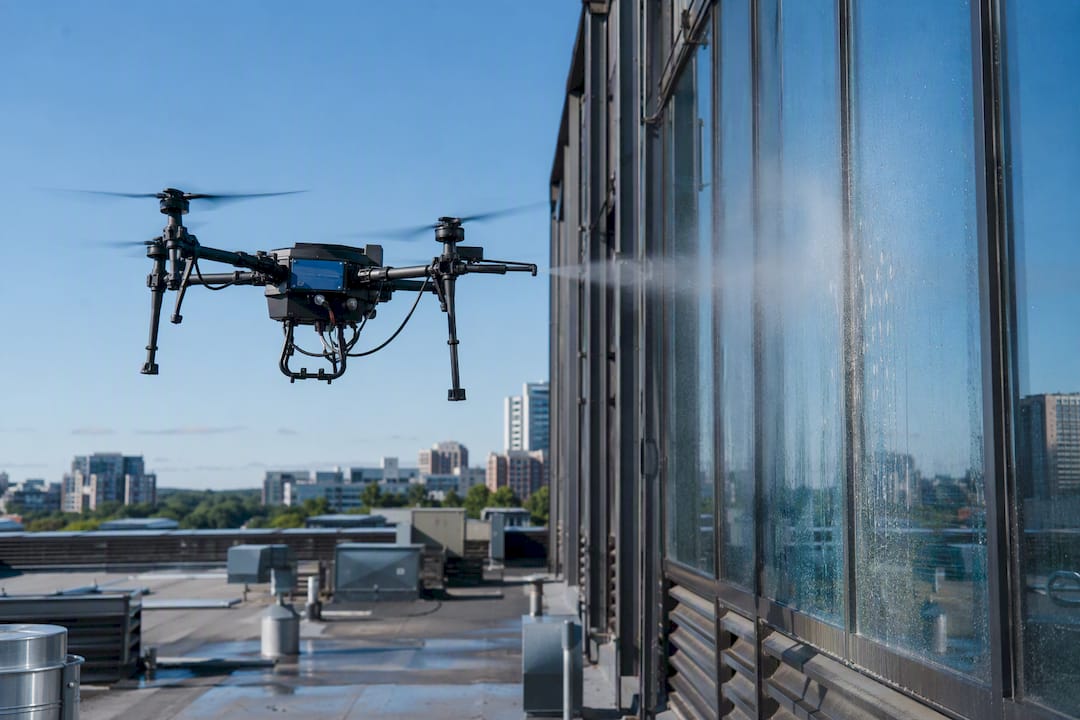
Most exterior building cleaning produces short bursts of noise near the work zone roughly in the volume range of a garbage disposal to a gas lawn mower, depending on the method. The fastest way to cut disruption isn’t a policy memo. It’s a baseline noise reading taken before work starts, paired with tenant notification and a lower-noise method where the job allows it.
Rough noise by method (illustrative, so measure on your own site):
- Pressure washers and gas pumps: 75 to 85 dBA
- Boom lifts and MEWPs (engine running): 70 to 80 dBA
- Rope access (minimal mechanical noise): 55 to 65 dBA
- Drone soft-wash systems: rotor and pump noise that varies by aircraft and distance, in short intermittent passes rather than continuous runs
Take that baseline reading, log the time and location, and notify affected tenants before equipment starts. If a lower-noise option like electric pumps or drone-based soft washing fits the job scope, it’s worth the conversation with your vendor before contracts get signed.
Key Takeaways
Cutting building cleaning noise comes down to measuring before you mitigate, choosing shorter-duration methods over continuous-run equipment, and documenting everything for compliance and dispute resolution.
| Point | Details |
|---|---|
| Baseline before work starts | Take dBA readings at the façade and nearest occupied space before equipment runs. |
| Match method to sensitivity | Reserve continuous pressure-washing or lift work for less noise-sensitive zones and hours. |
| Use engineering controls first | Vibration isolation and temporary barriers cut noise more reliably than asking crews to work quieter. |
| Notify early and log complaints | Give tenants at least 72 hours’ notice and assign one point of contact for complaint tracking. |
| Consider drone soft-wash for tall or occupied buildings | Exterior Drone Washing’s drone jobs often finish in a single day, which shortens the noise window compared with multi-day scaffolding or lift work. |
Table of Contents
- Common Sources of Building Cleaning Noise and How They Travel
- How Do You Measure and Document Cleaning Noise?
- What Actually Reduces Cleaning Noise on Site?
- How to Plan a Low-Noise Cleaning Campaign
- Why Drone Cleaning Cuts Disruption, and What to Ask a Vendor
- How to Evaluate and Book Exterior Drone Washing for Low-Noise Cleaning
- Sources
- FAQ
Common Sources of Building Cleaning Noise and How They Travel
Not every noise source behaves the same way, and that matters when you’re trying to predict where complaints will come from. Pressure washer pumps and generators create continuous, high-frequency noise that carries well through open air but drops off fast with distance. Boom lifts and MEWPs add engine drone plus hydraulic whine, often for hours at a stretch, since repositioning takes time. Suspended platforms and rope-access rigs are quieter mechanically but introduce intermittent clanks from anchors and rigging.
Drone rotor noise sits in a different category entirely: a sharper, higher-pitched sound, but it moves with the aircraft and rarely lingers over one façade section for more than a few minutes.
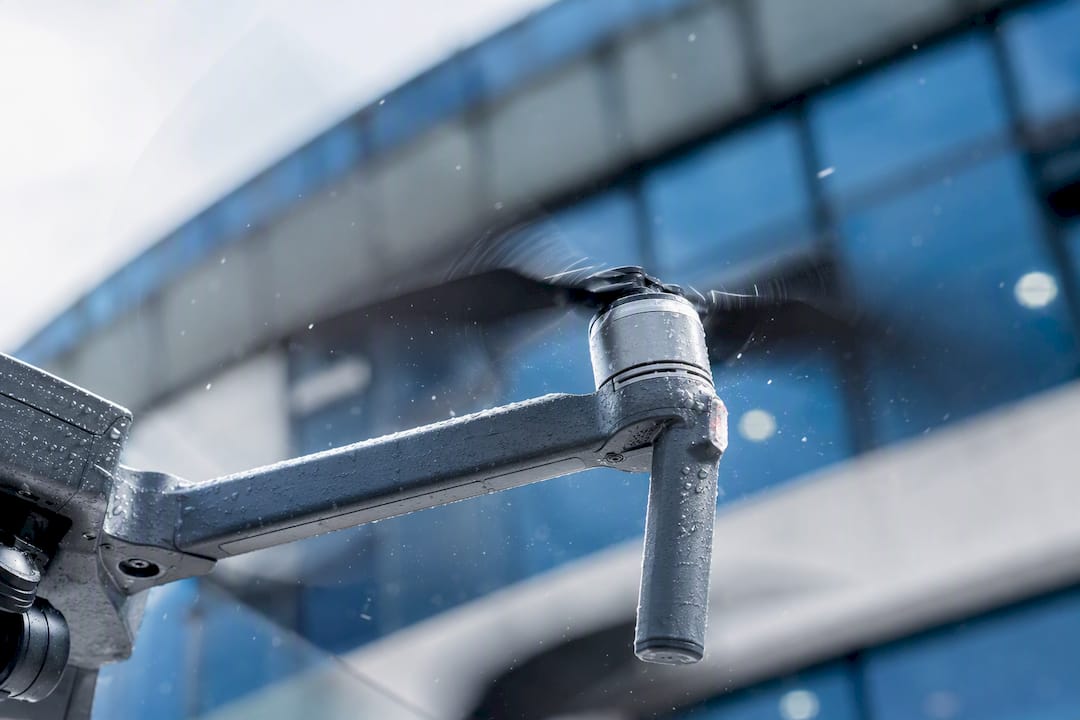
The bigger issue for tenant complaints is often structureborne transmission, not the airborne noise itself. Vibration from generators or pumps set on a rooftop can couple into ductwork, piping, and the building slab, turning into a low hum three floors down that has nothing to do with how loud the equipment sounds outside. ASHRAE’s guidance on mechanical system noise notes that low-frequency structureborne noise tends to generate more complaints than higher-frequency airborne sound of the same intensity, because it’s harder for occupants to place and impossible to ignore.
How Do You Measure and Document Cleaning Noise?
A dBA reading (A-weighted decibels) approximates how the human ear perceives loudness, filtering out the very low and very high frequencies people barely notice. It’s the standard unit named in most municipal noise codes, and it’s what you want on record if a complaint turns into a dispute.
Measurement protocol:
- Take a baseline reading at the façade and at the nearest occupied room or balcony before work begins, with no equipment running.
- Take readings during peak activity, at the same two distances, timestamped.
- Photograph equipment placement and log wind conditions, since wind can skew handheld readings by several dBA.
- Take a post-job verification reading and file it with the completion report.
A calibrated smartphone app is fine for internal tracking and quick complaint response. If you’re facing a formal dispute, a regulatory threshold close to your readings, or a persistent tenant complaint, bring in a sound level meter (SLM) or an acoustical engineer instead. Municipal thresholds vary widely by zoning and time of day, so check your local code rather than assuming a number.
| Measurement Point | When to Take It | Tool |
|---|---|---|
| Façade, at work zone | Before, during peak, after | Smartphone app or SLM |
| Nearest occupied room/balcony | Before, during peak, after | SLM preferred |
| Property line (if required by code) | During peak activity | SLM |
Keep every reading with a timestamp and photo. Documentation practices that pair completion reports with measured data resolve disputes faster than a verbal assurance that “it wasn’t that loud.”
What Actually Reduces Cleaning Noise on Site?
Engineering controls work better than asking crews to be quieter. AMCA’s guidance on environmental noise points to ventilation silencers, acoustic louvers, and barrier walls as proven attenuation methods for mechanical equipment, and the same logic applies to cleaning gear staged on a roof or in a loading area. Vibration isolators matter too. For heavier rooftop units, isolators need enough deflection rating to actually decouple the equipment from the structure, or the noise just travels through the slab anyway.
Engineering and equipment controls:
- Vibration isolation pads or spring mounts under pumps and generators staged on rooftops or setback areas
- Temporary acoustic barriers or enclosures around stationary equipment when clearance from sensitive spaces is limited
- Electric MEWPs and battery-powered pumps in place of gas engines wherever the job scope allows
- Drone operations flown in short, targeted passes rather than continuous hovering over one section, which limits sustained noise exposure
Administrative controls that cost nothing to implement:
- Scheduling loud phases outside occupied hours, especially near bedrooms or conference rooms
- Phasing the building into zones so no single day concentrates noise near the most sensitive tenants
- Setting a decibel-based stop level in the vendor contract, not just a “keep it reasonable” clause
- Avoiding staging noisy equipment directly above units with home offices, medical suites, or hotel rooms
Pro Tip: Ask your vendor which rooftop penetrations and HVAC anchor points sit above sensitive tenant spaces before scheduling. Moving a generator fifteen feet can be the cheapest noise fix on the job.
Operational choices like short-duration passes and off-peak scheduling are often the fastest way to cut complaints, faster than waiting on an engineering fix to get budgeted and installed.
How to Plan a Low-Noise Cleaning Campaign
A site survey the week before mobilization catches most problems before they become complaints.
Site survey checklist:
- Identify sensitive receivers: bedrooms, home offices, medical suites, conference rooms facing the work area.
- Confirm roof construction and HVAC penetrations near planned equipment staging.
- Note balconies, pool decks, and amenity spaces that overlap with the cleaning schedule.
- Flag anchor points for rope access or platform rigging.
Notification and monitoring:
- Notify tenants, HOA boards, and adjacent property managers at least 72 hours before major work, longer for multi-day jobs.
- Post signage at entrances and elevators listing work hours and a complaint contact.
- Assign one person to log complaint calls, including time, unit, and description, so patterns show up fast.
- Close the job with final readings, photos, and a written completion report kept on file for at least one lease cycle.
For occupant-side noise concerns during ongoing HVAC or mechanical work, some managers pair site controls with interior soundproofing fixes for the most noise-sensitive units.
Why Drone Cleaning Cuts Disruption, and What to Ask a Vendor
Drone-based exterior cleaning changes the noise equation mainly by changing the timeline. Where scaffolding or rope access can mean days of continuous presence, industrial drones flown by FAA Part 107 certified pilots using soft-wash and de-ionized water systems often complete a full façade, roof, or solar array in a single day, at up to 320 feet (about 29 stories) per staging position. Shorter jobs mean shorter noise windows, a smaller ground footprint, and no lift engines idling for hours between repositions.
Vendor procurement checklist:
- FAA certification and current insurance
- Written safety plan and method statement for the specific building
- Sample before-and-after documentation from comparable jobs
- A contract clause requiring measured dBA verification, not just a promise of quiet operation
- Wastewater and runoff handling plan, especially where detergents are used
A Note From the Field
Two similar jobs can generate very different complaint volumes depending on whether anyone took a baseline reading. The lesson isn’t that any single method is quiet. It’s that assumptions about noise cost more than measurements do. Trust the meter over the vendor’s sales pitch, every time.
— Eliot
How to Evaluate and Book Exterior Drone Washing for Low-Noise Cleaning
Exterior Drone Washing runs drone cleaning with FAA Part 107 certified pilots for commercial façades, roofs, windows, and solar arrays across the United States, which shortens the noise window that scaffolding and lift work usually stretches across days. For a high-rise, condo association, or hotel worried about complaint volume during a scheduled clean, that shorter timeline is the practical difference: less continuous engine noise, less lift traffic in the parking structure, less time for any single tenant to stay irritated.
Before signing with any vendor, ask for FAA certification, proof of insurance, a written safety plan specific to your property, and sample noise readings from a comparable job. Exterior Drone Washing’s drone cleaning services can include before-and-after photos, which gives your board or ownership group a paper trail if a tenant does raise a concern. If your property includes a solar array, the same pure-water drone approach applies without the added noise of ground-based equipment near rooftop mechanical systems. Request a quote and ask specifically about projected job duration and measured noise expectations for your building’s height and layout.
Sources
- ASHRAE handbook (ch. on mechanical system noise and vibration)
- AMCA article on mitigating environmental noise from mechanical equipment
- Efficient Cleaning — pre-Q4 facilities readiness and documentation
FAQ
What Decibel Level Counts as Too Loud for Building Cleaning?
There’s no single universal threshold. Most municipal codes set limits based on zoning and time of day, so check your local ordinance, and any reading approaching your local limit warrants an engineering or scheduling fix.
Are Drones Quieter Than Boom Lifts for Facade Cleaning?
Not always at the source. Drone rotor noise is sharper and higher-pitched, but it comes in short passes and the job is typically shorter than continuous boom lift work. Ask for measured readings.
When Should I Call an Acoustical Engineer Instead of Using an App?
Bring in an acoustical engineer or a calibrated sound level meter when readings sit close to a regulatory threshold, when a complaint escalates to a formal dispute, or when structureborne vibration is suspected but hard to isolate with a phone app.
How Do I Handle a Tenant Noise Complaint During a Cleaning Job?
Log the time, unit, and description immediately, check it against your logged readings for that period, and respond with the documented data rather than a verbal assurance.
Does Exterior Drone Washing Provide Noise Documentation With Its Jobs?
Before-and-after photos are available on request. Noise readings are not a standard deliverable, so ask any vendor, us included, to add measured readings to the completion report if you need them.