
Drone RFP for Property Managers: Bird Droppings Facade Cleaning
· Exterior Drone Washing
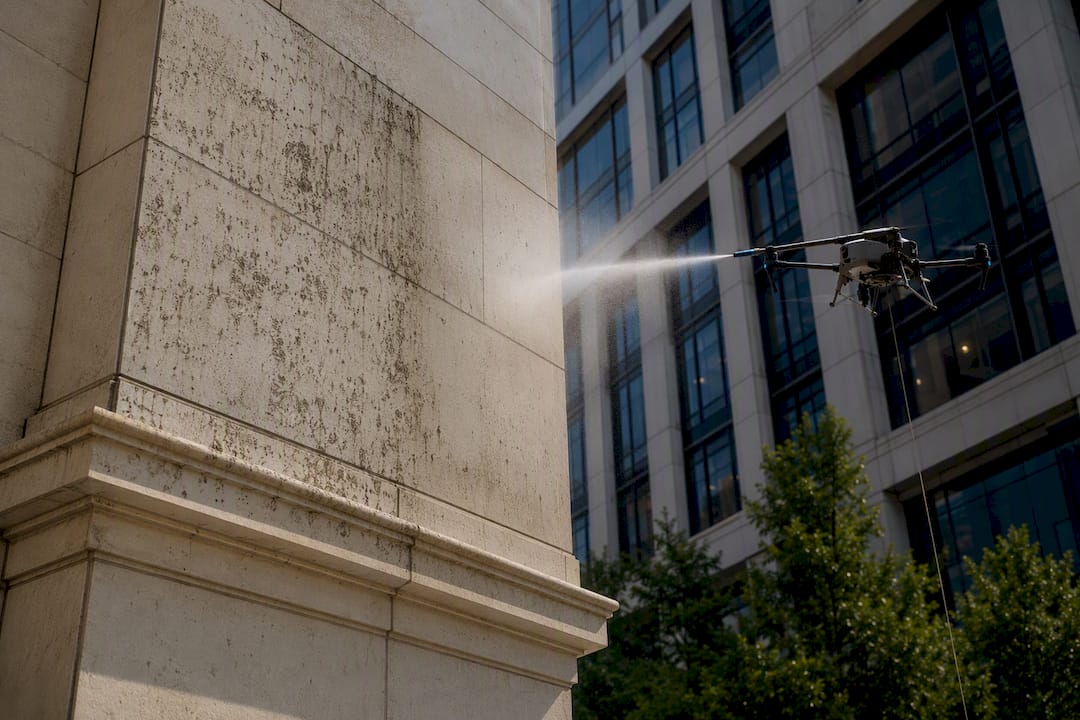
For large or high-rise properties, hire a professional drone-based facade cleaning contractor to remove bird droppings when access, worker safety, and glazing sensitivity are on the line. Drone-based soft-wash cleaning reaches up to 320 feet without scaffolding, cuts project timelines to a single day for many buildings, and pairs the right chemistry with the least disruptive access method. Pair every cleanup with proofing measures, or you’ll be paying for the same job again in a few months.
TL;DR:
- Drone-based soft-wash cleaning reaches up to 320 feet and mobilizes in hours rather than days, usually without the road closures scaffolding needs.
- Frequent high-rise cleaning every 2 to 3 weeks may be necessary in dense bird populations unless proofing measures like netting or deterrents are installed.
- Contractors should provide a detailed scope, including access plans, chemical details, photo documentation, and insurance, to prevent surprises.
- Proper surface treatments, such as hydrophobic sealants and early paint repairs, are essential to extend facade life and reduce future cleaning costs.
- Addressing bird roosting hotspots with netting and deterrents is necessary to break the cycle of recurring fouling and avoid continuous cleaning expenses.
Table of Contents
- What to Expect From a Professional Bird Droppings Facade Cleaning Contractor
- Why Bird Droppings Damage Facades Faster Than Most Managers Realize
- Drone-Based Soft-Wash vs. Rope Access, Lifts, and Scaffolding
- How to Vet a Bird Droppings Facade Cleaning Contractor
- Pricing, Timelines, and What Drives the Cost
- Preventing Repeat Bird Dropping Cleanups
- Protecting the Facade After Cleaning
- Environmental and Regulatory Considerations for Facade Cleanup
- What Actually Moves the Needle on High-Rise Bird Fouling
- Get a Facade Cleaning Quote Without the Guesswork
- Sources
- FAQ
What to Expect From a Professional Bird Droppings Facade Cleaning Contractor
A serious contractor starts with a site assessment, not a price quote. They walk (or fly) the elevations, break the building into zones by height and severity, and map an access plan before touching a single surface.
Expect the scope to define exactly what gets cleaned, in what order, and with what equipment. Fresh droppings on a lobby canopy need different handling than months-old deposits baked onto a 15th-floor cornice. Trained crews dampen heavy deposits before removal and use PPE to limit exposure to airborne pathogens during bird droppings removal from buildings.
A solid proposal should spell out:
- Scoped elevation bands and square footage, with an access plan for each
- Sidewalk, traffic, and parking management during work hours
- Tenant notification windows and noise or drone-flight restrictions
- Before-and-after photo documentation, a cleaning log, and a written warranty
Pro Tip: Ask for the photo documentation format before you sign anything. A contractor who already has a standardized before-and-after report template has done this enough times to know what property managers actually need for their records.
Why Bird Droppings Damage Facades Faster Than Most Managers Realize
Uric acid in bird droppings starts etching paint and coatings almost immediately, and delay is what turns a simple wash into a coating replacement. Left on a painted surface, it degrades the finish, causes gloss loss and hazing, and eventually opens the door to substrate corrosion that no amount of cleaning will reverse.
Heavily fouled high-rise glass facades in areas with dense bird populations can need cleaning as often as every 2 to 3 weeks without mitigation. That frequency turns a nuisance into a recurring line item in the operating budget, and insurers take notice when slip-and-fall claims start showing up under canopies coated in dried guano.
The damage compounds in ways that are easy to underestimate:
- Etched or hazed glazing that requires refinishing, not just washing
- Blocked drainage from nesting debris, leading to water intrusion and roof repairs
- Pathogen exposure risk for maintenance staff and tenants near dried droppings
- Rising insurance exposure tied to documented slip hazards in high-traffic zones
Drone-Based Soft-Wash vs. Rope Access, Lifts, and Scaffolding
The right method depends on how bad the fouling is, how sensitive the surface is, and how much disruption the building can tolerate. Drone-based soft-wash systems apply a foam pre-treatment that clings to vertical surfaces longer than a liquid spray, which improves removal on dried or crusted deposits before a de-ionized water rinse finishes the job. Scaffolding often accounts for a significant portion of a facade project’s mobilization cost, so avoiding it helps make drone cleaning more price-competitive for many jobs, in addition to being faster.
Rope access and mobile elevated work platforms still earn their place. Heavily crusted deposits on textured stone or ornamental detail sometimes need a technician physically scrubbing the surface, something a drone’s rinse pass can’t replicate. Full scaffolding remains the right call when the job isn’t just cleaning, but structural remediation, sealant replacement, or a full recoat.
| Method | Best for | Typical mobilization | Disruption level |
|---|---|---|---|
| Drone soft-wash | Glass, painted panels, metal, most facade cleaning | Hours, no lane closures | Low |
| Rope access / MEWP | Crusted deposits, ornamental detail, spot repairs | 1 to 2 days setup | Moderate |
| Scaffolding | Structural work, recoating, full remediation | Several days to weeks | High |
Ask any bidder which method they’re actually proposing and why. A contractor who defaults to scaffolding for a straightforward cleaning job, without explaining why drones or rope access won’t work, is padding the estimate.
How to Vet a Bird Droppings Facade Cleaning Contractor
Treat the RFP process like you would any capital project. The questions you ask upfront save you from surprises once the crew is on-site or, worse, once the invoice arrives.
Start with these pre-qualification questions:
- Are your drone pilots FAA Part 107 certified, and what’s your experience with high-rise bird fouling specifically?
- What cleaning chemicals do you use, and can you provide safety data sheets for each?
- How do you handle waste and runoff disposal, and does it meet local environmental requirements?
- Can you share before-and-after documentation from a comparable building?
- What’s your certificate of insurance coverage, and does it name us as an additional insured?
Require a written method statement, proof of equipment certification, and at least two references from buildings of similar height and facade material. Red flags include vague insurance answers, no photo evidence from past jobs, reluctance to describe the access plan in writing, or evasiveness about where waste and contaminated water actually go.
Pro Tip: Build your RFP checklist once, save it as a template, and reuse it for every bid you request. Consistent questions make it far easier to compare quotes side by side instead of comparing apples to oranges.
Pricing, Timelines, and What Drives the Cost
Vertical area and severity of deposits set the baseline, but access complexity usually decides the final number. A drone crew that can fly straight up a clean elevation costs less than one that has to navigate balconies, setbacks, and mechanical equipment on every floor.
Because drones skip scaffolding and road closures entirely, autonomous facade maintenance removes some of the biggest overhead line items from a traditional bid. Many drone-based facade cleanings finish in a single day; scaffolded jobs on the same building often stretch across several days to weeks, depending on weather delays and elevation count.
Other factors that move the price:
- Containment and disposal requirements for contaminated runoff
- Whether remediation (recoating, sealant repair) is bundled with cleaning
- Permit requirements for drone flights near flight paths or dense urban corridors
- Building height bands, since crews often price per elevation tier rather than flat square footage
Ask for a fixed price with the square footage and scope written out, and check whether mobilization or travel is charged on top.
Preventing Repeat Bird Dropping Cleanups
Cleaning without addressing why birds keep coming back is a losing cycle. Industry analysis on facade fouling consistently points to the same conclusion: cleaning alone doesn’t solve the underlying problem if roosting behavior isn’t addressed at the same time.
Netting remains the most effective non-lethal control for balconies, mechanical voids, and covered walkways where pigeons like to settle, according to research on pigeon impacts and mitigation strategies. Spikes and angled deterrent plates work on ledges and parapets, though they come with a maintenance and aesthetic tradeoff worth weighing against a building’s design.
- Install netting on voids, overhangs, and balcony undersides where birds nest
- Add perching deterrents to ledges, signage, and mechanical equipment
- Secure exposed food and waste sources that attract birds in the first place
- Schedule quarterly inspections to catch new roosting spots before they become colonies
Pro Tip: Focus proofing budget on the roughly 20 percent of the facade generating most of the fouling. Concentrating spikes and netting on high-use roosting zones stretches a limited maintenance budget much further than spreading it evenly across the whole building.
Protecting the Facade After Cleaning
A clean facade is a temporary state unless you follow it with the right surface treatment. Once droppings and residue are gone, the next decision is whether the substrate needs anything beyond a rinse.
Painted and coated surfaces that show early signs of gloss loss or hazing from uric acid exposure benefit from a targeted spot recoat rather than waiting for full-panel failure. Catching that damage early and documenting it with inspection photos in a maintenance log makes it far easier to justify the smaller repair now instead of a full remediation project later, a pattern well established in coatings damage research.
Glass and metal surfaces often benefit from a hydrophobic sealant applied after cleaning. These treatments make future droppings easier to rinse off before uric acid has time to bond with the surface, which shortens the next cleaning cycle and reduces the intensity of scrubbing needed. For stone and masonry, a breathable sealant protects against staining without trapping moisture that could cause its own damage over time.
Whatever treatment gets applied, log it. A maintenance record that tracks cleaning dates, treatment applications, and inspection photos does two things: it protects your capital budget by catching problems early, and it gives you leverage when negotiating warranty terms with contractors on future jobs.
Environmental and Regulatory Considerations for Facade Cleanup
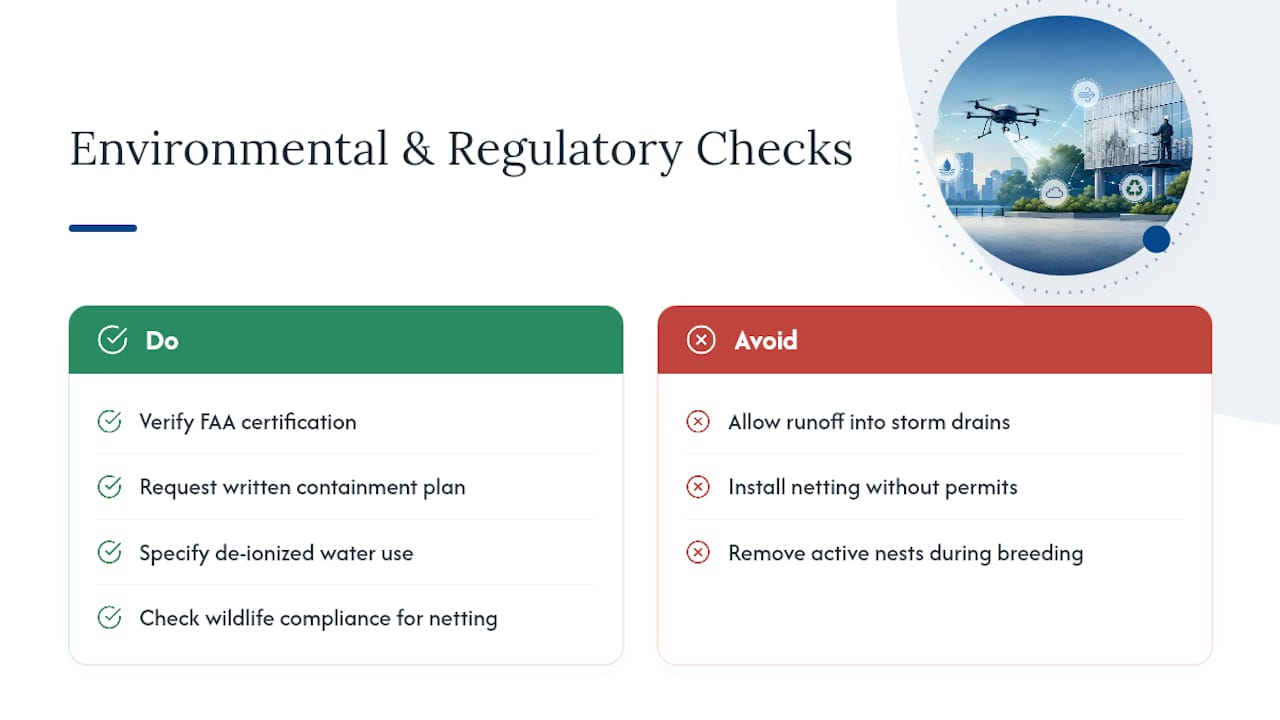
Drone operations near buildings fall under FAA rules, and any contractor flying over or near a commercial property needs to operate within those certifications. That’s a baseline compliance question, not a nice-to-have, especially for buildings near flight paths or dense urban corridors where airspace restrictions can apply.
Runoff is the other major regulatory issue. Cleaning chemicals and contaminated wash water can’t simply drain into storm systems in most municipalities, which means contractors need a containment and disposal plan that meets local environmental requirements. Ask for this in writing before the job starts, not after.
De-ionized water systems, common in professional drone soft-wash setups, reduce chemical volume needed for effective cleaning and lower the environmental footprint of the runoff itself. That matters for buildings pursuing ESG targets, and it’s part of why some property owners are piloting drone programs specifically to document water savings and reduced risk across their portfolios.
Bird proofing measures like netting also carry local rules in some jurisdictions, particularly around protected species. Confirm with your contractor that any netting or deterrent installation complies with local wildlife ordinances before work begins, since removing active nests during breeding season can trigger separate legal considerations depending on the species involved.
What Actually Moves the Needle on High-Rise Bird Fouling
Most property managers treat bird dropping cleanup as a reactive line item, something you call in after a tenant complains or an inspection flags visible staining. That’s backwards, and it’s expensive. The buildings that spend the least on facade cleaning over a five-year span are the ones that treat the first cleanup as a diagnostic step, not a one-off fix.
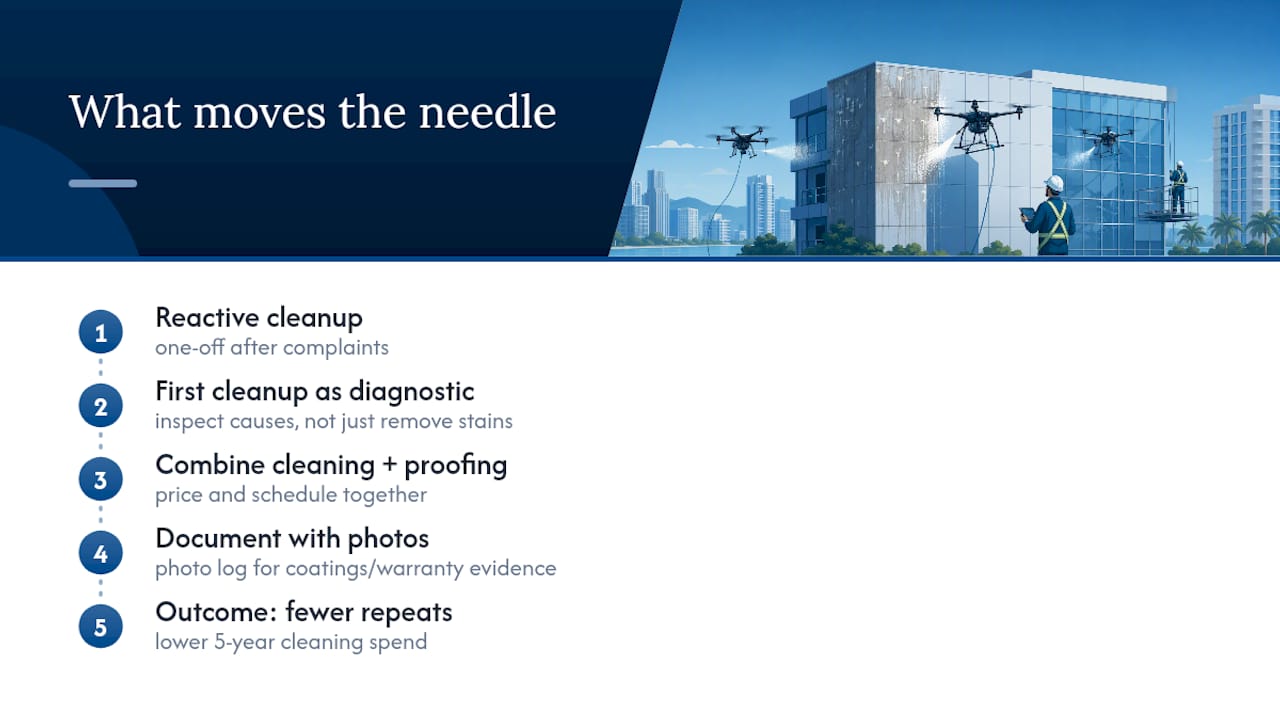
Here’s what gets overlooked: the method you choose for the first cleaning tells you almost nothing about long-term cost if you skip the proofing conversation entirely. A drone crew can strip a facade clean in a day, document it with photos, and hand you a spotless building, but if the roosting spots that caused the fouling are still open, you’re back on the schedule within weeks on a heavily trafficked building. The real savings come from treating cleaning and proofing as one project, priced and scheduled together, instead of two separate budget lines that never talk to each other.
The other underestimated factor is documentation. A photo log isn’t paperwork for its own sake. It’s the evidence that lets you catch coating failure early, negotiate warranty claims, and prove to a board or ownership group that the maintenance budget is being spent on prevention rather than repeated emergency calls. Buildings that skip this step end up re-litigating the same “why does this keep happening” conversation every budget cycle.
— Eliot
Get a Facade Cleaning Quote Without the Guesswork
Professional drone-based facade cleaning offers commercial property managers a faster path to a clean facade than the traditional scaffolding-and-lift model. drones flown by FAA Part 107 certified pilots with soft-wash and de-ionized water systems reach up to 320 feet without lane closures, tenant disruption, or the multi-week mobilization that rope access and scaffolding require, and jobs are documented with before-and-after photo reports.
To get a fast, accurate estimate, send over a few photos of the affected elevations, note your target zones and preferred completion window, and flag any access constraints (parking restrictions, flight path considerations, tenant hours). From there, expect a remote review followed by an on-site survey and a written scope that spells out mobilization, chemicals, and documentation deliverables before any work starts. Reach out through the drone facade cleaning services page to request a site survey and get a scoped quote for your building.
Sources
- Pigeons & Buildings: Understanding the Impacts and Mitigation Strategies – IJERT
- Conference paper on bird nesting and droppings impacts in high-rise buildings
- How Bird Droppings Damage External Paintwork | Vanda Coatings
FAQ
How often should a high-rise facade be cleaned for bird droppings?
Buildings with heavy bird activity may need cleaning every 2 to 3 weeks without proofing measures in place; those with netting or deterrents installed can often stretch to quarterly or seasonal cleanings.
Is drone-based facade cleaning safe for glass and painted surfaces?
Yes, professional drone systems use foam pre-treatment and de-ionized water with soft-wash pressure settings calibrated for glass, painted panels, and metal, avoiding the abrasive scrubbing that can damage sensitive coatings.
What should be included in a bird dropping cleaning contract?
Require a scoped access plan, PPE and biocide handling procedures, before-and-after photo documentation, a cleaning log, and written warranty terms before signing.
Does drone cleaning cost less than scaffolding for bird dropping removal?
Often yes, since scaffolding can account for a significant portion of a project’s mobilization cost, and skipping it is a major reason drone-based facade cleaning tends to be more cost-competitive for cleaning-only jobs.
What’s the most effective way to stop birds from returning after cleaning?
Netting on voids, balconies, and overhangs is widely considered the most effective non-lethal deterrent, especially when paired with perching spikes on ledges and regular inspection cycles.